Lore
Blade, Crown, Ring: The Things That Outlive Us
Once power makes its home in metal, stone, or glass, it can be stolen, inherited, and allowed to change its owner—even after kingdoms end.
In the drawer of an old house lies a ring that fits no living finger. A sword sleeps in a museum after the last owner's name has worn away. A broken crown survives in the storeroom of a palace, while the people who once knelt before it have been dead for centuries. Objects are silent, but their silence is not empty. Hands change, kingdoms fall, and names leave memory; metal, stone, wood, and glass remain, carrying traces of human desire, fear, labor, and grief.
Fantasy takes this ordinary truth to its furthest point. A sword may choose the king. A ring may enslave its bearer. A mirror can reveal the future or a hidden truth, while an unknowable device produces the prosperity of a whole country. A magical object matters for more than its extra ability. It takes power out of the abstract and places it in something that can be touched, stolen, inherited, lost, repaired, or broken. Magic suddenly acquires weight.
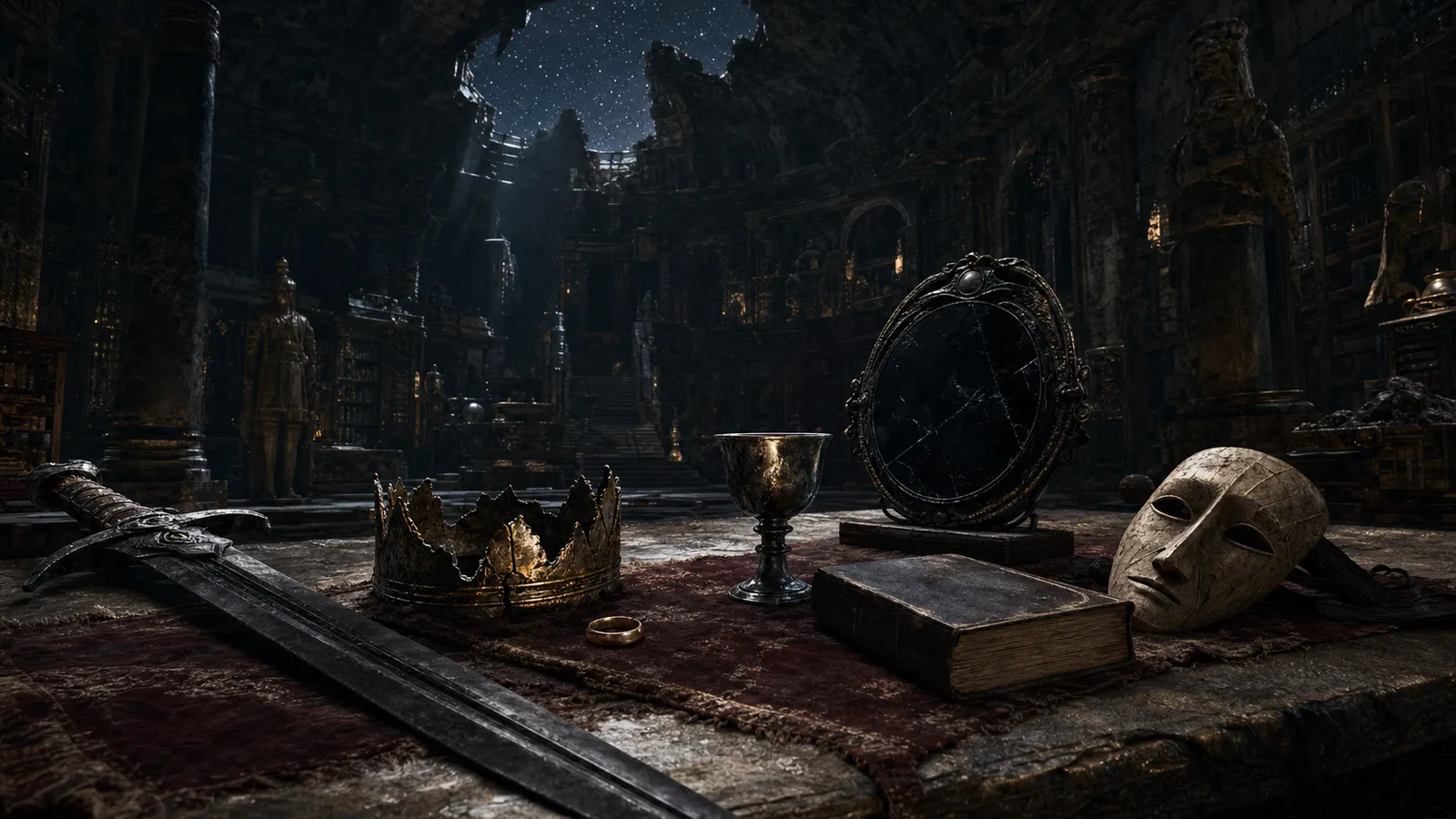
Objects were magical before fantasy
Human beings did not wait for the fantasy novel to imagine enchanted things. Across cultures, amulets, seals, blades, stones, pendants, cups, and textiles have carried protection, legitimacy, healing, fortune, or danger. In ancient Egypt, an amulet's material, color, shape, image, inscription, and the acts performed over it could all contribute to its attributed power. In Mesopotamia, the choice of stone and the image of a frightening being could participate in protection. In Madagascar, Japan, Europe, the Americas, and elsewhere, objects have stood between the human body and forces it feared or trusted.
These traditions do not form one interchangeable global magic system. Their meanings belong to particular religions, rituals, histories, and everyday lives. What recurs is a human need: to keep something small close to the body so that we are not alone before an immense and uncontrollable world. If Before Fantasy, There Was Myth, then before magic became a genre effect, matter was already a home for hope and fear.
Why does power live in a thing?
A spell held only in a magician's mind ends with death or forgetting. Power placed in an object can travel. A ring passes from king to thief. A book escapes a burned library. The enemy lifts a sword from a battlefield. An object makes power transferable, and transfer creates story.
The object also gives magic a boundary. A crown may confer authority, but it cannot sit on two heads at once. A key opens a particular lock. A cup must be filled. A blade can be lost, blunted, or taken. In fantasy magic systems, limits and costs connect ability to choice. An object performs the same work through matter: it lets the audience see who holds power, who lacks it, and what must happen for possession to change.
Material is not a shell
A convincing magical object cannot be imagined apart from its substance. Iron that rusts does not mean what untarnished gold means. Glass reveals an image and remains vulnerable to breaking. Wood was once alive and keeps the marks of blade and fire. Stone can outlast the person carving it. When material is chosen well, it tells part of the story before any explanation begins.
Ancient Egyptian amulets show how form, color, and material could belong to function rather than decoration. Fantasy should demand the same intimacy. A sword made from meteoric iron needs more than a higher damage score to distinguish it from one carved out of dragon bone. The first brings sky into earth; the second repeats an ancient creature's death with every strike. Dragons in Fantasy gain depth when even their remains continue to alter the world.
The sword: power made recognizable
A legendary sword is rarely just a sharper weapon. Across many stories, the blade reveals lineage, fitness, covenant, or the right to rule. The image of Arthur drawing a sword from stone endures because it converts a political claim into a visible test. The crowd need not accept his words; stone and steel become witnesses.
Arthurian tradition accumulated through centuries and many texts, and the sword in the stone is not always simply identical with the Excalibur later received from the Lady of the Lake. That variation is part of the point. A legendary object is reforged every time a storyteller inherits it. Its power resides neither in one imaginary piece of steel nor in a single canonical chart. It grows through voices that give it new meanings without entirely erasing the old ones.
Sword, mirror, jewel: three faces of rule
In Japanese tradition, the three sacred treasures—the sword Kusanagi, the mirror Yata, and the jewel Yasakani—are bound to the legitimacy of the imperial throne. Their conjunction creates a precise language. The sword can carry courage and force; the mirror brings reflection and perception; the jewel holds value and continuity. Rule is not completed by a weapon alone. Power also requires the capacity to see and to preserve.
Here, the object does not replace the person. It connects a temporary body and reign to something handed down from before birth and intended to remain after death. Crown, seal, sword, or regalia tells a people that office is larger than its present holder. That continuity may be magnificent or dangerous. A ruler who understands stewardship may feel responsibility; one who treats the object as proof of absolute entitlement can dress violence in sacred authority.
The ring: a world of power in the smallest circle
The ring is a nearly perfect narrative object. It is small, stays against the skin, hides easily, and speaks through its closed form of covenant, recurrence, and the endless. A sword displays power in public. A ring disappears beneath a glove. Its power is intimate even when the consequence destroys a kingdom.
Plato's story of the Ring of Gyges uses invisibility to test justice. How the ring works matters less than what a person does once freed from being seen and punished. The object does not first corrupt Gyges from outside; it removes a barrier that had helped restrain desire. Magic becomes an ethical experiment. The ring asks whether a person was good, or merely observable.
When the tool reads its owner
Tolkien's One Ring takes the problem further. It grants invisibility as a secondary effect, but its deeper nature condenses the will to dominate into matter. In a letter to Milton Waldman, Tolkien described the Ring through the desire for power objectified by force and mechanism. A bearer imagines that a tool has been found. The tool feeds upon the bearer's desire and shapes what counts as a reasonable use.
This reversal is one of fantasy's strongest ideas: do we use the tool, or does the tool select the kind of person we are becoming? An always-victorious sword calls forth more wars. A mirror that exposes every truth destroys the possibility of forgiveness. A book with every answer erodes the ability to endure uncertainty. Magic need not issue an order. It arranges conditions in which the owner's worst desire begins to resemble the most logical choice.
Invisibility reveals the human being
An object that hides the body can expose the character. Once Gyges escapes the gaze of others, he chooses possession rather than moral freedom. Many later stories preserve the same unease. Invisibility becomes a fantasy of consequence-free access: seeing without being seen, entering without consent, acting without answerability.
The best enchanted objects turn a simple ability into a human question. An invisibility cloak is not merely an escape device; it tempts someone to violate a boundary. A key to every door offers more than freedom; it demands a decision about which door deserves to remain closed. When Metaphor Becomes Real explored how an image becomes ethically serious once the imagined rule begins to govern lived choices.
Cup and mirror: the desire to see everything
Some objects place power in perception rather than command or violence. The world-seeing cup of Persian literary tradition, assigned in different periods and works to Kay Khosrow or Jamshid, makes distant and hidden things visible upon a small surface. Luminous mirrors in Mesoamerican societies could likewise participate in kingship and divination and be conceived as portals. A polished plane stops returning an ordinary face and brings elsewhere into the room.
This quiet power can be more dangerous than a sword. Someone who sees everything may assume that seeing equals understanding. An image removes context; a glimpse of the future changes the viewer's behavior until the glimpse helps produce itself. In When Escaping Fate Becomes the Road to It, attempts at prevention could complete the feared event. Cup and mirror become partners in tragedy: they deliver a partial truth, and a confident human supplies the rest.
The Sampo: an object nobody sees clearly
In the Kalevala, the great smith Ilmarinen forges the Sampo. It produces prosperity, becomes the object of a struggle over ownership, is stolen, and finally breaks in the sea. Yet its physical identity remains uncertain. Readers and scholars have understood it as a mill, a sun, a boat, and a figure for agriculture or economic development. The object stands at the story's center while its form remains in mist.
That ambiguity offers an important lesson. A magical object does not need to read like a product in a catalogue. Sometimes its effect on society matters more than an internal diagram. Because the Sampo produces abundance, it generates questions about possession and distribution. Who may keep prosperity? Is taking a device that monopolizes well-being theft or justice? When people battle for exclusive control and the object shatters, even its fragments acquire a different meaning.
The curse: debt attached to metal
A cursed object should be more than evil without cause. In stronger stories, the curse remembers an injustice: murder committed for treasure, a violated oath, a maker whose name was erased, or a gift returned with contempt. The curse refuses to let the past finish neatly. Something humans sought to own begins to remind its owner of a debt.
The best curses permit no clean disposal. Selling the object transfers harm to a stranger. Hiding it preserves danger for the next generation. Destroying it may also destroy evidence of what happened. In When a Promise Becomes Heavier Than Life, an oath crossed beyond speech and bound the future. A cursed object is that oath after it has acquired a body and can no longer be dismissed as forgotten words.
Inheritance: a gift we did not choose
Fantasy often joins inheritance to blood, family name, and crown, but an object makes inheritance intimate. A protagonist receives the sword with which a father committed an atrocity, a pendant a mother broke while saving someone, or a key generations have feared to use. The heir did not choose the thing. Choice begins with deciding whether to continue or alter its previous meaning.
The distinction between legacy and fate becomes visible. The past hands over possibilities and debts without necessarily fixing the result. A crown can be worn again, melted down, returned, or placed in a museum. Each decision about the object is a decision about relation to the dead: obedience, denial, forgiveness, repair, or an ending.
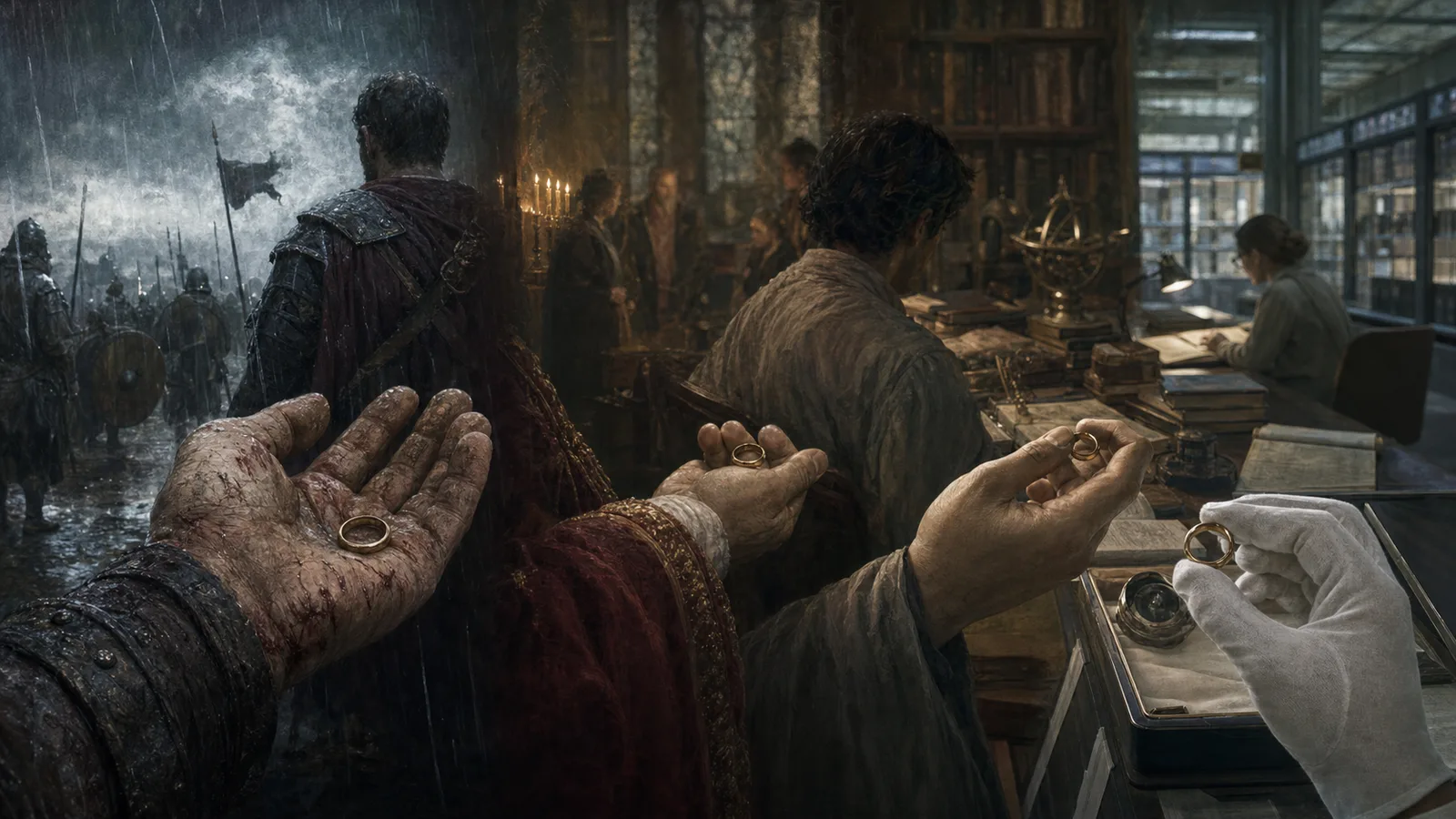
The maker remains in what was made
Every magical object had a maker, even when the story forgot the name. Someone mined the material, someone shaped it, someone marked it, and perhaps somebody else paid the cost. When a relic is attributed only to the king or hero who carried it, the labor of creation disappears behind the glory of use.
Fantasy can turn that injustice into story. What if a blade retains a portion of the smith's memory? What if a crown answers only to someone who knows the names of its anonymous makers? What if a city's magic does not come from a monarch's command but from thousands of workers who built its walls? Such questions help make a fantasy world believable because they connect power to labor, exchange, craft, and material history.
The object is changed by its owner
We usually ask what an enchanted object does to a person. The reverse question is rarer: what do people do to the object? A blade collects a notch from every battle. A book fills with the marginal notes of successive readers. A mirror cracks and thereafter returns every face through the same fracture. Even if the underlying power remains stable, the history of use can alter how it behaves.
In a living world, magic has a use history as well as a function. A ring employed for protection over generations may resist when a new ruler orders murder. A mask worn by every owner while lying may eventually stop separating truth from the face beneath it. The object need not become a talking human personality. Matter can instead become an active archive.
Destruction is harder than use
Acquiring an object often begins the adventure. Relinquishing it provides the greater test. Power immediately produces its own arguments: I will use it once. I am better than the previous owner. If I surrender it, someone worse will take it. Every sentence may contain truth, which is why the danger deepens.
The destruction of the One Ring remains memorable because the problem cannot be solved by gaining greater power. The goal is not to capture the enemy's weapon but to refuse its logic. Sometimes heroism lies in returning a sword, breaking a crown, or throwing a key into the sea. Fantasy heroes, from the chosen one to the antihero become complicated when their greatest victory is an act no triumphant song can make outwardly grand.
How an object carries the history of a world
One thing can bring several eras into the present scene. Metal reveals the trade routes of a civilization. A crude repair recalls years of decline. An erased emblem points toward revolution; a new name toward conquest. A stain that cannot be cleaned may preserve a crime removed from the official chronicle. Instead of delivering pages of historical explanation, the writer places an object on the table and lets characters disagree about what it means.
That is the difference between information and depth. In Middle-earth and Deep Time, ruins, names, and inheritances pressed upon the present. An enchanted object is a portable form of the same pressure. Wherever it travels, it carries the past and prevents the world from pretending that today began from nothing.
Where to begin when writing a magical object
Do not begin with the ability. Begin with the need. Who made this object, and what did they fear? Why did power have to be confined in matter? Who paid the cost? How is the object transferred, and why has it not been destroyed? Who suffers if it is lost? Who claims it if it is found?
Then tie the limit to material and history. A mirror reveals truth only in darkness because it was made for a ruler afraid of the court's light. A sword protects only someone who first chooses not to strike. A book answers every question by erasing a memory. These rules succeed when they create decisions rather than merely making a puzzle more difficult.
From “legendary item” to real object
Games rightly give special objects mechanical functions, but the language of levels, rarity, and statistics sometimes migrates into fiction. The result is a warehouse of glowing equipment: each thing has an ability, none possesses a past. The magical object becomes an item replaceable by a version with a larger number.
The remedy is not a longer lore dump. One habitual detail can do more. A character apologizes before drawing the blade. A ring grows cold on the hand of a liar. A cup keeps the flavor of the last liquid poured into it. The detail shows that the object occupies a life. The beings in a guide to fantasy creatures also cannot live through ability lists alone; relation and consequence grant presence.
Why an ordinary keepsake can outweigh a crown
Not every powerful object needs to save the world. An unsent letter, a blunt kitchen knife, a broken toy, or the button from the coat of someone who will not return may weigh more for a character than a royal crown. No spell gives these objects their force. Memory has found no way to remain except through matter.
When fantasy allows room for such small things, grandeur becomes human. The hero fights for a kingdom but, in the darkest night, closes a hand around the wooden bead a child at home provided. Maps and armies enlarge the world. Meaning returns to something small enough to fit in a fist.
When kingdoms end
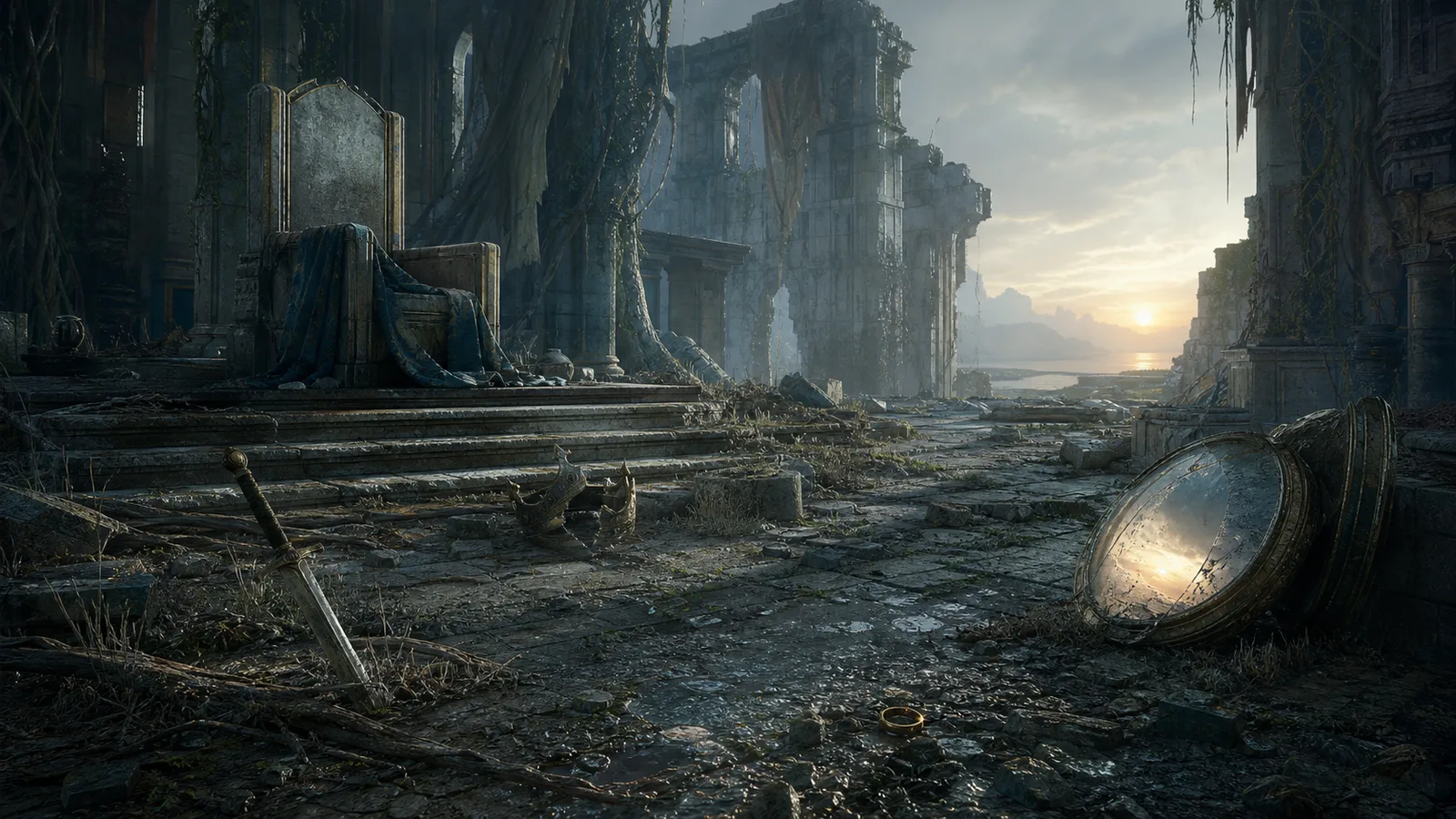
Centuries later, someone enters the broken hall. They do not know which dynasty owned the crown or in which battle the sword failed. The mirror still returns the morning light. A ring gives a weak gleam beneath the soil. The magic may have gone, fallen asleep, or simply acquired a new meaning.
Things that outlive us are not our judges. They are witnesses. Every victory eventually becomes an arrangement of remains on the ground. A crown for which people killed will one day tarnish beside a tree root. A cup that displayed the world will finally reflect the broken sky above the roof. The image is bitter, but it carries comfort: no power remains the owner of the world forever.
What remains in our hands
A good magical object speaks about power, but finally it speaks about keeping. What should we carry? What must be returned? Which inheritance deserves repair, and which should be allowed to end? Human life is brief while objects can cross many lives; nevertheless, each generation remakes their meaning.
Perhaps no one ever fully owns an ancient thing. For a while, someone guards it. The ring settles onto a finger, the sword leaves its scabbard, the book opens, and a choice is made whose consequence belongs to the next keeper as well. By making objects magical, fantasy reveals that responsibility. Everything we hold eventually leaves our hands. Before it goes, it remembers their shape.
Sources and further reading
- The Metropolitan Museum of Art, “Ancient Egyptian Amulets” on the relation of material, color, form, and function in protective objects.
- The Met, “Mesopotamian Magic in the First Millennium B.C.” on magical materials and portable protection.
- Plato's Republic, Book II, at Perseus for the Ring of Gyges and justice without fear of punishment.
- The British Library, “King Arthur: Fable, Fact and Fiction” on the layered Arthurian tradition and the sword in the stone.
- Kokugakuin University's Encyclopedia of Shinto, “Sanshu no shinki” on sword, mirror, and jewel as imperial regalia.
- The Finnish Literature Society's introduction to the Kalevala and Sampo on the prosperity-making object and its unresolved form.
- The Met, Maya “Mirror-bearer” on the mirror as courtly, divinatory, and portal-like object.
- Encyclopaedia Iranica, “Jām-e Jam” on the world-seeing cup in Persian literature and art.
- Tolkien's letter to Milton Waldman at the Tolkien Estate on the Ring as the objectification of the will to domination.
- Cambridge, Amulets in Magical Practice on agency and the range of meanings attributed to amuletic objects.