Guides
What Is High Fantasy, and Why Do We Need a Secondary World?
A clear guide to high fantasy: secondary worlds, maps, myth, epic scale, and the distant homes we remember though we never lived there.
High fantasy is one of the most recognizable forms of fantasy, but the name can mislead us. If we define it only as fantasy with larger castles, older swords, more kingdoms and more dramatic wars, we miss the thing that gives it life. High fantasy is not simply fantasy made bigger. It is fantasy in which a world stands up with its own weight.
At the heart of high fantasy is the sense of entering a secondary world: a realm with its own geography, history, cultures, laws, magic, memory and wounds. This world is not merely a painted background behind the hero. When it is well made, it feels older than the story being told. Roads existed before the protagonist stepped onto them. Songs were sung before the first chapter. Kingdoms rose and failed. Names were forgotten. The world has weather, ancestry, fear, hunger and a horizon.
That is why high fantasy can feel so powerful. The reader, viewer or player does not merely ask what happens next. They begin to ask where they are. The land becomes part of the experience. Mountains are not just obstacles. Ruins are not just decoration. Cities are not only places to buy supplies or receive quests. They are vessels of time. High fantasy becomes memorable when the world seems to breathe even when the hero is not looking.
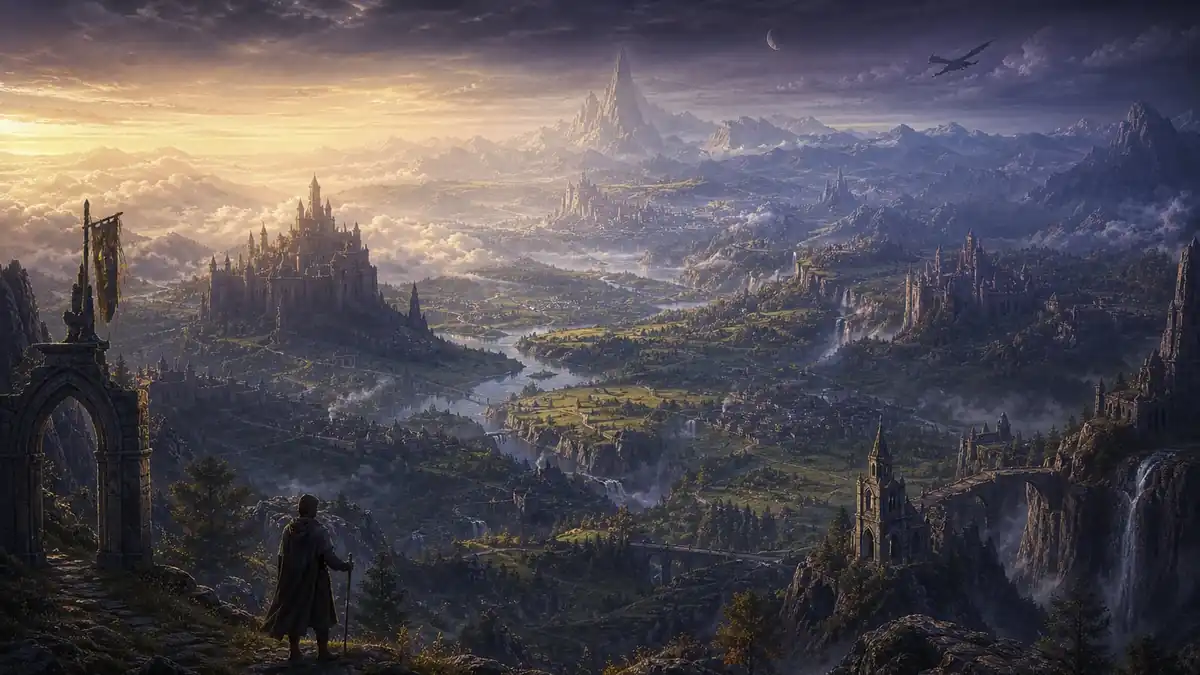
In What Is Fantasy?, we began with the larger definition of the genre. Here we enter one of its highest halls. High fantasy matters to Fantasya because it shows why human beings need large imaginary worlds: not only to flee the real one, but to see fear, hope, power, death and meaning at a mythic scale. It also continues the question raised in Why Our Own World Is Fantasy, because a secondary world becomes serious when it sends us back to the strangeness of reality itself.
A Short Definition of High Fantasy
High fantasy usually refers to fantasy set in a fully imaginary or strongly independent world, where magic, myth, ancient forces, kingdoms, prophecy, nonhuman peoples or fate-shaping conflicts have serious importance. The world may be entirely separate from our own, or so internally distinct that it feels governed by another order of reality.
A better definition is this: high fantasy is fantasy in which world, history and scale are central. The story is not only about what a character does. It is about how that action gains meaning beneath the pressure of history, power, myth and destiny. A small act can create a large echo. An oath, betrayal, journey, mercy or refusal can alter the weight of an age.
Large scale does not always mean constant war. High fantasy can be quiet, sorrowful and intimate. But even in the quietest scenes, the world should be present behind the character. When someone sits beside a fire, we should feel that beyond the small circle of light there are mountains, kingdoms, dead languages, old grief and powers not yet asleep.
What Does "High" Mean?
The word high does not mean that high fantasy is better than other kinds of fantasy. It points more toward elevation of scale and experience: a larger world, forces beyond ordinary life, conflicts that are not only personal, and the feeling of a human being standing before something greater than the self.
High fantasy often works with a stronger separation from the everyday world. In low fantasy or urban fantasy, magic often enters a more familiar setting: a street, a school, an apartment, a modern city. In high fantasy, the audience is often placed from the beginning inside a realm whose names, borders, history and fears belong to itself.
But high is not geography alone. A completely invented world can still feel shallow if it is only scenery. Another work can approach high fantasy through mythic scale, firm internal law and a powerful sense of consequence even while bending genre borders. So we should recognize high fantasy not by the number of castles on the map, but by worldhood, grandeur and consequence.
What Is a Secondary World?
A secondary world is an invented world that asks to be believed within its own terms. The idea is especially important in discussions shaped by Tolkien's thinking on fairy-stories and sub-creation. Such a world is not only a colorful version of our own. It needs internal law. That law may be magical, mythic or mysterious, but the world should not feel arbitrary.
A secondary world succeeds when the audience can dwell in it mentally. Its map is not only a guide; it is a promise of depth. Its history is not merely a list of kings; it is pressure upon the present. Its languages and names are not decoration; they suggest that the people of this world spoke, feared, prayed, mourned and forgot before the story began.
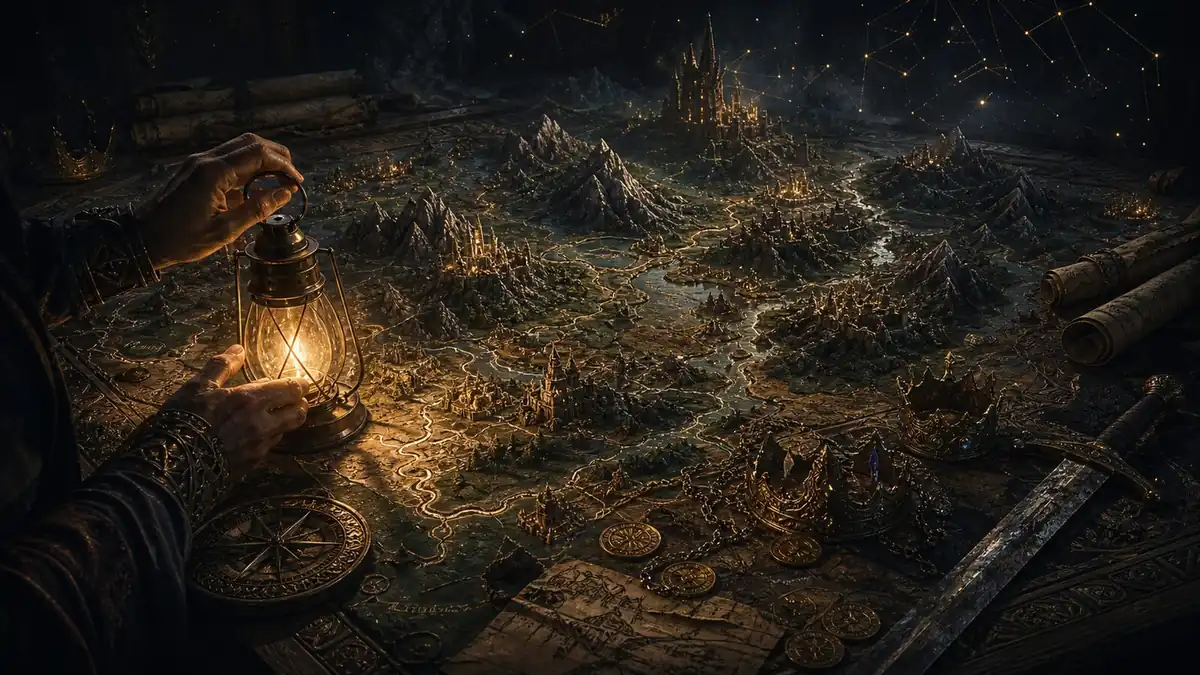
The secondary world gives the writer freedom, but the freedom is not cheap. The farther a world moves from ours, the more responsibility it has to create internal logic. If magic exists, it should affect culture, power, fear and ordinary life. If kingdoms exist, they need economy, law, memory, conflict and belief. If different peoples exist, they should carry histories and worldviews, not only different costumes.
Common Elements of High Fantasy
High fantasy often includes familiar signs: an independent world, a map, deep history, magic or supernatural force, kingdoms and empires, different cultures, invented names and languages, powerful objects, prophecy, conflict between large forces, long journeys, and characters who gradually realize their choices matter beyond themselves.
None of these signs is enough by itself. They matter when they connect. If there is a map, it should affect politics, travel and fear. If there is magic, it should have limits, costs or consequences. If there is ancient history, it should cast a shadow over the present. If darkness rises, it should reveal something about power, corruption, fear or desire, not only wait as a final enemy.
Weak high fantasy arranges elements beside each other. Strong high fantasy creates relationships. The map speaks to history. Magic troubles ethics. Myth presses on politics. A small home becomes connected to the fate of a world. Then the audience feels that the world is not only large. It is alive.
High Fantasy, Low Fantasy, Dark Fantasy and Sword and Sorcery
High fantasy is usually recognized by its secondary world and large scale. Low fantasy more often brings the impossible into a world closer to our own. If magic appears in a modern street, school or apartment, we may be near low fantasy or urban fantasy. If we begin in a land with its own calendar, history, kingdoms and metaphysical order, we are closer to high fantasy.
Dark fantasy is not the opposite of high fantasy. A work can be both. Dark fantasy focuses on shadow, corruption, moral ambiguity, suffering and the cost of hope. High fantasy focuses more on scale, independent worldhood and mythic structure. A world can therefore be vast and secondary while also wounded, morally gray and tragic.
Sword and sorcery is usually more direct, adventurous and character-driven. Danger, skill, desire, survival and confrontation are often closer to the surface. Its worlds can be vivid, but they do not always carry the deep historical and mythic weight associated with high fantasy. These categories are tools for understanding experience, not prisons for works.
Why The Lord of the Rings Remains Central
Any serious discussion of high fantasy eventually approaches Middle-earth. This is not only because Tolkien is famous. It is because Middle-earth feels less like a stage for a plot than like a world with a past and a future. Languages, legends, peoples, ruins, songs and the passing of ages tell the audience that each place has a depth beyond its immediate use.
The power of that world is not only the conflict of good and evil. It is also the sadness of fading ages. The sense that beautiful things pass away. The Shire is not only a starting point; it is an image of home and of what must be protected. Mordor is not only a dangerous destination; it is the shape of a will that wants to dry the world into obedience.
That is why a future article about why The Lord of the Rings still feels like a world should begin from this distinction: some works have stories, and some works have worlds. High fantasy, at its best, belongs to the second kind. Until that separate analysis is published, this question sits well beside Fantasy Is Not Escape from Reality; It Is the Repair of Reality, because both ask how invented worlds return deeper meaning to the real one.
How High Fantasy Feels in Games
In games, high fantasy is not only read or watched. It is walked. The player climbs a mountain, gets lost in a city, finds something in a ruin, hears a sound in a forest, and decides which road to take. This is why fantasy games can make secondary worlds feel especially inhabitable.
In a world such as Skyrim, the power is not only in quests. It is in dwelling: snow, mountains, music, villages, caves, dragons, houses and roads crossed without urgency. In Elden Ring, the experience is darker and more fragmented, as if the player has entered the remains of a myth whose ending began long before arrival.
The distinction matters. High fantasy in games comes alive when the world is more than a route between objectives. There must be room to pause. There must be places the player can remember. At some point the player should be able to say: I know this road, even though it was never real.
Fantasya Lens: Why Do Humans Need a Secondary World?
For Fantasya, the secondary world is not merely a place of escape. It is a mythic laboratory for understanding the human being. In everyday life, our fears and hopes often feel scattered. Power is faceless. Suffering is unnamed. Hope can become small and tired. High fantasy enlarges these forces so we can see them.
In a secondary world, power can become a crown, corruption a fortress, fear a shadow over mountains, hope a torch in a dark pass. If this enlargement is careless, it becomes childish. If it is well made, it reveals human truth at epic scale. By watching the fate of kingdoms, the audience may begin to feel the seriousness of smaller choices.
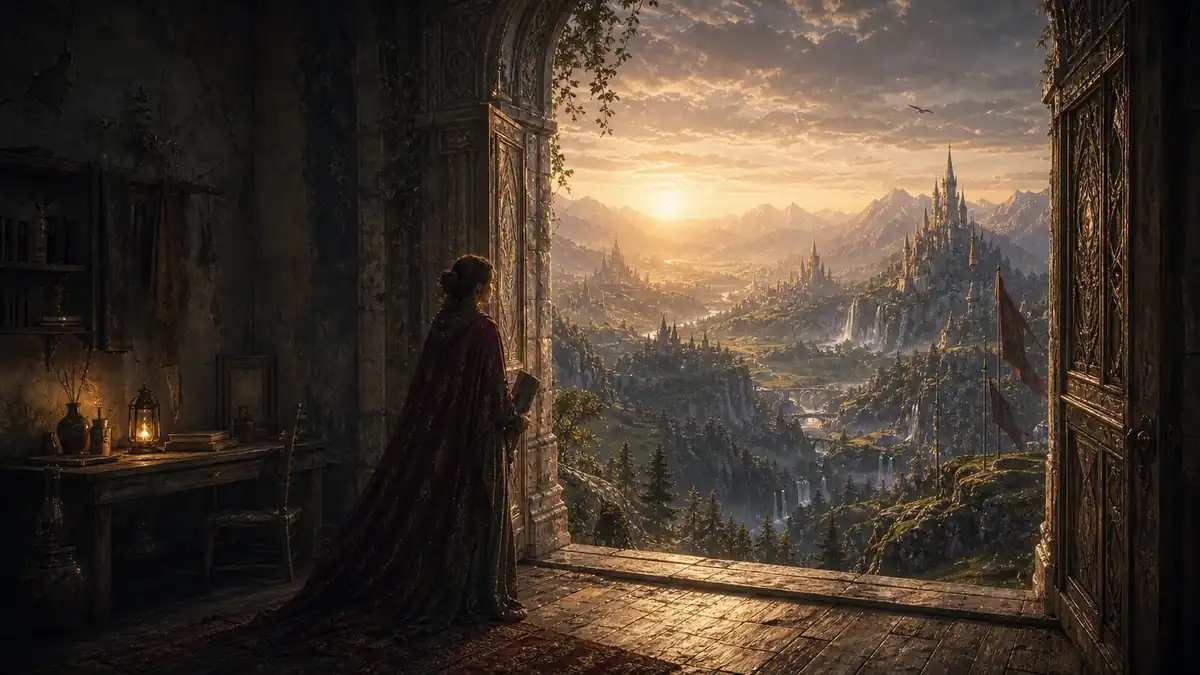
We need secondary worlds because the first world can become too close, scattered and horizonless. High fantasy returns the horizon. Not a naive horizon, but one that contains danger, cost and road. Sometimes a human being must learn in another world that a world can have meaning, history and direction before returning to this one.
Common Misunderstandings About High Fantasy
The first mistake is measuring high fantasy only by size. A large world without logic is only a large emptiness. A wide map is decoration if it does not shape culture, danger, travel and history.
The second mistake is assuming high fantasy must always use a simple final battle between pure good and pure evil. Many classic works use such patterns, but high fantasy can also hold moral complexity, wounded hope and layered characters. A grand world does not require simple people.
The third mistake is confusing worldbuilding with explanation. Not everything must be explained. Sometimes one ruin, one old name, one half-forgotten song or one silence about a past war is enough to make history felt. A secondary world does not live through information alone. It lives through the pressure of the past on the present.
Where Should a Beginner Start?
If you are new to high fantasy, look for works whose worlds have consequence. Ask whether magic affects ordinary life. Ask whether history truly shapes decisions or only appears in the prologue. Ask whether ordinary people have a place in the world, or whether everything exists only to move the hero forward.
Classics can be excellent gates, but the more important question is what kind of experience you want. If you want a living world with quiet mythic depth, The Lord of the Rings remains a strong doorway. If you want dwelling and wandering, games such as Skyrim may speak more immediately. If you want a broken and solemn world, Elden Ring approaches another edge of high fantasy.
Do not recognize high fantasy only by a checklist. Ask instead: does this world continue in my mind after the book closes or the game ends? Do I miss places where I have never lived? If the answer is yes, you may have crossed the right gate.
Conclusion
High fantasy is a branch of fantasy in which the secondary world, mythic scale, history, internal law and grandeur matter deeply. It is not only about castles, magic and maps. It is about what a human being becomes when standing before a world larger than the self.
High fantasy lets us see fear, hope, power, death, home, destiny and choice at a scale everyday life rarely provides. When it is well made, it does not sever us from reality. It gives reality back a horizon. After leaving a secondary world, the first world may be the same, but our gaze is not entirely the same.
For the wider map of fantasy genres, see Types of Fantasy Genres.
Further Reading
- Encyclopaedia Britannica: Fantasy for a broad definition of fantasy as a narrative genre.
- Tolkien Estate: On Fairy-Stories for secondary worlds, recovery, escape and consolation.
- The Encyclopedia of Science Fiction: Fantasy for a broader genre overview.
- The Encyclopedia of Science Fiction: J.R.R. Tolkien for Tolkien's place in modern fantasy.
- Britannica: J.R.R. Tolkien for literary and historical context.