Guides
What Is Fantasy? A Genre of Wonder or the Hidden Language of the Human
A clear definition of fantasy, its major elements, its neighboring genres, and the human meanings behind magic and impossible worlds.
Fantasy, in its simplest definition, is a form of storytelling in which the world contains something that ordinary reality does not allow, or at least does not experience in the usual way. Magic, impossible creatures, invented histories, other worlds, prophecies, curses, gods, enchanted objects and altered laws of nature are among its familiar signs. If the impossible element matters to the world of the story, shapes its dangers and changes the lives of its characters, we are usually standing inside fantasy.
But that definition is only the gate. Fantasy is not merely a box of strange things. A story can have dragons and still feel empty. Another story may contain no dragon at all and yet carry the deep pressure of fantasy because it treats imagination as a way of changing how reality is felt. The real question is not only whether magic appears. The question is what the impossible does to the human experience.
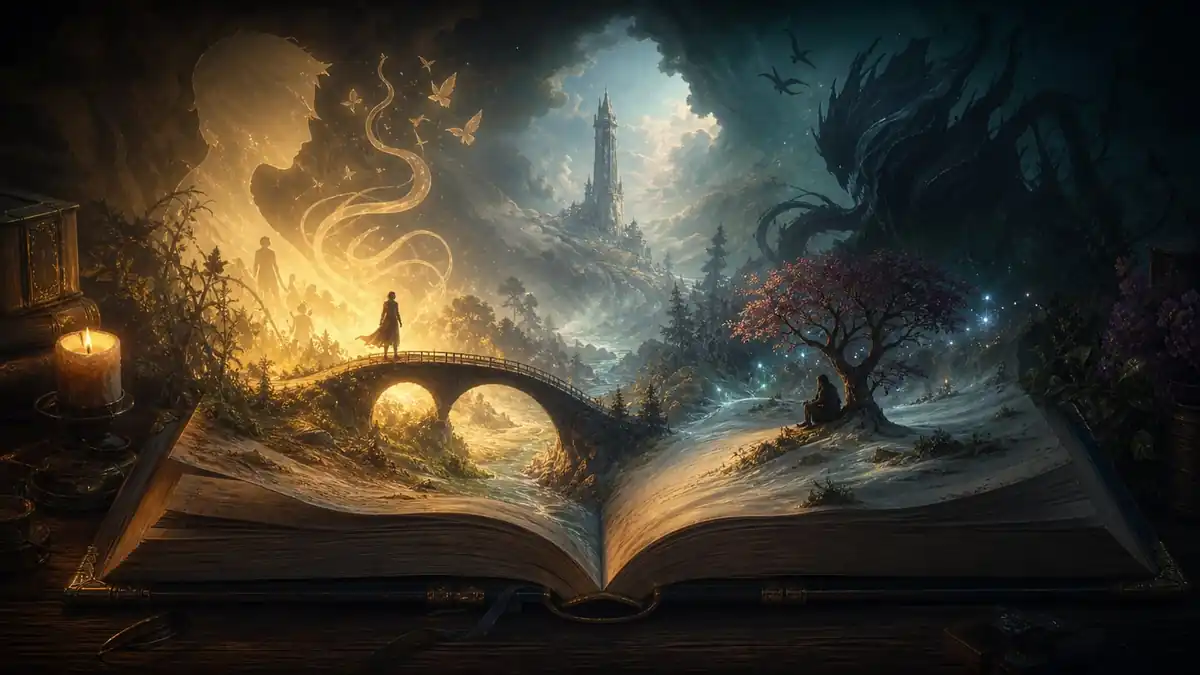
If Why Our Own World Is Fantasy begins with wonder at existence itself, this guide begins with the practical meaning of the genre. We first need to know what fantasy is in literature, cinema, games and series. Only then can we ask why human beings keep returning to it.
A Short Definition
Fantasy is a narrative genre that uses non-realist elements and treats them as meaningful inside the world of the work. Those elements may be magic, a secondary world, mythical beings, supernatural forces, impossible histories, living symbols or laws of existence different from ours. The important point is that these elements are not decoration. They affect choices, danger, morality, politics, memory and meaning.
In a good fantasy work, magic is not only visual light. If it exists, it should change the world. If a creature appears, it should belong to some fear, culture, myth or history. If a land is invented, it should feel as if something happened there before the hero arrived. The map is not enough. A world needs consequence.
Fantasy can be vast and epic, but it can also be intimate. It can deal with the fate of kingdoms or with a child finding a door in a room that has always felt too small. Scale matters, yet it is not the heart of the genre. The heart is that imagination becomes a structure for meaning.
Common Elements of Fantasy
Most fantasy works use several familiar elements, though none of them is mandatory by itself.
- Imaginary worlds or altered versions of the real world
- Magic, curses, prophecy or forces beyond everyday law
- Mythic beings such as dragons, elves, spirits, demons or ancient monsters
- Invented histories, fallen kingdoms, sacred lineages and old wars
- Journeys, trials, moral choices and transformations of identity
- Conflicts involving power, temptation, fear, hope and death
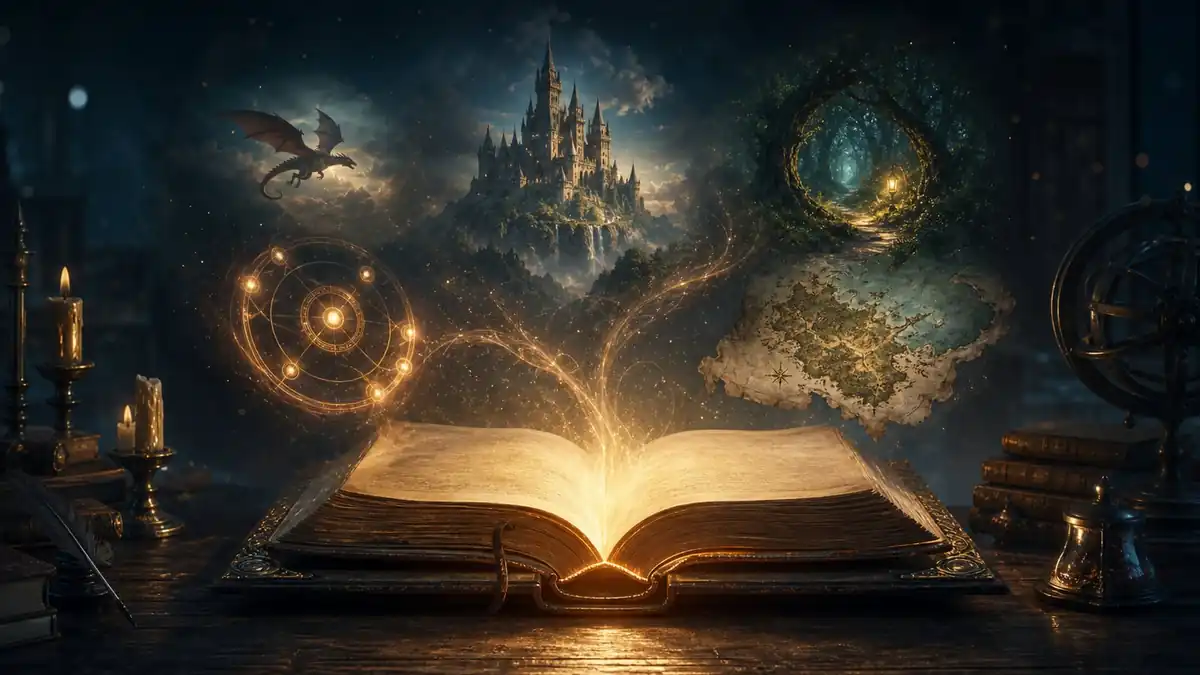
These elements matter when they are connected. If magic exists, it should affect fear, religion, economics, politics or ordinary life. If dragons exist, people should have legends, rituals, caution, desire or laws around them. Weak fantasy places elements side by side. Strong fantasy gives them memory, consequence and pressure.
Fantasy and Science Fiction
Fantasy and science fiction both step away from everyday reality, but they do so through different kinds of imagination. Science fiction usually works with technology, possible futures, space, biology, artificial intelligence or the consequences of knowledge. Even when speculative, it often asks to be understood through scientific or quasi-scientific possibility.
Fantasy works more directly with wonder, myth, magic, destiny, ancient forces and symbolic law. It does not need to explain everything through technology. Of course the border is not always clean. Some worlds combine magic and advanced machines. In those cases the question is: what creates the deepest experience of the work? Explanation, or enchantment?
Science fiction often asks what may happen if humanity gains a new power. Fantasy often asks what happens when the world becomes meaningful, dangerous and haunted again.
Fantasy, Horror, Myth and Fairy Tale
Fantasy overlaps with horror, but they are not the same. Horror seeks fear, dread, threat or psychic instability as its primary effect. Fantasy can be frightening, but fear is not always its final purpose. Fear may become part of discovery, moral testing, transformation or meaning.
Myths and fairy tales are close relatives. Modern fantasy borrows from old stories, ancient beings, sacred patterns and oral memory. Yet fantasy usually rebuilds these materials inside new worlds, novels, games or films. Myth may explain a culture's cosmos; fantasy often uses mythic energy to create a literary or interactive experience.
In simple terms, fantasy is the modern child of old memory and active imagination. It feeds on ancient stories, but it also speaks to modern loneliness, power, violence, ecological fear, identity and hope.
Major Subgenres
High fantasy usually takes place in a large secondary world with its own geography, history, peoples, conflicts and metaphysical structure. Low fantasy brings the impossible into a more familiar or restrained setting. Dark fantasy carries heavier moral shadow, wounded worlds, dangerous magic and fragile hope. Urban fantasy lets magic breathe inside modern streets, alleys, apartments and cities. Sword and sorcery tends to focus on direct adventure, danger, skill, desire and survival.
These categories are useful, but they are not cages. A strong work may move between them. What matters is not the label alone, but the kind of experience created for the reader, viewer or player.
The Hidden Human Language
Fantasy endures because it is not only about impossible things. It is about real needs wearing impossible shapes. A dragon may be a monster, but it may also be fear of power. Magic may be a tool, but it may also be the human dream of reshaping reality by will. A second world may be a map, but it may also be the place where we can see what our own world has left unnamed.
This is why fantasy sometimes speaks more honestly about reality than realism does. Realism often shows the world directly. Fantasy shows its symbolic face. One says what happened. The other asks what shape the event has in fear, longing and meaning.
For Fantasya, fantasy is not only a genre of escape. It is one of the hidden languages of the human being. It lets us speak about things that become too dry or too painful when named directly. A curse may be inherited trauma. A door may be longing for passage. A monster may be the part of ourselves we cannot calmly describe.
Where Should a New Reader Begin?
If you are new to fantasy, begin with the kind of question that pulls you. Do you want vast worlds, maps and ancient wars? High fantasy may be your doorway. Do you want shadow, moral ambiguity and wounded hope? Dark fantasy may speak more closely. Do you want magic entering the modern city? Urban fantasy is a strong beginning. Do you want direct adventure and danger? Sword and sorcery may be the cleaner path.
But if you want to understand fantasy more deeply, do not only collect lists. Ask what a fictional world makes visible. What fear did it give a body to? What hope did it keep alive? What part of your own reality did you recognize there?
The best entry point is often emotional before it is academic. Notice the work that makes you feel you have entered a place rather than consumed a product. Notice the story whose invented names begin to feel remembered, whose landscape returns to you when your own day becomes too flat. That is where fantasy stops being a shelf label and becomes an experience.
After that, definitions become more useful, because they are attached to something felt.
They stop sounding abstract.
How Do We Know a Work Is Truly Fantasy?
Sometimes a work only wears the surface of fantasy. Strange names, mist, a sword and a map are not enough. A useful test is this: if the impossible element were removed, would the heart of the story remain the same? If yes, fantasy may be only decoration. If no, the impossible belongs to the work's blood.
Another test is consequence. In a world where dragons exist, architecture, trade, myth, war and fear should not remain unchanged. In a world where magic exists, law, secrecy, religion and desire should feel its pressure. Serious fantasy lets wonder have consequences.
Conclusion
Fantasy is a genre of imaginary worlds, magic, impossible beings and altered laws. But its fuller definition is this: fantasy is a way of building worlds where fear, hope, power, death, grief and meaning become visible.
Fantasy is not always escape. Sometimes it is a more precise return to reality. Through imaginary worlds we learn what the real world has hidden, what it has left unnamed, and why human beings still need stories that cross ordinary borders.
For the wider map of fantasy genres, see Types of Fantasy Genres.
Further Reading
- Encyclopaedia Britannica: Fantasy for a general definition of fantasy.
- Encyclopaedia Britannica: Science Fiction for comparison with science fiction.
- Encyclopaedia Britannica: Myth for the relation between myth and imaginative storytelling.
- Tolkien Estate: On Fairy-Stories for recovery, escape and consolation in fantasy.