Lore
Fantasy Creatures: A Guide to Elves, Orcs, Dragons, and Ancient Monsters
A lore hub for understanding fantasy creatures: wise peoples, dark beings, ancient powers, cursed bodies, forest spirits, and the creatures of death and night.
Fantasy creatures are often the first sign that a world is not ordinary. A strange footprint on the road, a voice in the forest that does not sound human, the shadow of a dragon crossing a mountain, or a pale figure standing too still in moonlight can change the rules of a story before a single spell is explained. The reader understands that this place is governed by more than everyday reality.
Yet fantasy creatures should not exist only to fill a map. If they are only enemies, decorations, or visual variety, they become forgettable. A strong creature has a role. It shapes history, fear, religion, trade, war, magic, taboo, or memory. A dragon that is only large is finished quickly. A dragon that guards forbidden power, tempts kings, remembers a dead age, or tests human greed can deepen the whole world.
At Fantasya, we read creatures as bodies for ideas. The elf may carry long memory and distance from mortal life. The dwarf may bind stone, work, fire, craft, and family. The orc may ask what violence, exile, tribal identity, and war do to a people. The vampire carries fear of death and desire for eternal life. The werewolf turns the human body into a battlefield. The dragon becomes power itself: majestic, dangerous, seductive, sometimes wise.
What Is a Fantasy Creature?
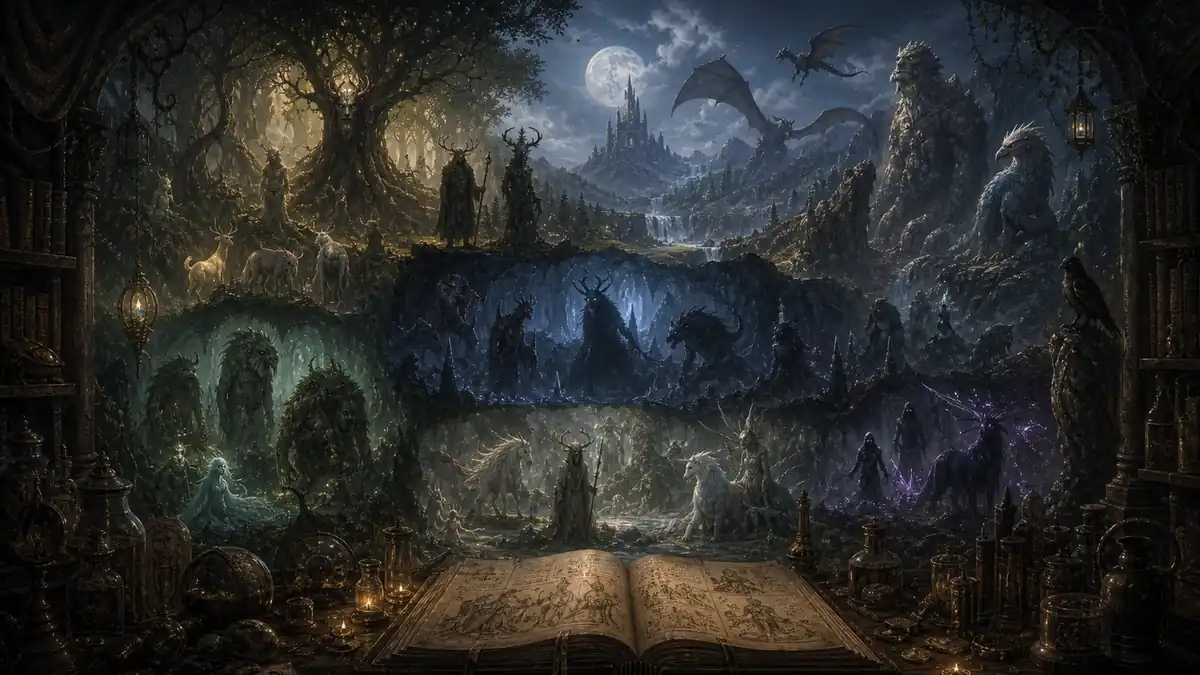
A fantasy creature is any being in an imaginary world that cannot be fully explained by ordinary biology, history, or daily reality. It may be intelligent, like an elf or dwarf. It may be monstrous, like a demon, ogre, or shadow thing. It may be cursed, like a vampire or werewolf. It may belong to nature, like a fairy, forest spirit, river being, or mountain guardian. It may belong to death and night, like a ghost, revenant, lich, or returned dead.
But being unreal is not enough. In good fantasy, a creature belongs to the world. If magic has a cost, magical creatures should have weight and consequence. If the world is marked by old wars, its creatures should remember those wars in their bodies, customs, or legends. If the setting is dark fantasy, monsters should do more than frighten. They should place pressure on morality, memory, and fear.
In What Is a Magic System?, power mattered because it had rules and consequences. The same is true of creatures. A fantasy creature endures not because of its shape alone, but because of its relationship to law, fear, myth, and the daily life of the world around it.
Why Sort Creatures by Role?
Sorting creatures is not just a librarian's habit. It helps us understand what each being does. Some creatures build civilization. Some create fear. Some remind the world of its ancient past. Some stand between humanity and nature. Some bring the story close to death.
That is why this guide is not alphabetical. Elf, orc, dragon, vampire, fairy, and ghost are not only names. They are functions. Once we understand the function, future pages about each creature become more useful. This page should work like an entrance map: from here, the reader can move toward dragons, wise peoples, dark beings, cursed bodies, spirits of nature, and creatures of night.
Wise Peoples: Elves, Dwarves, Orcs, and Other Kin
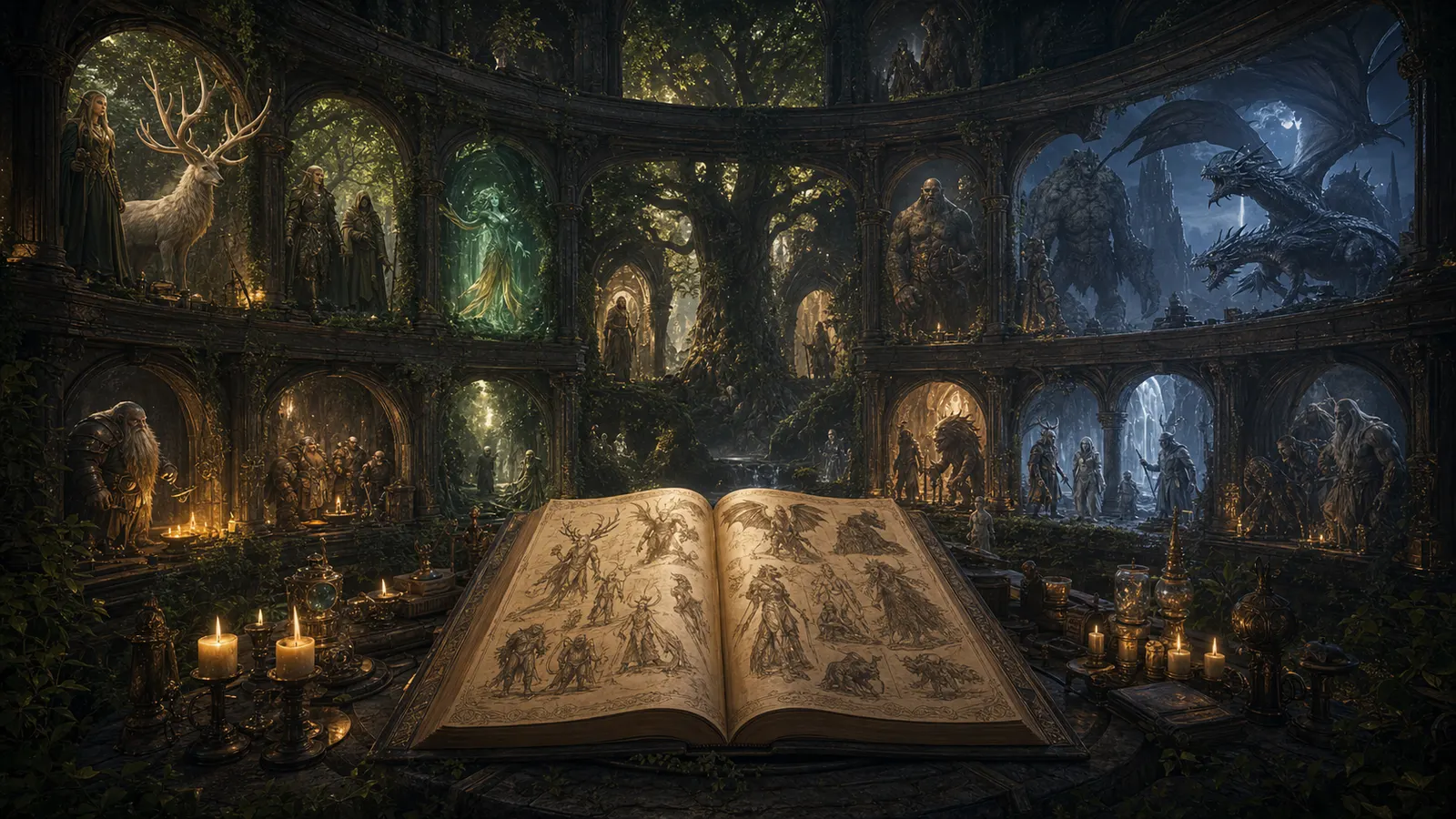
Intelligent fantasy peoples matter because they turn a land of monsters into a world of history, politics, language, and culture. Elves are often tied to long life, beauty, art, nature, sorrow, and distance from human time. In many fantasy worlds, the elf is not simply a human with different ears. The elf is a question about what memory does when life lasts too long.
Dwarves often bind fantasy to stone, metal, mountains, craft, lineage, and hidden halls. They give a world material weight. If elves suggest forests and stars, dwarves suggest mines, hammers, furnaces, oaths, and the memory buried under mountains. Their presence can deepen economy, warfare, architecture, and the relationship between a people and the resources beneath their feet.
Orcs require care. Fantasy has often used them too simply, as faceless enemies made only for war. Modern worldbuilding can do better. An orc people can be connected to survival, exile, clan bonds, structural violence, conquest, or an alternative understanding of strength. If orcs have language, grief, parents, rituals, humor, and history, they stop being target practice and become part of the world's moral fabric.
Dark Creatures: Goblins, Demons, Shadows, and the Underground
Dark creatures create unease. Goblins are usually smaller, craftier, and closer to everyday anxiety: theft, sabotage, mockery, traps, tunnels, broken tools, and laughter from places beneath the city. They do not have to be huge. Their power often comes from smallness, number, and the idea that civilization has cracks full of eyes and teeth.
Demons and devils are commonly tied to corruption, temptation, contracts, sin, forbidden power, or lower worlds. When written well, they are not only final bosses. They ask questions: What will a person trade for power? Is evil outside humanity, or does it reveal desires already present within it? In dark fantasy, the demon is strongest when human beings helped invite it in.
Shadows and underground beings carry another function. They remind us that the world has a hidden underside. Beneath the city, beneath the castle, beneath the forest, and beneath the mind, something waits. These creatures suit mystery and slow dread, especially when they are not fully explained. In What Is Dark Fantasy?, that distinction matters: darkness works when it becomes part of the world's logic, not only its color.
Ancient Creatures: Dragons, Titans, and First Giants
Ancient creatures work through scale. They remind us that the world existed before the hero and may remain after the hero is gone. The dragon is the clearest example. It can be a monster, but not only a monster. It can guard treasure, preserve knowledge, embody nature, rule the sky, or become the image of power that humanity fears and desires at once. Dragons in Fantasy explores those roles in detail.
Titans, first giants, and elder beings connect a world to ages before human history. They make geography feel mythic. A mountain may be the body of a sleeping giant. A ruin may be built from bones no human kingdom could have lifted. A valley may exist because something vast fell there long before language.
Ancient creatures should be used with restraint. If a titan wakes every chapter, awe disappears. Their strength often lies in scarcity, silence, and aftermath: broken temples, huge bones, forbidden rituals, and names people still whisper.
Cursed Creatures: Vampires, Werewolves, and Broken Bodies
Cursed creatures are powerful because they blur the line between human and monster. The vampire is not only a blood-drinker. Across many traditions and modern fantasy forms, it can carry the fear of death, the hunger for immortality, cold beauty, aristocratic decay, loneliness, seduction, and a form of life that survives by consuming life.
The werewolf approaches from another side. It turns the body into conflict. By day, a person may speak, love, remember, and regret. By night, hunger or curse may take command. The werewolf asks how much of the self belongs to reason. If the body rises against the will, what remains of identity?
Cursed beings matter because they show that the monster is not always outside the gate. Sometimes the monster is history. Sometimes it is a decision made long ago. Sometimes it is a body society refuses to look at. In The Witcher: A World Where Good and Evil Are Not Simple, monsters often become moral questions rather than simple targets.
Nature Creatures: Fairies, Forest Spirits, and Green Guardians
Nature creatures begin with a simple but important idea: the world is not raw material for human use. Forests, rivers, mountains, wind, and seasons can have memory, will, and guardians. Fairies may be playful, beautiful, dangerous, deceptive, generous, or cruel, depending on the tradition and world. Their smallness should not make them harmless.
Forest spirits and green guardians often mark a boundary. Humans enter the woods, cut trees, poison rivers, hunt too deeply, or break an old law. Then they learn that nature was not a backdrop. Something saw, waited, and answered. These creatures can be gentle, majestic, or terrifying. Their purpose is to make nature a participant in the story.
For worldbuilding, nature creatures can shape culture. If people believe a spirit lives in each river, water law changes. Bridges, offerings, fishing rites, childhood warnings, village festivals, and taboos all change. A good creature does not only appear in a scene. It changes behavior.
Creatures of Death and Night: Ghosts, Revenants, Liches, and the Returned
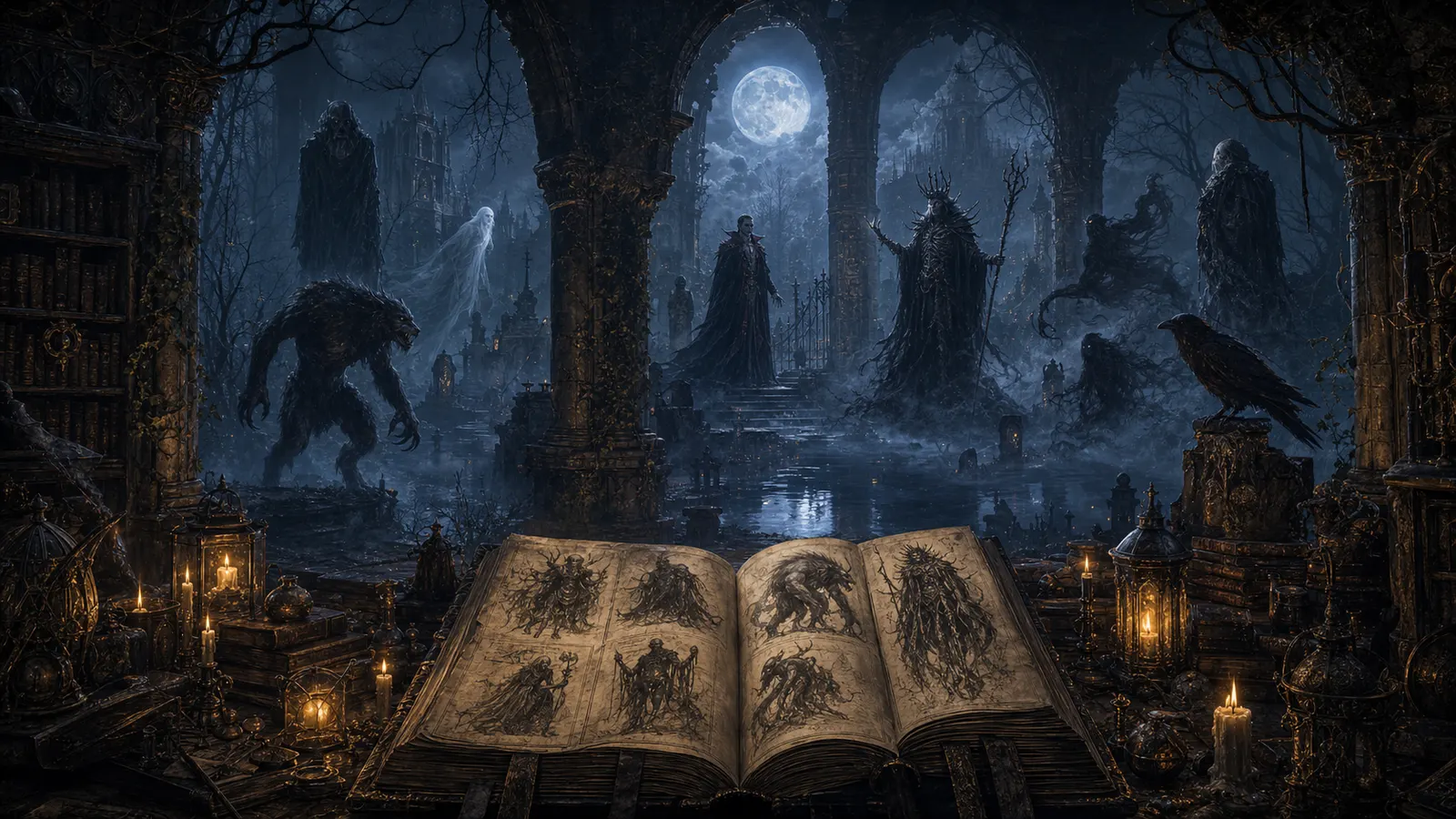
Creatures of death and night touch one of humanity's oldest fears: death that does not end cleanly. A ghost often represents unfinished business, grief without burial, hidden guilt, or memory that has attached itself to a place. A good ghost does not only scare. It asks why the past still refuses to leave.
The revenant or returned dead is often more active and angry. It may come back for revenge, loyalty, curse, or because the world denied it a proper death. These beings become stronger when their death belongs to the history of the place, not just a convenient enemy encounter.
The lich is one of fantasy's most intellectual death figures: a person who tries to escape death through magic, knowledge, ritual, and the sacrifice of humanity. The lich shows that immortality gained by cutting oneself away from life may become less like victory and more like imprisonment.
Monster or People? The Risk of Simplification
One of the great dangers in fantasy is simplifying entire kinds of beings. If an intelligent group exists only to be killed, the world becomes poorer. If one people is always evil, always stupid, or always savage, the story is not becoming darker; it is becoming lazy. Even when a creature is truly dangerous, the world should know why it exists, how it lives, and what different cultures believe about it.
This does not mean every monster must be softened. Fantasy still needs darkness, danger, and beings that cannot be negotiated with. But fear lasts longer when it has logic and texture. A creature with habitat, myth, ritual, life cycle, or history remains in the mind even when it is an enemy.
How to Use This Lore Hub
This page is an entrance. If you want dragons, begin here and move to the dragon article. If you are building dark fantasy, focus on dark beings, cursed creatures, and the dead. If you are designing a world, wise peoples and nature creatures help you create culture, economy, faith, and law. If you want mythic scale, ancient beings and dragons are the pillars.
Later, each creature can have a dedicated page: elves, orcs, dwarves, goblins, vampires, werewolves, ghosts, liches, fairies, demons, giants, and elder beings. Before those pages multiply, the map matters. A reader should know which branch of the bestiary they are entering.
Why Fantasy Creatures Still Matter
Fantasy creatures matter because they give bodies to imagination. Fear of death becomes a ghost. Desire for immortality becomes a vampire. Hidden rage becomes a werewolf. Power becomes a dragon. Long memory becomes an elf. Stone, work, and lineage become a dwarf. The darkness under the city becomes a goblin or shadow. Wounded nature becomes a forest spirit.
That is why creatures are not only entertainment tools. They are a visual language for things that are hard to say directly: power, death, desire, fear, loneliness, instinct, nature, history, and difference. A fantasy world can be beautiful without creatures, but with the right creatures, it begins to breathe.
Sources and Further Reading
- Britannica: Fantasy narrative genre for the literary frame of fantasy.
- Britannica: Dragon for dragon myth and symbolic background.
- Britannica: Elf for folkloric roots of elves.
- Britannica: Dwarf for dwarf mythology and folklore.
- Britannica: Vampire for vampire folklore and cultural history.
- Britannica: Werewolf for werewolf traditions and human transformation.
- Britannica: Fairy for fairy traditions and nature-associated beings.
- Tolkien Estate: On Fairy-Stories for Tolkien's view of fairy-stories and secondary worlds.