Guides
Types of Fantasy Heroes: From Chosen Ones to Wanderers
A guide to fantasy hero types: chosen ones, small bearers of great burdens, gray professionals, flawed mages, silent player avatars, wanderers, and tragic heirs.
A fantasy hero is not a single shape. Treating all fantasy protagonists as the same figure leads to shallow reading and shallow writing. Frodo's humility does not work like Harry Potter's marked destiny or Rand al'Thor's terrible burden. Geralt of Rivia differs from Ged in Earthsea. The Tarnished in Elden Ring is formed by silence, failure, and the path taken through ruin, while the Dragonborn in Skyrim often becomes meaningful through wandering, joining factions, building a home, and living inside the world. We can call all of them heroes, but we are naming a broad family, not one fixed face.
This article is therefore not a recipe for the perfect fantasy hero. Its purpose is to map several major kinds of fantasy heroes, explain what each type does, where it becomes powerful, and where it collapses into cliche. That matters for readers, writers, and search intent. People looking for fantasy heroes often do not need a single definition; they need a clearer sense of why some characters are shaped by destiny, some by wounds, some by profession, some by moral pressure, and some by simply walking through a world larger than themselves.
In What Is Fantasy?, we described fantasy as a symbolic language for fears, desires, power, death, and hope. The hero is one of the central bodies of that language. Through the hero, fantasy asks what a human being becomes when confronted by magic, history, temptation, exile, home, and a world that refuses to stay small.
The Chosen One: Destiny as Pressure
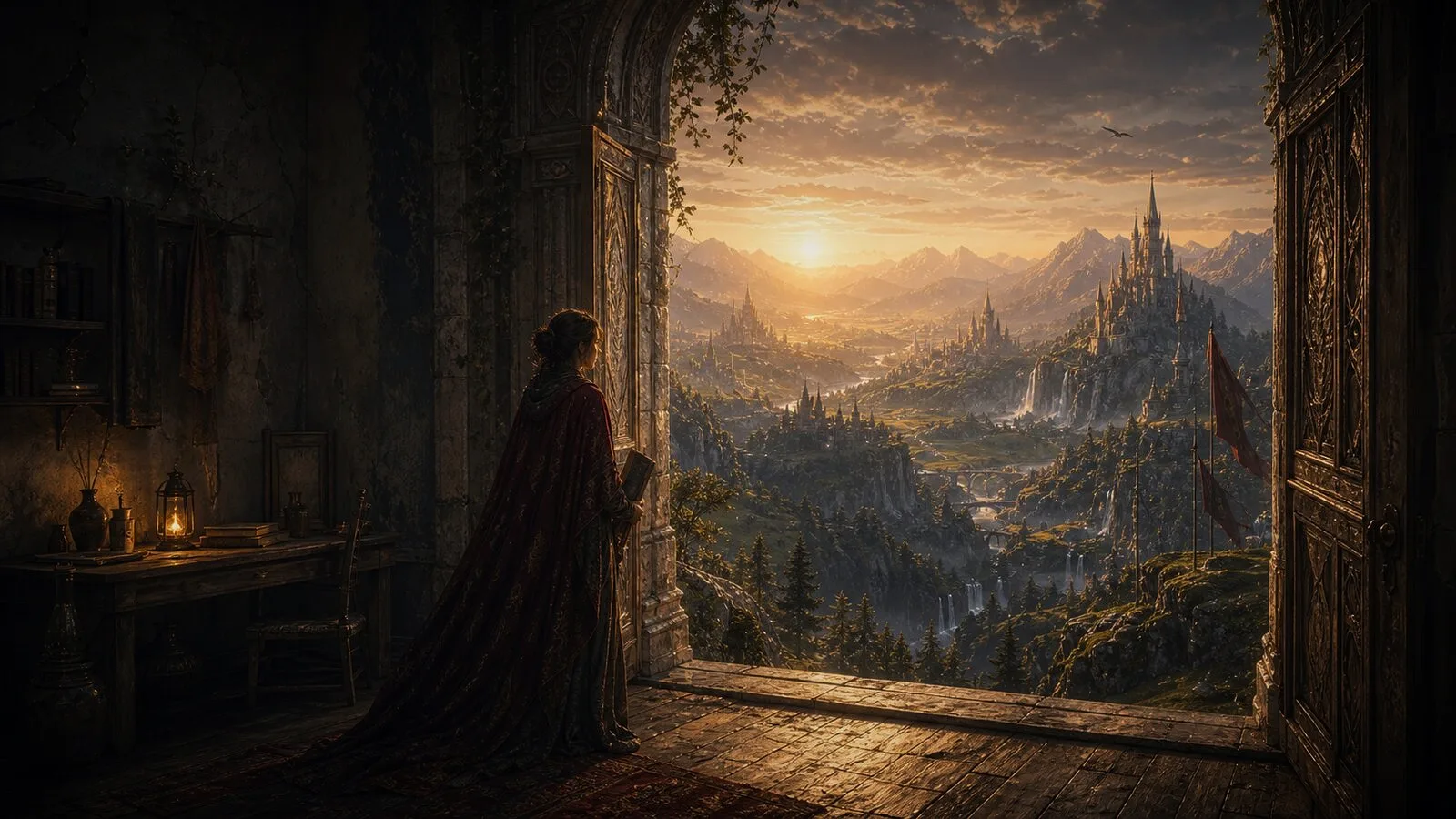
The chosen one usually begins with a prophecy, bloodline, mark, inheritance, or event that pulls a person out of ordinary life. On the surface this type looks simple: someone has been selected for a great task. The real power of the type is not the selection itself. It is the pressure that selection places on the person. If the chosen one is ready, certain, morally pure, and conveniently powerful from the start, the story becomes flat. Destiny becomes interesting when it feels less like a crown and more like a weight.
Harry Potter is one of the best-known modern examples because his life is tied early to a great enemy. Rand al'Thor in The Wheel of Time makes the pattern heavier: chosen status becomes close to terror, because saving the world may also damage the self. In both cases the question is not merely whether the hero is special. The deeper question is what being special does to friendship, fear, choice, and the ability to remain human.
When Chosen Ones Become Cliche
The chosen one fails when destiny becomes a shortcut. Instead of building character, the story stamps importance onto someone and expects the reader to obey. The remedy is consequence. The world must react to the chosen figure with expectation, dread, manipulation, worship, envy, or hatred. The chosen person should also struggle with the role, resist it, misunderstand it, or discover that prophecy can be used by institutions and enemies.
In mature fantasy, chosen status is rarely clean glory. It can be a shining chain. The larger the world, the heavier that chain becomes. This is why high fantasy so often uses the type well: personal destiny and ancient history meet in the same body.
The Small Hero in the Great World
The small hero stands against power fantasy. This character may not be a legendary warrior, prince, archmage, or heir to ancient blood. Their greatness comes from carrying a burden for which no one is truly prepared. Frodo in The Lord of the Rings is the clearest example. He does not save Middle-earth through military power. His worth lies in continuing, enduring, and resisting an object that wears down the soul.
This type matters deeply for Fantasya because it shows that epic feeling does not require outward grandeur. Sometimes epic force comes from small steps, exhaustion, loyalty, fear, and the desire to return home. In our Lord of the Rings world essay, the same point appears through worldbuilding: Middle-earth feels immense, yet its central burden is carried by hands that tremble.
The Gray Professional
The fantasy antihero is not simply a cruel or immoral protagonist. Often the better term is gray professional: someone who understands the dirt of the world more clearly than the classical heroic figure. Geralt in The Witcher is a strong example. He is a monster hunter, contractor, reader of tracks, user of preparation and specialized knowledge. His work begins as a profession, then repeatedly turns into moral pressure.
This type works when moral grayness sharpens ethics instead of erasing them. If a character does whatever they want and the story never weighs the consequences, the antihero becomes a pose. But when every contract, rescue, lie, or killing leaves a trace, the gray professional becomes one of fantasy's most human figures. The Witcher: A World Where Good and Evil Refuse to Stay Simple expands this angle through monsters, prejudice, and difficult choices.
The Flawed Mage: Power and Responsibility
The mage hero is not always the wise master standing above desire. One of the strongest versions is the person who receives power before moral maturity. Ged in A Wizard of Earthsea matters because his story is not a simple display of magical talent. His error summons the deeper subject: shadow, naming, fear, responsibility, and the cost of wanting to be greater than one is ready to be.
This type belongs beside What Is a Magic System?, because magic should never shrink into rules alone. Magic becomes human when it forces the character to face the wish to control reality. If every spell solves a problem, the story loses tension. If each spell reveals, costs, stains, or returns something, magic becomes moral language.
The Silent Avatar
In fantasy games, the hero may be built less through dialogue and backstory and more through path, failure, choice, and the player's body. The Tarnished in Elden Ring is a strong example. The protagonist is not introduced through extensive psychology. The world, enemies, deaths, ruins, and decisions form the heroic figure. The hero exists between the game's text and the player's experience.
That differs from the novel. In prose, we often enter the mind of the character. In a game, our body enters danger. We fall, return, change route, fear, attack, and sometimes understand a defeat hours later. That is why Elden Ring: A Broken World, Death, and the Beauty of Ruin is also about a kind of hero made by repetition and broken grandeur.
The Wanderer or Temporary Resident
Some heroes are defined less by a classic arc and more by the experience of inhabiting a world. The Dragonborn in Skyrim fits this type. The main quest gives mythic weight, but many players remember Skyrim through smaller acts: entering an inn, losing the road in snow, joining a faction, crafting, buying a house, returning to a town, or discovering a cave with no grand announcement.
This type matters for world-centered fantasy. Sometimes the protagonist is less vivid than the world, and that can be a strength. The wanderer leaves space for the audience to settle inside the secondary world. The hero becomes our eyes and feet rather than the final answer to the story. Skyrim: Why Some Worlds Become Livable explores this feeling of residence more directly.
The Tragic Hero and the Fallen Heir
The tragic fantasy hero is not defined by easy victory. They may be noble, but there is a flaw inside the nobility. They may hold power, yet that same power can pull them toward ruin. Dark fantasy is full of this pattern: a prince who becomes violent while trying to save the realm, a mage who creates a larger wound while trying to heal one, a warrior who discovers that the outer enemy was never the whole problem.
In What Is Dark Fantasy?, darkness matters when it complicates ethics. The tragic hero puts that pressure into the body of a character. Their fall, when written well, is not decorative sadness. It shows that good intention does not automatically create a clean path.
Companions, Heirs, Mentors, and Shadows
Not every heroic role stands alone at the center. Fantasy is full of nearby figures: the loyal companion, hesitant heir, wounded mentor, rival, shadow, apprentice, and guide who knows the road but cannot take it. These roles can become more human than the central hero because the full machinery of destiny is not always pressing on them.
Companions remind us that heroism is often relational. A wounded mentor shows that wisdom has history. A rival or shadow reveals a road the hero might have taken but did not. When these roles are written well, the main hero stops being a single voice, and the world becomes wider.
Choosing the Right Hero for a World
The better question is not which hero type is best. Ask what kind of hero the world demands. A world with strict magical law may need a protagonist who understands cost. A dark world may call for a gray professional. A mythic secondary world may become more moving through a small hero because the contrast between human scale and ancient history becomes painful. A livable open world may require a wanderer who leaves space for residence and detour.
When hero and world are designed separately, the protagonist floats above the setting. The hero should be made from the soil of the world: its economy, fears, magic, history, language, rituals, and wounds. That is why What Makes a Fantasy World Believable? also applies to character design. Believable worlds create believable heroes.
The Hero as a Shape of the Human
A fantasy hero is not a ready answer to human longing. Sometimes the hero is chosen. Sometimes small and tired. Sometimes professional and gray. Sometimes a mage who cannot escape their own error. Sometimes a silent avatar in a game. Sometimes a wanderer who understands the world by crossing it. Each type reveals a different part of human experience: the hunger for meaning, fear of power, weight of destiny, need for home, shame of failure, and hope that is rarely clean.
Fantasy matures when it refuses to turn the hero into a statue. The hero must move, fail, desire, be tempted, remain small at times, understand too late, and perhaps return with a wound no victory fully removes. At that point the hero stops being a plot device and becomes one of fantasy's deepest languages for the human being.
For the wider map of fantasy genres, see Types of Fantasy Genres.
Sources and Research Notes
- Britannica: Hero for the broader literary and cultural history of the hero.
- Joseph Campbell Foundation: The Hero with a Thousand Faces for the modern influence of the hero journey.
- Tolkien Estate: The Lord of the Rings for official context on Middle-earth and Frodo's quest.
- Tolkien Estate: Verlyn Flieger on On Fairy-Stories for secondary worlds and inner belief.
- Ursula K. Le Guin: A Wizard of Earthsea for Ged, naming, shadow, and magical responsibility.
- Farah Mendlesohn: Rhetorics of Fantasy for how fantasy mode changes the relation between protagonist and world.
- The Witcher 3 official site for Geralt, monster hunting, and gray fantasy context.
- Bandai Namco: Elden Ring for the Tarnished and the broken world of the Lands Between.
- Bethesda: Skyrim Anniversary Edition for Dragonborn and open-world context.
- Wizarding World: What if Neville had been the Chosen One for chosen-one discussion inside the Harry Potter setting.