Guides
What Makes a Fantasy World Believable?
A worldbuilding guide to rules, magic, history, geography, culture, power, ordinary life, and the old wounds that make an invented world feel alive.
A believable fantasy world does not need to look like our daily reality. If fantasy had to remain close to ordinary life, it would have little room for dragons, true names, ruined gods, immortal kings, haunted forests, or cities built around sleeping stars. The question is not whether the world is realistic. The question is whether the world is loyal to itself.
Readers can accept magic when magic behaves like part of the air: feared, regulated, desired, taxed, abused, studied, and sometimes paid for with blood. They can believe in a land full of silent gods if the ruins, laws, prayers, songs, and political fears show that those gods once mattered. Fantasy weakens when wonder stays decorative. It grows stronger when wonder becomes pressure.
In What Is High Fantasy?, we treated the secondary world as more than a large backdrop. This article follows that idea into practice. How does an invented place move beyond a map, a few strange names, and a bestiary, and begin to feel as if it existed before the hero arrived and will continue after the hero leaves?
Believability Is Consistency, Not Imitation
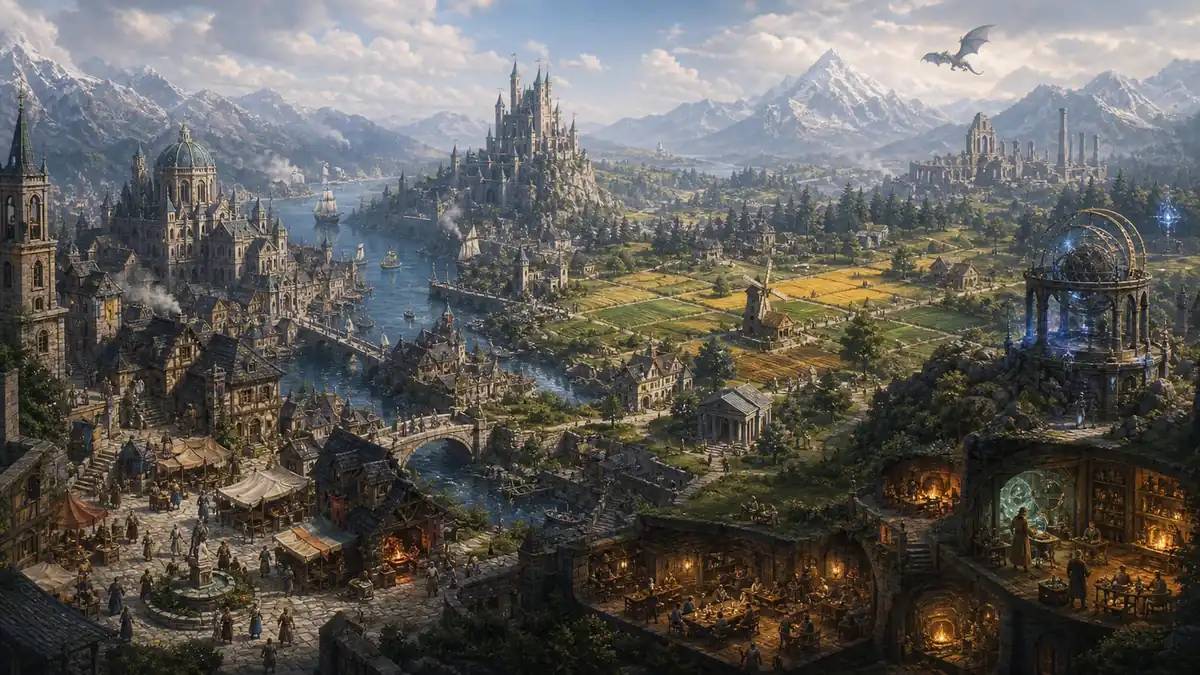
A fantasy world may contain impossible things and still feel internally solid. Believability begins when those things create a pattern. If a mountain is sacred, it should affect travel, law, pilgrimage, border disputes, or fear. If royal blood carries magical force, marriages, succession, assassination, and hostage politics should bend around it. If the sea is cursed, the harbor cannot live like an ordinary port.
Real life is useful here because it teaches consequence. Rivers create trade. Winters change storage. Mountains divide kingdoms. Disease alters belief. A fantasy world needs similar chains of cause and effect. When a major element enters the world, its ripples should appear somewhere else.
Rules That Are Felt
World rules do not always need exposition. Often they are stronger when people obey them before anyone explains them. Nobody enters the forest after dusk. Children never give strangers their true names. City gates close during the new moon. A widow places iron under the threshold. These habits tell the reader that the world has teeth.
Ursula K. Le Guin's Earthsea places true names at the center of magic. That one principle changes behavior, education, fear, and power. Knowing a thing's true name becomes an intimate and dangerous relation. In What Is a Magic System?, we explored this through limits and cost. A rule matters when characters must live with it.
History Should Leak Through the Walls
A believable world has a past that does more than sit in a prologue. It appears in architecture, songs, grudges, dynasties, ruined roads, and half-remembered ceremonies. Tolkien's Middle-earth feels deep because its languages, lineages, poems, and old names make the present story seem smaller than the world around it. Each name feels like a door; behind every door waits an older age.
Elden Ring reaches a similar force through a different method. The Lands Between rarely explains everything directly, but broken statues, exhausted castles, repeated titles, dead giants, and sacred architecture let the past press on every horizon. In Elden Ring: A Broken World, Death, and the Beauty of Ruin, we read that silence as a kind of world memory.
Geography Should Change Behavior
A beautiful map is not enough. Mountains, rivers, deserts, roads, seas, and borders must alter what people can do. A capital on a river has different trade, defense, disease, immigration, and symbolism than a fortress in a frozen pass. A northern land with brutal winters should develop different clothing, food, architecture, burial customs, and military habits.
A Song of Ice and Fire draws power from that material pressure. Long seasons, distance, walls, castles, grain, roads, and inheritance keep politics from floating above the land. Skyrim works through a more experiential version of the same principle. Its roads, inns, mines, snowy passes, rivers, and small towns make the province memorable as a place to move through. Why Skyrim Feels Livable continues that thought.
Culture Begins With Names, Then Goes Further
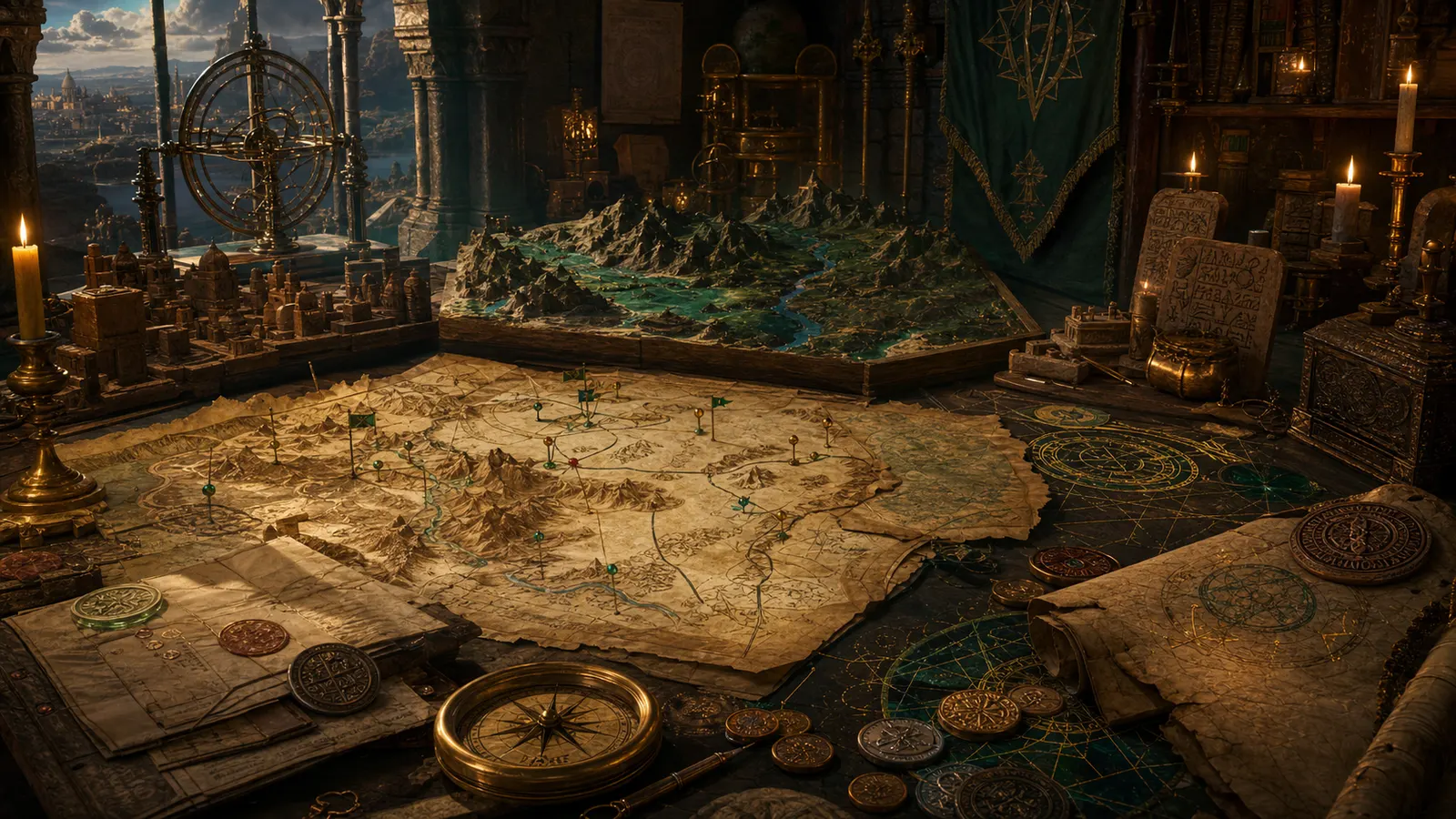
Names matter, but culture cannot end with names. How do people greet each other? What do they hide? What colors mean mourning? What meal belongs to winter? Which animal is holy? What story frightens children? Which word is never spoken in a royal hall? Which song is sung before battle, and which one is sung after defeat?
Tolkien's attention to language mattered because language is more than vocabulary. It is memory, worldview, sound, age, and social shape. Le Guin, in From Elfland to Poughkeepsie, argues with equal force that careless language can break the spell of fantasy. A culture becomes believable when its speech, gestures, taboos, foods, and fears seem to have grown from the same soil.
Economy Makes Power Physical
Every fantasy world has an economy, even when the story is not about merchants. Where does iron come from? Who feeds the army? Are mages paid by courts, temples, guilds, or frightened villages? Do peasants pay taxes in coin, grain, labor, or magic service? Has a dragon closed a trade road? What happens to salt when war reaches the coast?
Power without infrastructure becomes a mask. A king with no roads, food stores, soldiers, law, myth, fear, or legitimacy stands on air. In Martin's Westeros, power is tied to land, houses, marriage, hostages, walls, winter, and grain. Politics feels heavier because matter keeps pushing back.
Magic Needs a Boundary
Unlimited magic kills danger quickly. If every wound can be healed, what weight does injury carry? If every distance can be crossed with a spell, what remains of travel? If every lie can be exposed instantly, how does politics survive? Limitation is not an enemy of imagination. It is the furnace that makes imagination hotter.
Earthsea uses true names. The Witcher uses signs, curses, monster knowledge, potions, contracts, and risk. Many myths use ritual, sacrifice, taboo, or divine price. Power becomes moving when it asks for something. The character must know what force costs; the reader must sense a shadow behind every wonder.
Consequence Is the Hidden Spine
Decisions need residue. If a city is saved, who benefits and who becomes resentful? If forbidden magic is used, do priests, guilds, scholars, or rulers respond? If a monster is killed, are the villagers safer, or has an old balance been broken? A world without consequence is a stage set that resets after each scene.
The Witcher 3 stays powerful because its monster contracts often become moral knots. Villages smell of mud, poverty, fear, prejudice, superstition, and grief. Killing the monster may not cleanse the situation. In The Witcher: A World Where Good and Evil Are Not Simple, we follow that connection between creature, community, and choice.
Ordinary People Are the Heart of the World
If the world exists only for the hero, it soon feels hollow. A living world has bakers, guards, children, farmers, monks, thieves, apprentices, widows, healers, exhausted soldiers, and people who may never stand in the center of the plot. They show that the world begins its morning without waiting for us.
This is why a Skyrim inn can carry more atmosphere than a royal throne room. This is why a poor village in The Witcher can make a kingdom feel morally larger. Ordinary people are not background decoration. They are the reason politics, war, magic, and heroism matter. If nobody lives in the world, saving it becomes abstract.
Wounds and Memory Make a World Old
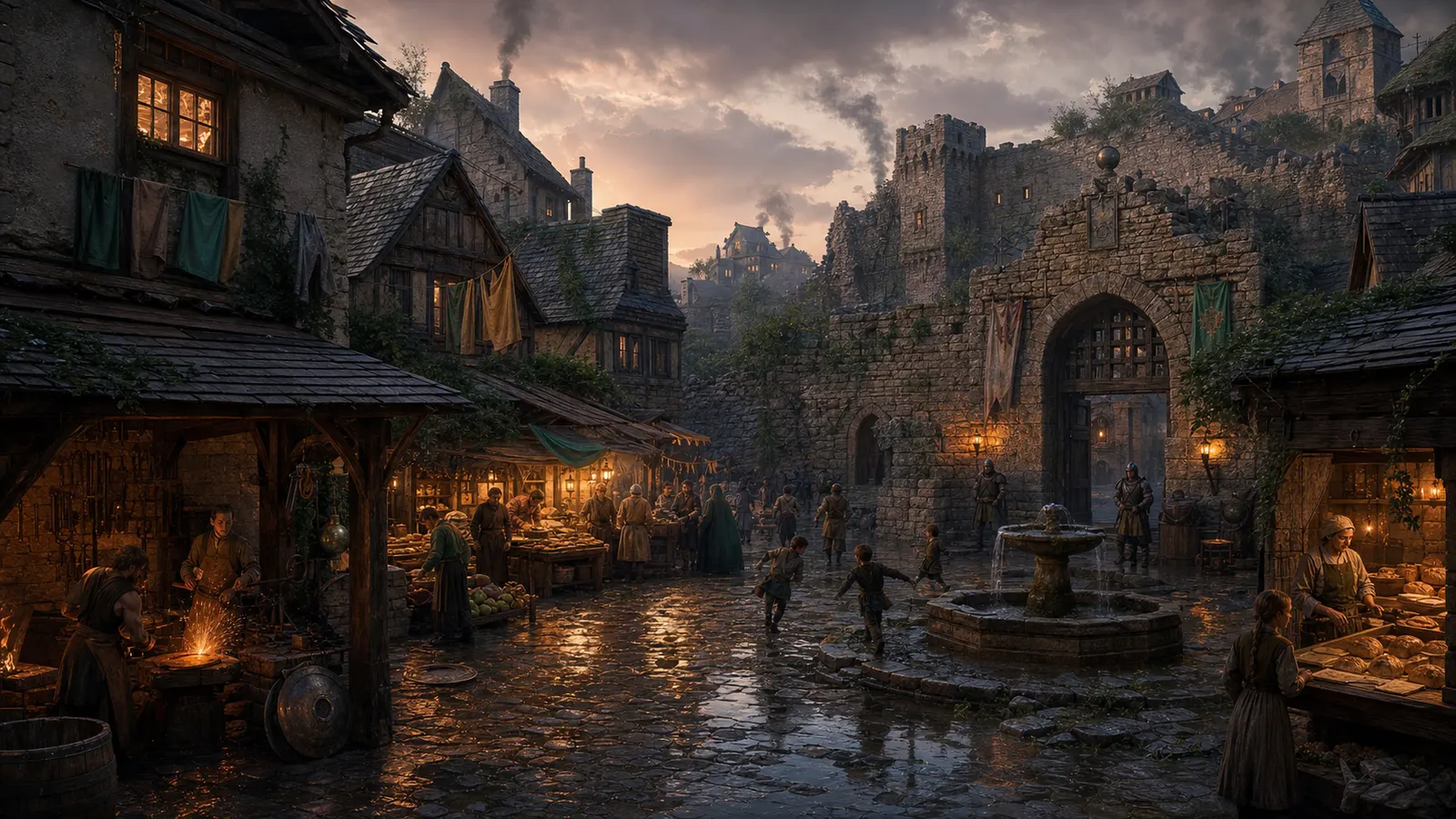
Young worlds can be beautiful, but unforgettable worlds often carry wounds. A broken bridge, a festival whose origin has been half-forgotten, a castle whose name is spoken softly, a law written after disaster, or a city that mourns a distant war every year gives a place age.
The wound does not always need melodrama. A small custom can do the work. People fall silent near a dry well. Old soldiers touch a stone before entering the gate. Families avoid a name because it belonged to a traitor. Such details tell the reader that the world has endured something and has not fully healed.
What Breaks Believability?
The first danger is convenience. When magic appears only to solve a problem, the law of the world weakens. When a map looks impressive but never changes behavior, geography becomes wallpaper. When culture is defined by clothing alone, the world loses depth. When every kingdom uses the same food, humor, law, calendar, and fear, the map has borders but no souls.
The second danger is over-explanation. Some worlds talk so much about themselves that they stop breathing. The reader does not need every law on the first page. Some rules can be shown through habit, some history through ruins, some secrets through silence. A living world always stands slightly beyond the text.
A Practical Checklist For Worldbuilders
Ask what the strongest force in the world is and who fears it. Ask how geography has forced people to adapt. Ask what magic makes easier and what it makes more dangerous. Ask how poor people survive. Ask where rulers get food, legitimacy, information, and soldiers. Ask what ordinary people think of heroes. Ask which wound still remains in language, ritual, law, or architecture.
When the answers connect, the world slowly gains a body. It becomes more than names and places. It gains hunger, pride, memory, fear, work, weather, debt, hope, and old shame. Then a short scene beside a well, a forge, a snowy road, or a market stall can do more worldbuilding than a long lecture.
Why Believable Worlds Keep Us
We enter fantasy for worlds that exceed ordinary reality, but the mind still needs meaning, consequence, and the feeling of life. A dragon becomes powerful when it casts a shadow over history and fear. Magic becomes moving when it has a price. An invented land becomes home when its people wake, work, age, lie, pray, love, and fear the future.
A believable fantasy world does not say, "This could happen here." It says something more important: "If this world existed, this is how it would breathe." That feeling turns a map into a homeland, a rule into fate, and a story into a place worth returning to.
Sources and Further Reading
- Tolkien Estate: Verlyn Flieger on On Fairy-Stories for secondary worlds and inner belief.
- Ursula K. Le Guin: From Elfland to Poughkeepsie for fantasy language and style.
- Ursula K. Le Guin: A Wizard of Earthsea for true names as magical structure.
- Bethesda: Skyrim Anniversary Edition for official Skyrim context.
- Bandai Namco: Elden Ring for official Elden Ring context.
- The Witcher 3 official site for dark fantasy and monster contract context.
- George R. R. Martin: A Game of Thrones for A Song of Ice and Fire context.
- Britannica: Fantasy narrative genre for a general frame of fantasy literature.