Guides
The Best Fantasy Games for Entering Another World
A practical guide to choosing a fantasy game by the feeling you want: wandering, dark grandeur, moral choice, difficult combat, mythic wonder, or a gentler first gate.
The best fantasy game is not always the one with the largest map, the longest campaign, or the loudest reputation. Sometimes the right game is the one that matches the shape of your hunger tonight. Maybe you want snow, mountains, and a road that lets you disappear for a few hours. Maybe you want a wounded world where every victory feels earned. Maybe you want companions, dialogue, and choices that refuse to become clean. Or maybe you simply want another world to breathe in, not as a shallow escape, but as a different way of being.
This guide is not a rigid ranking. Fantasy changes with mood, age, patience, memory, and fatigue. So instead of declaring one universal winner, we will sort games by the kind of doorway they open: wandering, dark fantasy, moral choice, combat, mythic play, long-term residence, and gentler entry points. If you are new to fantasy games, this should help you choose a first gate. If you already know the genre, it may clarify why some worlds remain in memory longer than others.
In What Is High Fantasy?, a secondary world was not just scenery. It needed laws, geography, history, and wounds of its own. Fantasy games make that idea physical. You do not only observe the world. You walk through it, fail inside it, return to it, build habits in it, and sometimes stay there after the objective has stopped mattering.
First Question: What Are You Looking For?
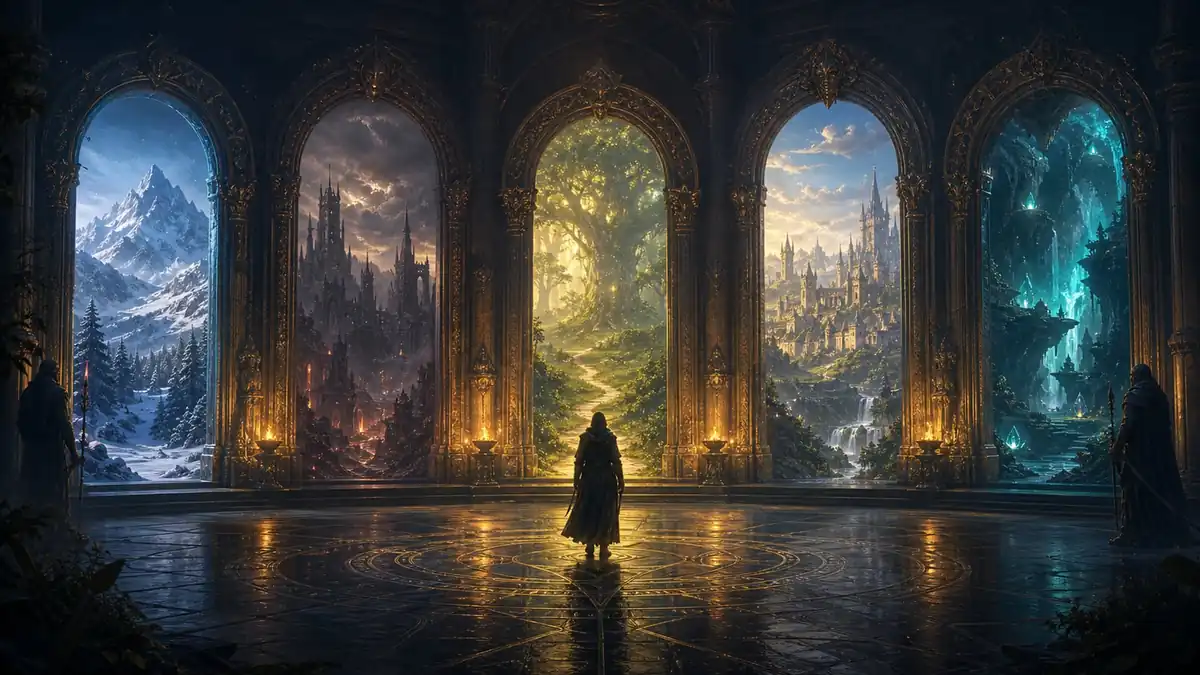
Ask "what is the best fantasy game?" and the answer becomes vague quickly. Ask "what do I want fantasy to do for me right now?" and the path becomes clearer. Do you want freedom or story? Calm or challenge? A world that feels like home, or a world that scars you a little? Do you want to fight monsters, or to ask who the monster is?
That is why fantasy games work better as doorways than as trophies. Some gates lead to habitable worlds. Some lead to darkness that must be crossed carefully. Some lead to dialogue, companions, dice, and consequence. Some lead to combat, where timing and endurance become part of the story.
The Quick Map
If you want an immediate direction, start here. For open-world wandering and a sense of residence, Skyrim remains powerful. For dangerous grandeur and challenge, Elden Ring is one of the strongest doors in modern fantasy. For morally gray storytelling, The Witcher 3 still matters. For party role-playing and consequence, Baldur's Gate 3 is essential. For physical action and unpredictable journeys, Dragon's Dogma 2 has a distinct flavor. For an easier magical entry point, Hogwarts Legacy works better than many heavier RPGs. For an online world you may live with for months or years, Final Fantasy XIV is closer to migration than completion.
That is only a map. The real question is what each world asks from you when you step through.
For Wandering and Getting Lost: Skyrim
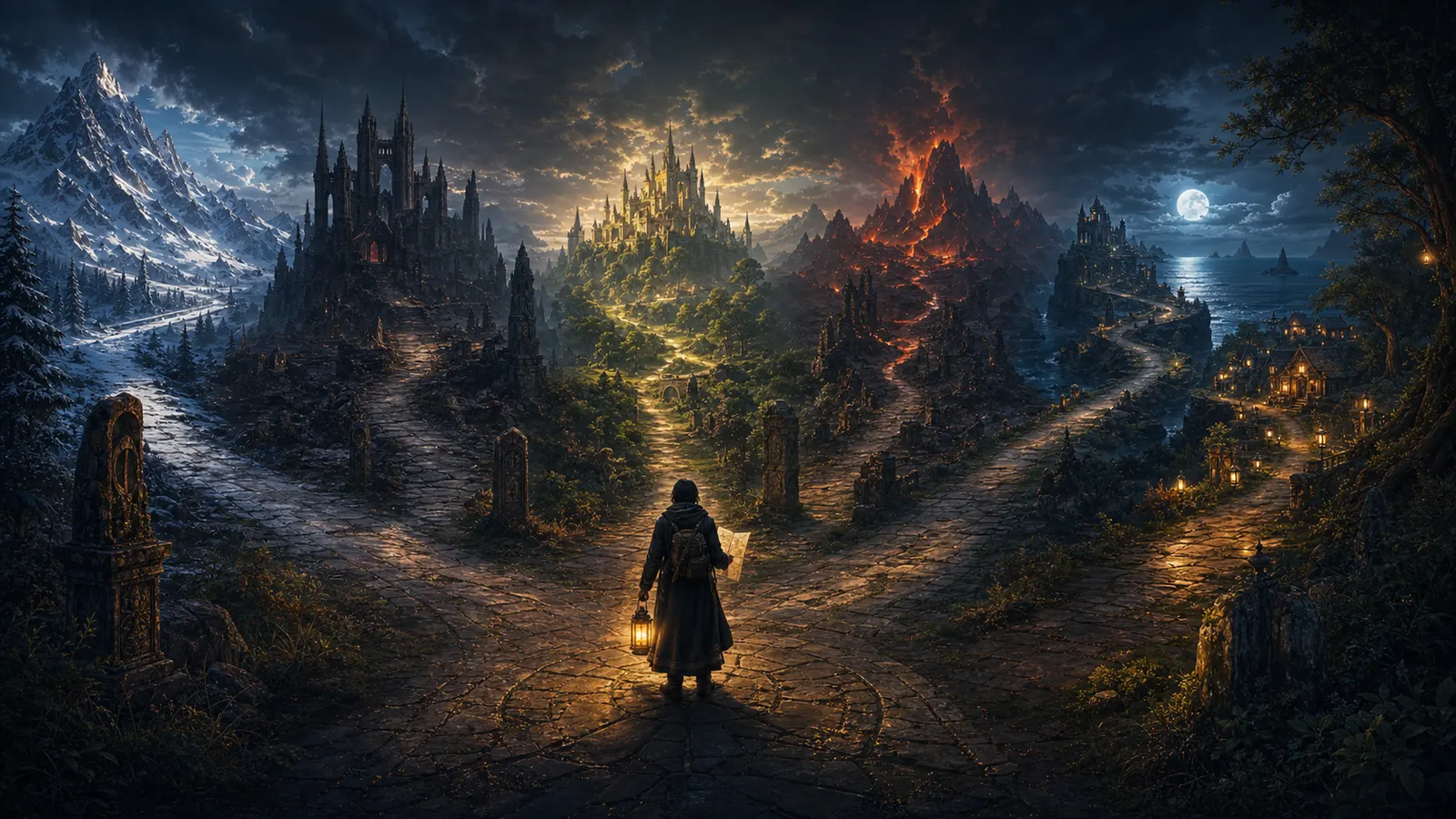
If you want a world that does more than give quests, Skyrim is still one of the strongest starting points. Its power is not perfection. Its power is habitation: snow, mountain wind, inns, music, caves, familiar towns, and roads that slowly turn into memory.
Skyrim suits players who want fantasy as place. Not only a place to defeat enemies, but a place to return to, build a home in, wander through, and fill with small stories. Its systems can show their age, but its geography still knows how to feel lived in. If that feeling interests you, Skyrim: Why Some Worlds Become Livable goes deeper into why the game became a mental home for so many players.
For Dangerous Grandeur: Elden Ring
Elden Ring is for players who do not want fantasy only as comfort. It presents a world like the remains of a broken myth: beautiful, brutal, silent, and full of things it refuses to explain completely. If you want every horizon to carry promise and threat at once, Elden Ring is a major choice.
But it is not a gentle gate. Elden Ring asks for patience, failure, attention, and a tolerance for mystery. If you need constant guidance and clean routes, it may exhaust you. If you want fantasy in a wounded, epic, almost liturgical form, few games leave such a mark. Elden Ring: A Broken World, Death, and the Beauty of Ruin explores that feeling more directly.
For Moral Grayness: The Witcher 3
The Witcher 3 is for players who want fantasy to move beyond simple rescue. In its world, the monster is not always the monster, and the human is not always more human. Its strength lies in muddy roads, damaged people, bitter decisions, and a world that rarely gives clean answers.
If heroic fantasy sometimes feels too polished, The Witcher 3 brings mud back onto the blade. Not to make everything meaningless, but to make morality harder and more human. It suits players who value character, dialogue, atmosphere, and decisions that remain uncomfortable after the quest ends. The Witcher: A World Where Good and Evil Are Not Simple follows the same thread.
For Role-Playing and Consequence: Baldur's Gate 3
Baldur's Gate 3 is for players who want to shape the journey through decisions. It is less about a single heroic path and more about possibility: persuasion, deception, mercy, disaster, party dynamics, tactical improvisation, and the strange afterlife of small choices.
It can be dense at first. There are systems, classes, spells, reactions, companions, and many ways to make a mess. But that density is also the point. If you enjoy tabletop-like freedom, party tension, and seeing the world respond to your approach, Baldur's Gate 3 is one of the most important fantasy gateways of the current era. It reminds us that fantasy does not live only through magic and swords. It lives through consequence.
For Playful Freedom: The Legend of Zelda: Tears of the Kingdom
Tears of the Kingdom is not dark fantasy, and it does not try to be. Its fantasy is discovery, movement, invention, and delight. The sky, caves, islands, ruins, devices, and strange solutions turn the world into a box of possibilities. It is less interested in grief than in curiosity.
This makes it a strong choice for players who want a world that encourages experimentation. If heavy violence, dense lore, or relentless despair feel tiring, Zelda can restore another side of fantasy: the belief that the world still has room for play. Sometimes wonder does not need to roar. Sometimes it begins when a small idea actually works.
For Physical Combat and Huge Monsters: Dragon's Dogma 2
Dragon's Dogma 2 is for players who want to feel fantasy through the body. Combat is not only menus and numbers. Position, weight, climbing onto monsters, companions, roadside danger, darkness, and travel interruptions matter. The game can be rough and demanding, but that roughness creates a living sense of adventure for the right player.
It is especially good when a plan collapses. Night falls too soon. A monster interrupts the road. A pawn reacts. A simple trip becomes a story. If you want fantasy travel to feel unpredictable rather than perfectly managed, Dragon's Dogma 2 has a rare texture.
For Long-Term Residence: Final Fantasy XIV
Final Fantasy XIV is not a game you simply finish over a weekend. It is closer to living with an online world: cities, jobs, continents, music, community, expansions, and story arcs that have grown across years. If you want fantasy to become a long habit, it is a serious candidate.
That also means it asks for time and patience. It is not ideal for someone who wants a short, self-contained experience. But if you like the idea of slowly inhabiting a world with other people moving through it, Final Fantasy XIV can create one of the strongest senses of a continuing secondary world.
For Gentler Entry: Hogwarts Legacy and Avowed
Not every player should begin with Elden Ring's difficulty or Baldur's Gate 3's density. Some people need a softer gate. Hogwarts Legacy works for players who enjoy magical school atmosphere, castles, spells, flying, collections, and a familiar wizarding frame. If that setting still has emotional charge for you, it is an accessible way to step into a fantasy world without being buried under systems.
Avowed can also work as a more focused entry point for players drawn to first-person role-playing, companions, exploration, and clear decisions. It is more compact than some enormous RPGs, and that can be a strength. Not everyone wants a hundred-hour labyrinth. Sometimes a mysterious island, a few companions, and a concentrated adventure are enough.
For Tactical Magic: Divinity: Original Sin 2
If Baldur's Gate 3 appeals to you, or if you want another tactical fantasy RPG with a different flavor, Divinity: Original Sin 2 remains valuable. It suits players who enjoy magic as environment: fire, poison, rain, height, surfaces, positioning, and chain reactions. Battles often feel like dangerous puzzles.
It is not the easiest starting point, but it rewards players who like thinking through combat instead of simply reacting. Its fantasy is not only in spell names. It is in the way the world itself becomes power and danger. That connects closely to What Is a Magic System?: power becomes interesting when it has rules, costs, and reactions.
Which One Should You Play First?
If you are new, start with Skyrim, Hogwarts Legacy, or Avowed. If you want story and consequence, choose The Witcher 3 or Baldur's Gate 3. If you want challenge, mystery, and dark grandeur, choose Elden Ring. If you want a long online life, try Final Fantasy XIV. If you want unpredictable action travel, look at Dragon's Dogma 2. If you want tactical magic and battlefield thinking, Divinity: Original Sin 2 still shines.
The important thing is not to choose the wrong gate for the wrong mood. A tired player looking for comfort may bounce off Elden Ring. A player hungry for moral depth may not be satisfied by a merely pretty world. Someone without patience for systems may leave Baldur's Gate 3 too early. The best fantasy game is the one that opens the right world at the right moment.
Why Fantasy Games Stay With Us
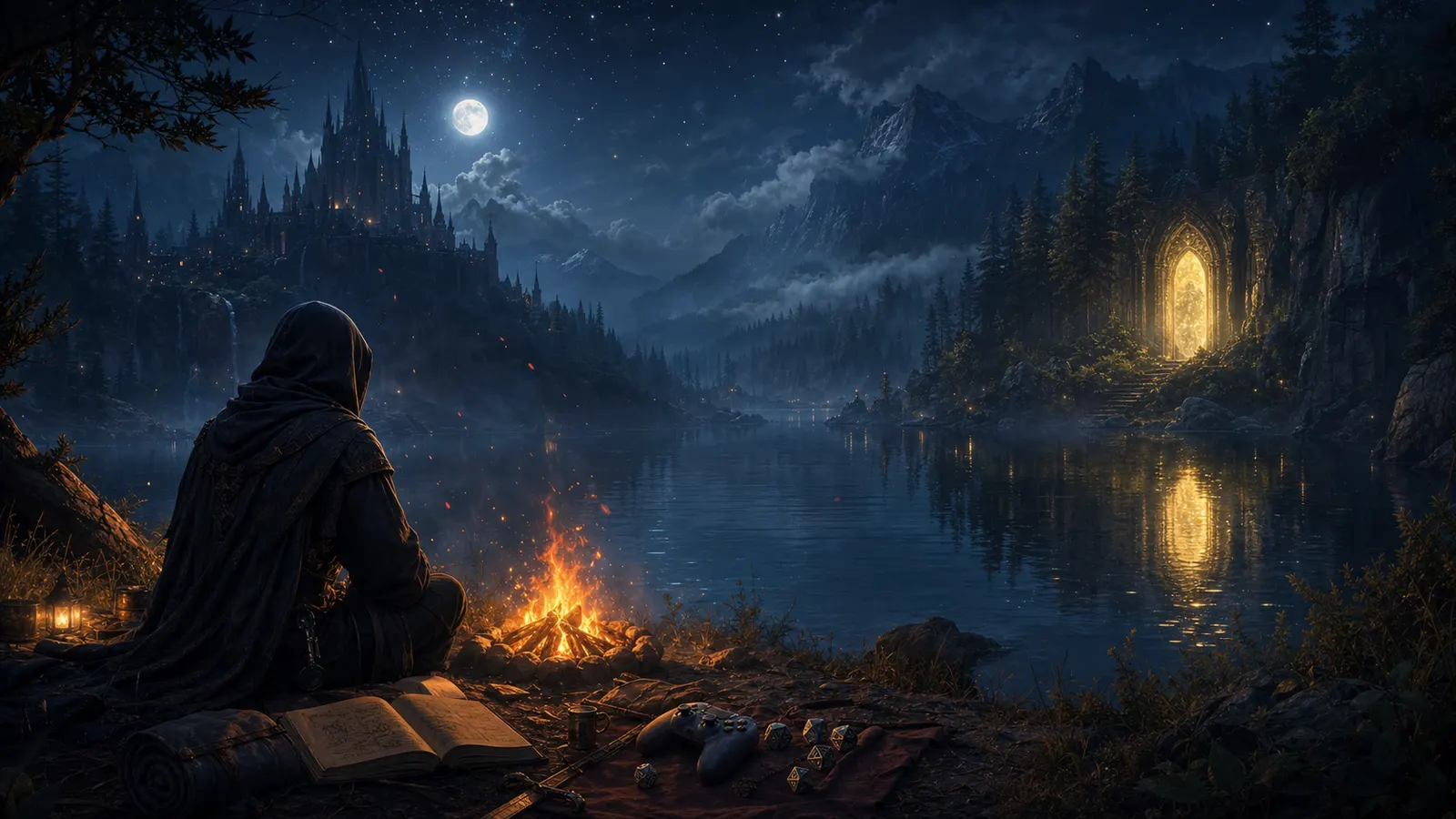
Fantasy games remain in memory because their worlds are not only seen. They are inhabited. In a novel, you follow the hero's road. In a film, you witness the image. In a game, even a scripted story passes through your body. You take the wrong road, fail, reload, return, decide, and sometimes stop beside a view for no practical reason.
That is why some fantasy games become places in memory. Skyrim becomes a season of life. The Witcher 3 becomes a set of choices that never fully clean themselves. Elden Ring becomes the feeling of standing before a huge broken world. Baldur's Gate 3 becomes the memory of companions and consequences. These are not only entertainment products. At their best, they are doors into human experiences: freedom, fear, power, friendship, failure, discovery, and return.
We enter fantasy games to leave reality for a while. But when the world is strong enough, we come back carrying something with us.
Official Sources
- Bethesda: Skyrim Anniversary Edition for official Skyrim edition, platform, and content details.
- Bandai Namco: Elden Ring for official product and publisher information.
- The Witcher 3 official site for the official dark-fantasy open-world description.
- Baldur's Gate 3 official site for platforms and role-playing information.
- Capcom: Dragon's Dogma 2 for the official action-RPG overview.
- Nintendo: Tears of the Kingdom for official product information.
- Final Fantasy XIV: Dawntrail for the current online world and expansion context.
- Hogwarts Legacy official site for the official open-world action RPG description.
- EA: Dragon Age The Veilguard for official single-player RPG information.
- Obsidian: Avowed for the Living Lands and core premise.
- Larian: Divinity Original Sin 2 for the official tactical RPG overview.