Worlds
A Song of Ice and Fire: A World at the Edge of Winter
Across Westeros and Essos, rulers plan for tomorrow while unruly seasons, ruined empires, and returning magic reveal that history never truly ends.
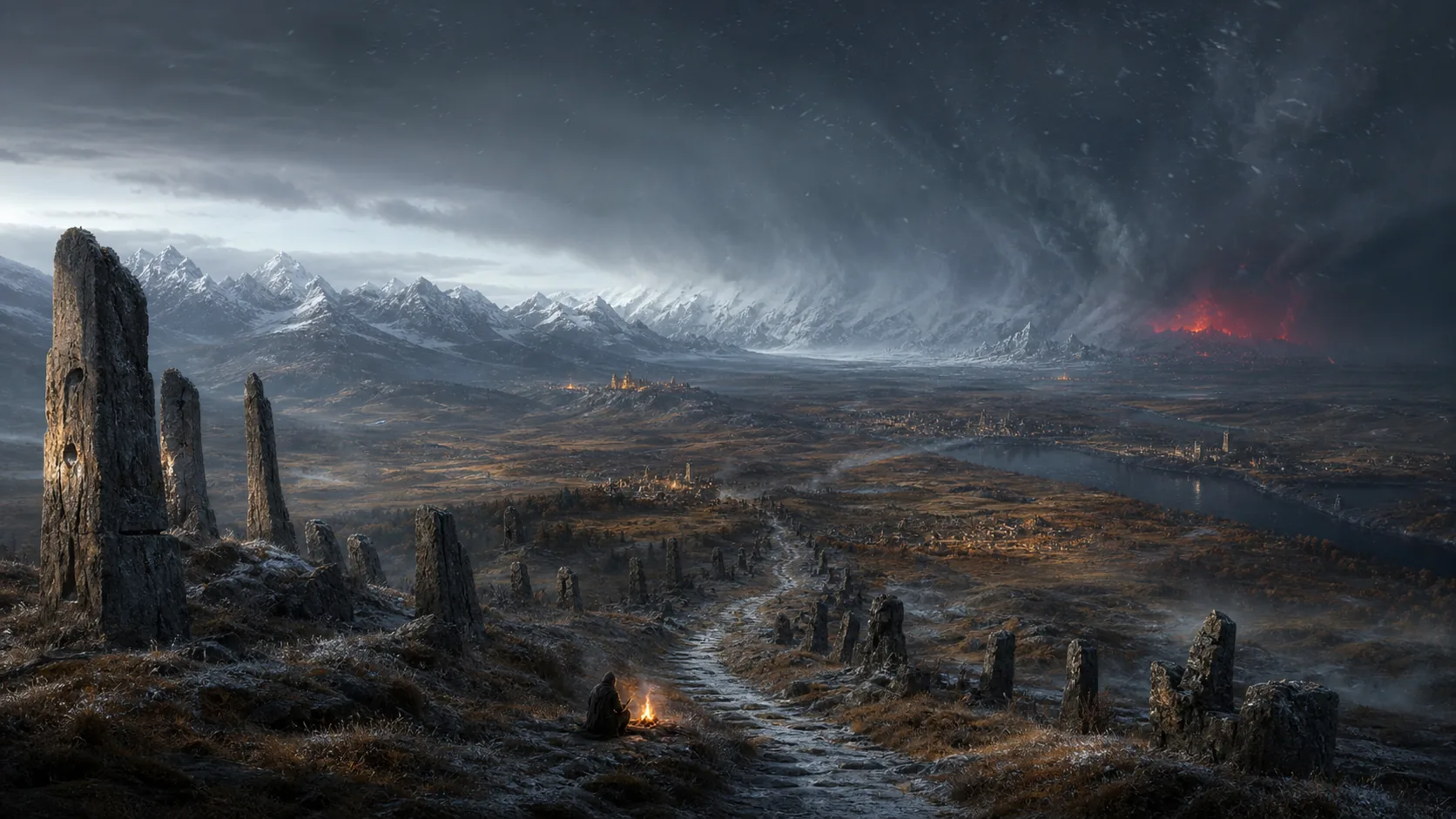
Summer has lasted so long that the child in the castle yard remembers no true winter. To him, snow belongs to old women’s tales: a soft whiteness that settles on towers and melts by morning. In the kitchen, an old woman salts meat, dries damp firewood, and keeps the moth-eaten fur of her dead husband. She knows that some seasons erase people’s names from their homes before they end.
The heart of A Song of Ice and Fire beats between the child’s confidence and the woman’s memory. A great civilization has mistaken temporary order for safety. Kings fight over inheritances that may not outlive a generation; cities stand on dead empires; ancient dangers have dwindled into lullabies. Everyone expects tomorrow to be a larger version of today—until the past returns through snow, ash, and half-forgotten songs.
Scope and spoilers: This essay explores the published novels and companion histories. HBO’s ending is not treated as the books’ definitive ending, and mysteries still open on the page receive no invented answers.
The world of the books, not the shadow of the show
A Game of Thrones names both the first volume and its famous television adaptation. That overlap has encouraged many to compress the world into the show’s final seasons, its actors, or the Iron Throne. The five published main novels are larger, stranger, and less settled. They move through dozens of minds, each seeing one broken piece of the view.
Martin has described book and television series as different tellings whose roads increasingly diverged. The show’s answers about particular lives, the enemy in the North, or the outcome of wars cannot close the literary mysteries.
That distinction belongs to the world’s meaning. Truth seldom waits behind clean glass. News comes by horse or raven; witnesses lie; chroniclers carry loyalties; dreams may warn, deceive, or wear the dreamer’s fear as a mask. We know the world as its inhabitants do: in fragments, often too late.
A summer that believed itself eternal
The seasons obey no ordinary calendar. Summer and winter can endure for years, and the published books have not explained why. More important is the memory such time creates. A generation born into gentle summer hears its elders’ warnings as exaggeration. A steward hesitates between a feast and full granaries, because distant danger seems weaker than pleasure close at hand.
Winter is no simple emblem of evil. Snow can bar an invader and cold preserve meat. Yet the long season shatters the present’s pride. Titles, treaties, and borders matter only while bread remains, roofs hold, and someone can carry an order.
The price of power in Game of Thrones follows a courtly decision into distant lives. Here the scale grows wider: victory may matter immensely by the court’s small clock and almost not at all by the great clock of the seasons.
A map that becomes legend at its edges
The map is incomplete and never pretends otherwise. Far from familiar centres, reports grow stranger, names less stable, distances uncertain. This haze is purposeful: a map extends only as far as its maker’s knowledge, journeys, and prejudices.
Westeros and Essos are not Europe and Asia under borrowed names. Martin drew on many eras and cultures, recombining their material in a secondary world. Resemblances matter; one-to-one equations diminish it.
A map is never neutral. Much of the far east reaches us through merchants, exiles, or historians who may never have seen it. Western characters flatten Essos into one strange elsewhere; their ignorance is not the world’s truth. The blank edge is an admission: we do not know.
Westeros: names that mean to outlive death
In Westeros, a house lets the self continue after death. A person dies while name, sigil, castle, sword, and crypt endure. Before knowing who they are, a child may know which oath they inherited and which house to hate. Genealogy promises an orderly time, as if blood could carry the past forward without spilling it.
History breaks that promise. Ancient houses fall silent; a conqueror’s name settles over a defeated castle; an heir dreams of another life. Even “the Seven Kingdoms” forces a rough reality to appear whole. The North, Dorne, the islands, and the riverlands share no single memory. One region’s defeat may be another’s liberation.
In the deep time of Middle-earth, the past shines like a fading light. In Westeros, it is an unfinished case. The dead still sit in the council room through grudges, blood claims, and stories chosen by the living.
The Wall: a monument whose reason was forgotten
The Wall contains a great contradiction: an immense monument raised against a danger that most people no longer believe in. Generations have seen it and sent guards there, yet its first purpose lies so deep in the past that service has become punishment rather than defence of the living.
Martin has said the image began on Hadrian’s Wall, imagining a Roman soldier looking into an unknown north. Fantasy magnified the feeling. The ice is invention; the impulse is familiar. We build a boundary against danger. Generations later, the boundary remains and the knowledge has gone.
The Long Night enters as worn memory, not living report. Grandmothers tell it, children shiver, adults smile. A society can possess evidence as high as the Wall and forget what it was built to say.
Essos: empires that rule after death
Essos is no single “East.” Free Cities, grasslands, islands, slave ports, deserts, and lands known only through rumour carry separate memories. Yet dead empires shadow much of the continent. Roads, languages, and city shapes can outlive their makers by centuries.
Collapsed power keeps working. People travel a conqueror’s road, spend a forgotten ruler’s coin, or accept a law once written for imperial profit. A sailor sells black stone without knowing whether it came from temple or prison. To him, it is supper; the past passes silently from hand to hand.
That depth helps explain why we build imaginary worlds. They let us watch catastrophe survive through language, habit, and economics long after the names of those responsible vanish.
Valyria: the fire that consumed its masters
Valyria embodies the dream of mastery. Dragonlords joined sorcery, dragons, and enslaved labour into a power that saw no equal. Then came the Doom, a catastrophe whose cause remains hidden inside layered accounts and whose ruins still inspire terror.
Its importance does not depend on solving the disaster. Valyria asks whether the force that makes a civilization invincible carries destruction from the beginning. When power can buy, burn, or enslave every warning, who remains to name a limit?
A dragon becomes the living memory of an age when fire redrew politics. Dragons in fantasy follows the creature through splendour, greed, sacred awe, and devastation. All those faces move beneath the same wings here.
Who carries history into the next morning?
The past has no single voice. Maesters copy manuscripts, septons see sin and sanctity, singers make defeat romantic, and conquerors rename the events they survived. The World of Ice & Fire speaks from within that tradition: an inheritance of learning, conjecture, omission, and received story, not a camera recording final truth.
Official histories have human authors with fears and patrons. A document may be honest and incomplete. The letter surviving the fire may be the one that lies; a truthful witness may die before the raven arrives.
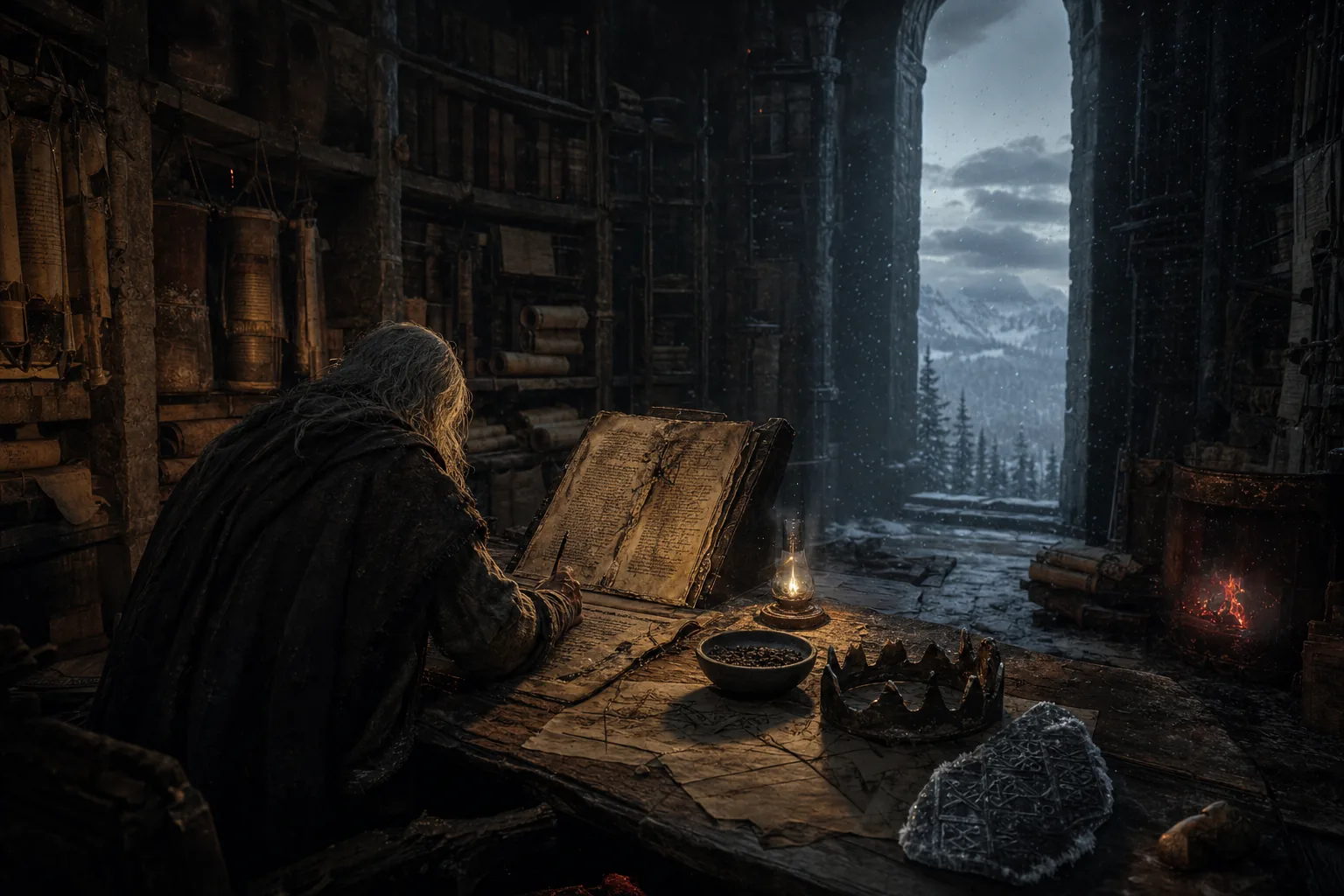
A Mythlore study examines books, letters, and lost records in the Song. Knowledge is found, destroyed, misread, or delivered too late. Civilization is shaped by what it preserves—and what it finds easier to forget.
Many gods, no certain answer
The old gods, the Seven, the Drowned God, the Lord of Light, and distant traditions share the world. Faith can be refuge, belonging, or political legitimacy. A sovereign binds a sacred sign to a claim; an unnamed mourner lights a candle to endure a child’s death.
Prayer, visions, returns from death, and sight across distance disturb the boundary between religion and magic. Yet no god explains existence to the reader. The impossible may occur without proving that every priest has understood it.
Silence gives faith its weight. If heaven answered clearly, belief would become obedience to fact. These people decide beneath a sky much like ours: one that may send signs and never sends instructions.
Magic does not return; the veil draws back
The story opens with the supernatural, though much of the world believes magic ended. Dragons are dead, northern beings are tales, and maesters trust what can be measured. Then dreams acquire weight. Glass, blood, fire, and trees reveal what should be impossible.
Martin keeps magic scarce and resistant to explanation. It never settles into a safe formula. Touching a power does not reveal its nature; knowing its name does not explain its cost. Magic systems and the price of power explores this tension between rules and mystery.
Perhaps magic never returned because it never left. Human memory grew shorter. The impossible waited beyond one generation’s experience, and that generation mistook absence from its life for absence from reality.
Life in a long season does not begin with a sword
Worldbuilding lives when a vast law creates a small habit. If winter lasts for years, a family counts salt, grain, roof tiles, and firewood before the first snow. A child’s boots are made large for next year. A castle room stays locked because warmth costs wood. Common illness may empty a village before help arrives.
These details matter more than a census of castles. A believable fantasy world grows from continuous consequences: climate enters the kitchen, distance alters news, history shapes the word used for a neighbour.
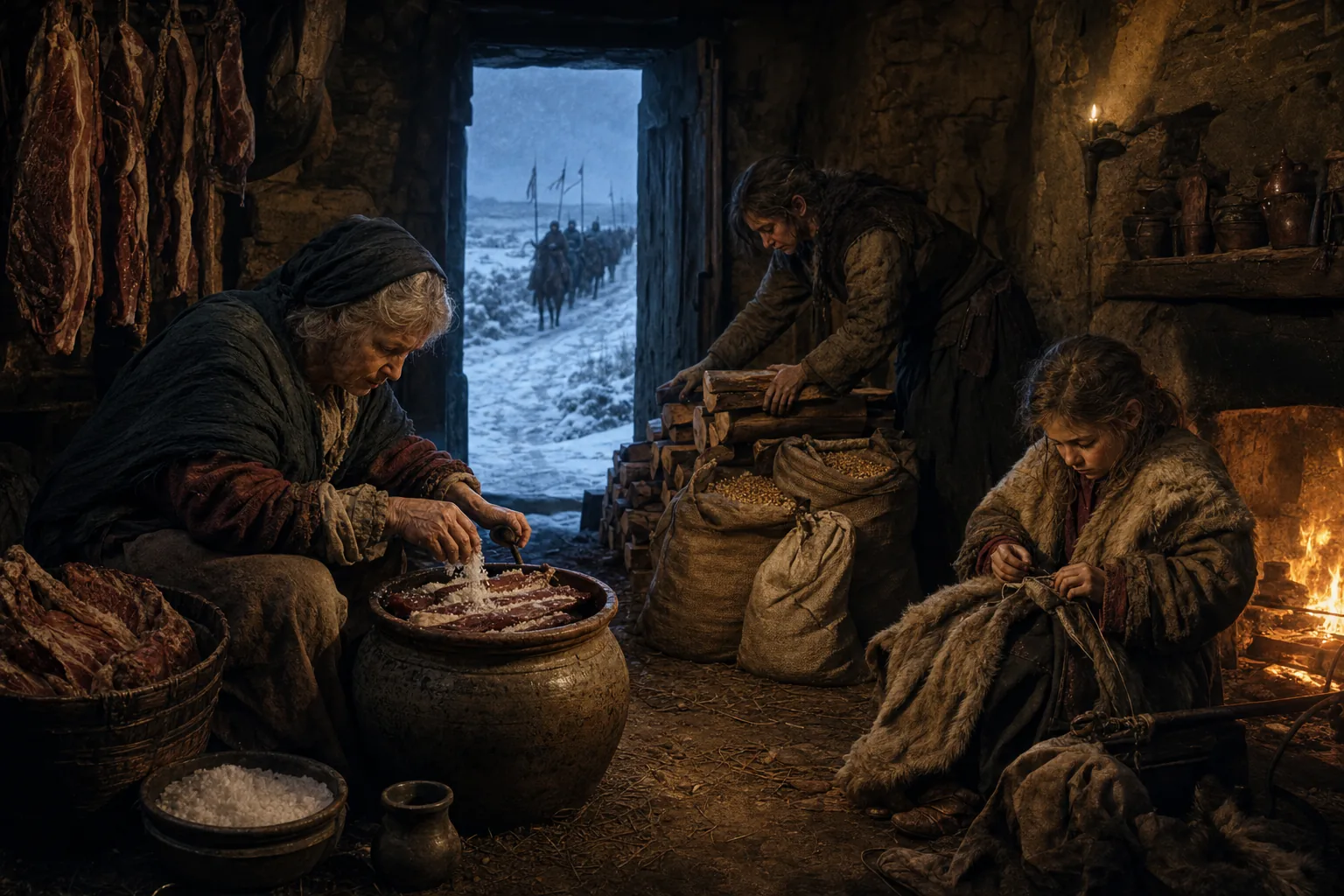
Outside, an army’s banners move down the road. Inside, the question is whether food lasts until spring. A child mends an old fur, unaware which winter killed its owner. The world becomes real when far-off splendour is heard beside the crack of the last firewood.
Ice and fire are not two armies facing one another
It is tempting to divide ice and fire into good and evil. The world refuses. Fire warms a house and devours a city. Ice preserves food and stills blood. Both are beautiful, both terrifying, neither made for human ease.
The title’s final meaning remains open in the published books. Northern powers and eastern dragons may be great poles, but their collision alone makes no “song.” Human voices live between them: a mother telling a fireside story; a watchman remembering the dead on ice; an enslaved person hearing freedom and another master in a dragon’s heat.
Both forces shatter the human scale. Crowns and family names mean nothing to them. People cannot command either; they can choose what to preserve between them, whom to risk themselves to save, and who will meet the cold.
Darkness is not this world’s final word
The Song is sometimes called nihilistic: honour is punished, death arrives without ceremony, force has the last word. That reading misses the harder part. If human values were empty, betrayal would not wound us, grief would mean nothing, and loyalty would leave us unmoved.
When goodness cannot guarantee victory, a good choice gains weight. Someone divides food without knowing whether any remains tomorrow. A guard stays beside a wounded friend though no singer records the name. What does fantasy do with death? finds meaning when a mortal person expects defeat and still refuses to leave another alone.
Darkness is pressure revealing the value of choice. Hope is no victory trumpet. It is a small bowl of seed kept at summer’s end because someone believes there may yet be spring.
A world larger than the wars of kings
Wars for crowns are only the world’s loudest surface. Beneath them lie a Wall carrying remembered fear; Valyria, where pride became ruin; an Essos beneath absent empires; faiths naming suffering; dragons burning the line between liberation and dominion; beings that measure time beyond humanity.
Every road returns to one fact. People build castles, name children, write histories, and keep the dead in song because they want something to endure. The world shows that endurance is temporary without mocking the attempt. Its grandeur and sorrow lie in knowing impermanence never cures the need for home.
Perhaps this is why the world lives despite its deaths. Research into the five novels found their vast cast arranged in relationships on a human scale. We know continents through friendship, debt, kinship, and loss. No map is complete without someone waiting beside its road for another to return.
A world on the threshold of winter
First snow settles on the yard. The child catches a flake; it melts, small and harmless. He does not know that an age need not end with a falling tower. Sometimes wind turns colder, salt grows dear, and the raven carrying a letter does not return.
The old woman lifts the fur from its chest; old fire still lingers in the wool. Outside, kings send letters, forges make swords, every house shouts its name. Beneath them something older moves, needing no crown’s permission to arrive.
The Song’s greatness cannot be counted in names and castles. Beneath every name, an older layer breathes. Beneath the halls lie bones history did not keep. Beneath a victory song waits a family whose grain was taken by both sides. Behind endless summer, winter stands.
Crowns change hands. Winter asks no one’s name.
Sources and further reading
- The A Song of Ice and Fire series at Penguin Random House for the published novels and the publisher’s introduction to the series.
- The official page for The World of Ice & Fire for its in-world historical form and its mixture of learning, conjecture, and inherited account.
- A Game of Thrones on George R. R. Martin’s website for the first volume and the formal beginning of the world.
- Martin on the differences between the books and the show and “A Winter Garden” for the two distinct narratives and their divergent future events.
- Martin on the inspiration of Hadrian’s Wall for the transformation of a historical experience into a fantasy image.
- TIME’s interview on fantasy, history, and the mystery of magic for the relationship between invented history and the impossible in the Song.
- Publishers Weekly’s interview with Martin for the secondary world, the unreliable historian, and the narrative voice of Fire & Blood.
- Martin’s StarTalk conversation for the Wall, warfare, violence, and the relationship between fantasy and historical experience.
- The University of Warwick study of the narrative’s social complexity for its character networks and the world’s human scale.
- The Mythlore study of books, records, and deep time for the fragility of knowledge and the incomplete survival of truth.
- Oxford’s Memory and Medievalism for history, memory, education, dreams, and the supernatural in Martin’s world.
- The University of Lisbon study of the haunted forest and the frontier of civilization for the northern border as a psychological and mythic boundary.
- The Fafnir study of religion and power in the Song for the relationship among faith, legitimacy, and rule.
- Medievalism in A Song of Ice and Fire and Game of Thrones at Cambridge for caution against treating Martin’s world as a direct copy of the historical Middle Ages.