Essays
Why We Build Imaginary Worlds
In an imaginary world, we can change the rules and see what kind of life takes shape.
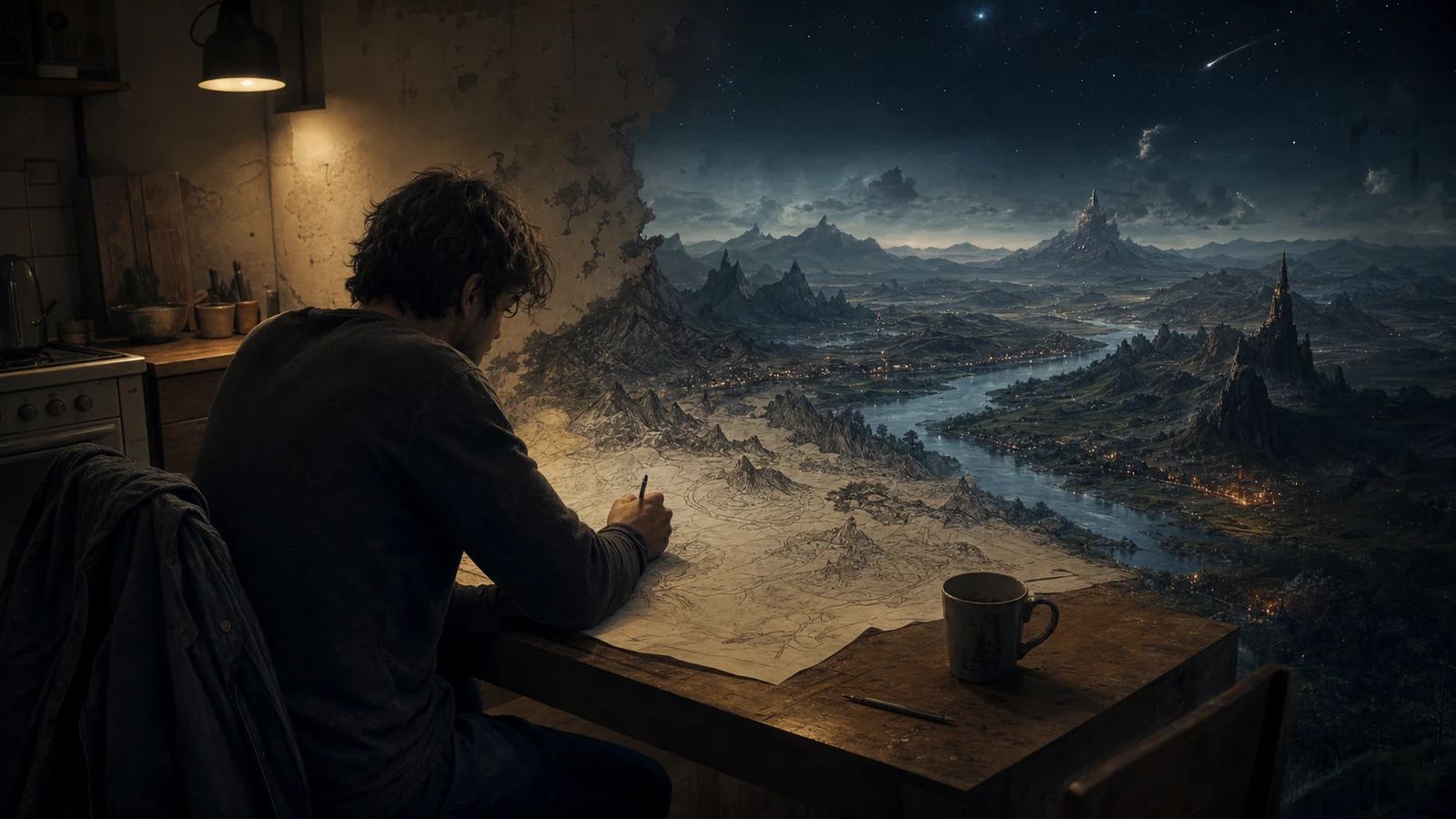
At nine, a child tapes two sheets of printer paper together and draws a river across the join. A city appears beside it. The city has a mayor who is afraid of birds, a bakery that opens at midnight, and a law against cutting down the blue trees. By dinner, the country has a border. By Friday, it has an argument with the island under the bed.
Years later, the map may turn up in a box with school reports and dead batteries. The paper world is gone, yet the act that made it is familiar. Adults do it with novels, game tables, sketchbooks, private notes, miniature cities, invented family histories, and maps drawn during meetings. We build imaginary worlds because a world lets an idea become a place where someone must live. Change the rules, and we can watch what those rules do to a morning, a friendship, a body, or a town.
Entering an existing fantasy world is one experience; making one is another. When Fantasy Takes the Place of the Real World follows immersion, refuge, and the risk of feeling more at home elsewhere. Here the hands stay on the paper. The question is why people keep giving unreal places weather, customs, distances, food, old grudges, and names.
The First Country May Fit Under a Table
Children rarely begin by announcing a theory of creation. A blanket becomes a roof. The strip between a sofa and a radiator becomes a dangerous pass. Two dolls belong to rival towns, and the rule that separates those towns is perfectly serious until someone is called for lunch.
Researchers use the word paracosm for an elaborate imaginary world that is revisited and developed over time. In two studies of children aged eight to twelve, researchers identified paracosms in 16.9 percent of one sample and 17.4 percent of another. Their descriptions included environments, inhabitants, and idiosyncratic details. Earlier retrospective reports described a real election followed by one in Bearland and an interest in language becoming a language for Possumbol.
Those numbers need their fences. The samples were modest and demographically narrow. Children with paracosms scored higher on a storytelling task, but not on every cognitive or creativity measure. Earlier work found worldplay in the childhoods of some highly creative adults without proving that one caused the other. A paper map under a bed is not a scholarship certificate.
The quieter finding is enough. Worldplay gives a child somewhere to organize curiosity. An interest in trains becomes a transport system. A quarrel becomes a border dispute. A rule can be invented, broken, repaired, and remembered the next day. The world holds the question still long enough to play with it.
A Question Becomes Weather
Some thoughts remain thin while they are phrased as opinions. What would a society without private property be like? What if names gave power? What if winter lasted a generation? A sentence can state each possibility. A world forces it to wake up in the morning.
If winter lasts twenty years, someone must store grain, mend boots, settle inheritance, and decide who receives the last dry room. If names carry power, lovers, judges, teachers, and enemies will handle introductions differently. The invented law enters kitchens and courts. It changes which mistakes are possible.
Philosophers discuss imagination as part of hypothetical thought: the mind can represent futures, alternatives, and counterfactual events. An imaginary world gives that capacity duration and resistance. The first idea is allowed to meet consequences the maker did not plan. A kingdom founded on perfect honesty may become gentle, or unbearable, or both. The world answers back.
This is why a strong invented place feels larger than an allegory with the labels rubbed off. It does not stand still as a code in which every tower equals pride and every forest equals fear. Rivers alter trade. A religious calendar interrupts work. A spell leaves a person tired during the conversation that follows. The question has acquired weather, and weather does not care how elegant the original thesis sounded.
Change One Law and Everything Moves
Worldmaking often begins with one impossible permission. The dead can speak once a year. Children inherit their parents' memories. Every oath becomes visible on the skin. Magic works only when the caster gives away something they intended to keep.
The pleasure lies partly in following the disturbance. A changed law pulls on every nearby custom. If the dead can testify, courts and funerals will change. If memory is inherited, privacy may begin before birth. If promises mark the body, powerful people will hire others to speak for them. The wonder becomes credible when it produces inconveniences, professions, evasions, and moral pressure.
Earthsea offers a clear example. True names make language an intimate relation with power; the rule shapes education, secrecy, responsibility, and the balance Ged repeatedly fails to respect. The fuller pattern appears in Earthsea's world of true names and balance. The rule matters because it enters character. It cannot be left behind in a glossary.
The maker also loses some control at this point. Once a river has a source and a city depends on it, moving the river may ruin the city. Once magic has a cost, a convenient rescue may become dishonest. Consistency is less like obedience to a handbook than keeping faith with lives that have begun to take shape.
Tolkien and the Labor of Sub-creation
Verlyn Flieger describes On Fairy-stories as Tolkien's central statement about what he called sub-creation: human language making a Secondary World. The term carries Tolkien's Christian understanding of a primary Creator and human beings who make because they themselves were made. That theology belongs to Tolkien; it should not be quietly presented as the universal explanation for every storyteller.
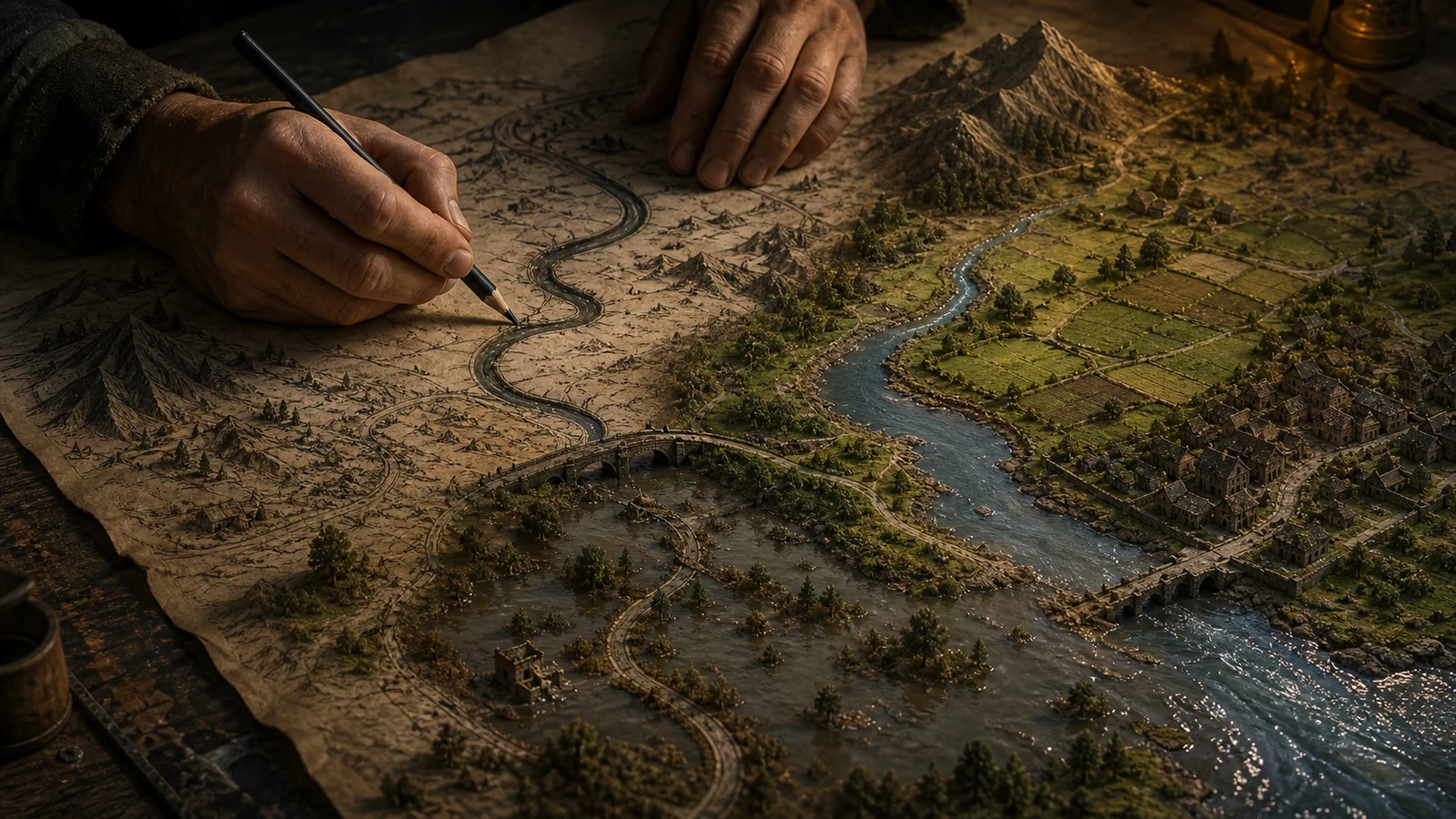
His practical insight reaches further. Words do not merely label a world after it exists. Language helps call the world into being. A name suggests a sound history. A sound history implies migration, kinship, conquest, borrowing, and loss. Tolkien's languages led toward peoples who could have spoken them, and those peoples required lands and a past.
The result is visible in the deep time of Middle-earth. A song recalls a place the current characters will never see. A ruined road points toward builders whose purposes have been forgotten. The reader receives fragments rather than a complete archive, but the fragments seem to belong to something whole.
Sub-creation is labor as well as enchantment. Dates must survive revision, and a mountain cannot wander when the plot needs a shortcut. Yet the labor serves a felt presence. A chronology matters when it lets a traveler stand beside a broken stone and sense that grief happened there before the story arrived.
The World Goes On Beyond the Plot
A story asks what happened. A world invites other questions. What grows beyond the northern road? Who minted the coin on the inn table? What song does the villain's grandmother know? The plot may never answer, and the unanswered space can still feel alive.
Mark J. P. Wolf argues that imaginary worlds deserve attention as entities that can extend across stories, media, and authors. A world may begin in a novel and continue through maps, games, illustrations, adaptations, invented reference books, and audience participation. Different stories become threads in a larger fabric.
This helps explain an odd attachment. Readers sometimes remember a minor harbor more clearly than a battle. Players spend an evening arranging a room that no quest requires. A writer works out the calendar of a province that appears in one paragraph. These details are not valuable simply because there are many of them. They imply that life continues outside the camera's view.
There is a tenderness in making more room than the plot needs. A worldbuilder invents festivals for people who may never meet the hero. Someone decides where old tools are repaired, how a widow inherits a shop, or why a village keeps an empty place at the winter table. The world stops behaving like a stage assembled for one important person.
Some Worlds Need More Than One Pair of Hands
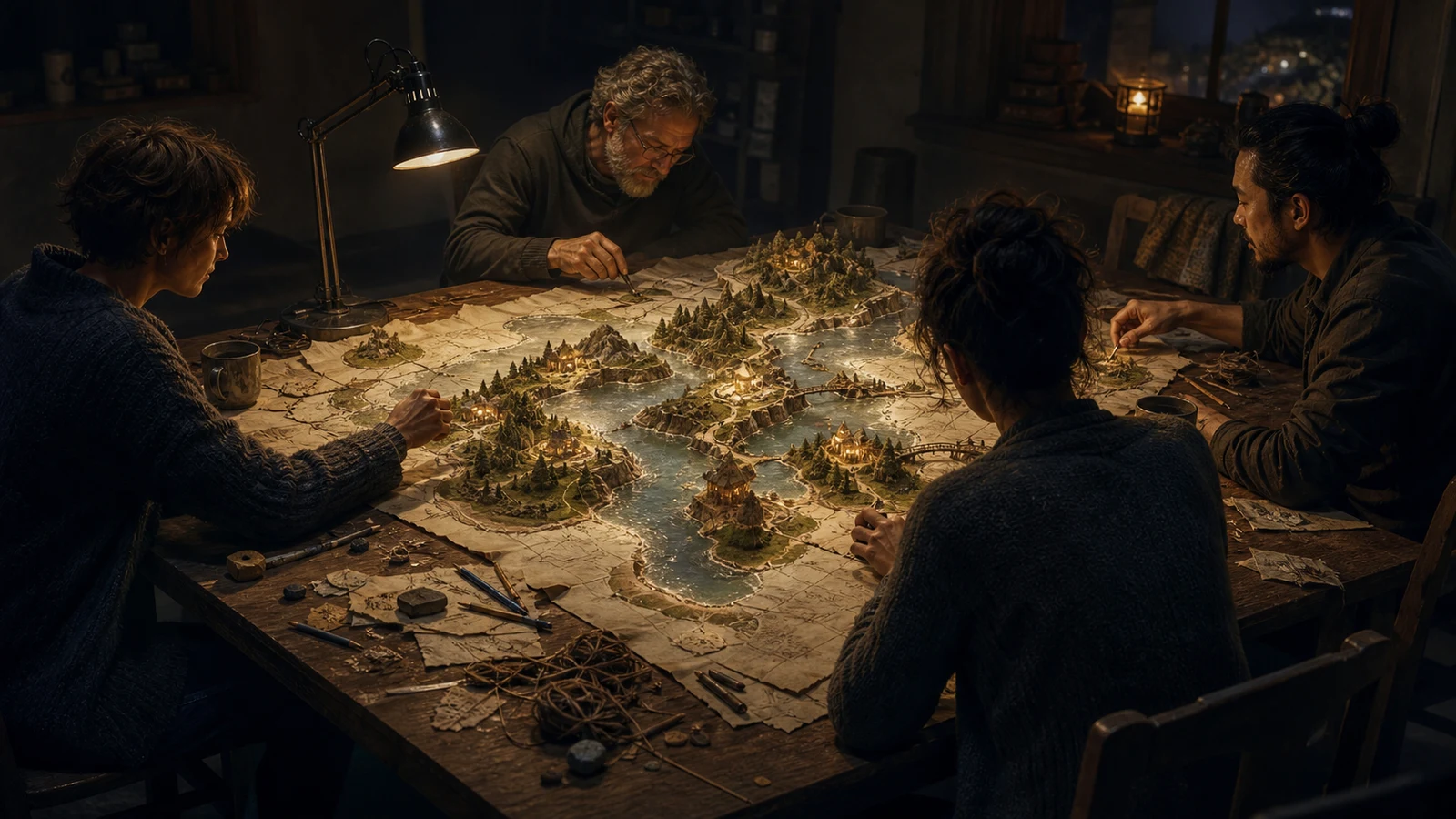
At a game table, one person describes a town and another asks whether the town has a bathhouse. Someone else remembers that the river flooded last session. A joke about a nameless guard becomes a family, a debt, and three years of shared history. No single participant owns everything that has happened.
Gary Alan Fine's study of early fantasy role-playing groups treated these games as social worlds. Players moved between ordinary conversation, rules, character performance, and a shared imagined situation. His fieldwork describes a particular hobby culture at a particular time; it is not a timeless portrait of everyone who rolls dice. It still makes one fact difficult to miss: an invented world can be a relationship.
Shared worlds require negotiation. One person's dramatic twist can erase something another person cared about. Rules distribute authority. Memory is uneven, so groups correct, reinterpret, and sometimes retcon their past. The world becomes a small public with customs of its own.
This form of creation changes the pleasure. Surprise can arrive from outside the maker's head. A road drawn by one person becomes sacred to a character played by another. A ruined tower receives a song no original plan contained. The world survives by becoming less private.
Who Is Allowed to Exist There?
An empty page appears free, but the imagination holding the pencil has a history. Familiar books, school lessons, films, maps, prejudice, desire, and omission all arrive before the first city. If every wise person in a new world has the same face, every distant culture exists as scenery, and every disabled body signals corruption, invention has carried old walls into new land.
Ursula K. Le Guin wrote angrily about the assumption that fantasy people are white, pseudo-medieval, and trapped in a simple battle between Good and Evil. Earthsea had brown-skinned peoples at its center, yet publishers repeatedly whitened them on covers. For readers who rarely found themselves inside the genre's imagined countries, presence was not a decorative issue.
Ebony Elizabeth Thomas examines how race shapes the fantastic and how young people use fanfiction and counter-storytelling to reimagine worlds that excluded or distorted them. The lesson is larger than adding a varied crowd behind the hero. Who is granted interior life? Whose fear sets the moral compass? Who gets magic without becoming a threat?
A created world reveals the maker's range of sympathy. It can repeat the hierarchy of the familiar world with prettier towers. It can also make room for lives the dominant story treated as impossible. Neither outcome happens automatically because dragons are present.
A World Can Become a Locked Room
Worldmaking has its own temptation: if enough facts are recorded, uncertainty might finally disappear. The creator adds dynasties, mineral tables, military ranks, moon phases, and seven thousand years of kings. The archive grows while nobody in it wants breakfast or fears tomorrow.
Coherence is valuable. Le Guin called inner consistency one of fantasy's chief ways of earning participation from the reader. She also warned against recycled assumptions and ideological purpose that flattens invention. A world can be consistent and still be dead. A prison is consistent too.
The locked world protects its maker from interruption. Every culture has one essence, history proves the present order inevitable, and outsiders exist to confirm the center. Characters discover what the lore already decided instead of exposing its cracks.
Living worlds contain disagreement and unfinished knowledge. A sacred account may matter without functioning as a neutral newspaper report. Maps can be wrong. Citizens may hate the official name of their own war. The creator does not surrender structure by allowing these fractures. The world gains people instead of entries.
The Impossible Still Needs Breakfast
After the dragon passes, someone replaces roof tiles. A gate guard's shift ends. The apprentice who spent all night learning a spell has to wash the ink from a borrowed shirt before work. Such moments are small, and they are where impossible laws touch a life.
This is different from demanding realism. A mountain may float and a forest may remember every trespass. The question is what follows. Does the floating mountain change pilgrimage, rain, mining, borders, or the price of rope? Do people ask the remembering forest to settle disputes, and can the forest lie?
The craft side of consequence is explored more fully in what makes a fantasy world believable. Here its human reason matters. We make worlds because abstraction is too clean. Justice sounds simple until a law must be applied to a hungry person. Immortality sounds glorious until one neighbor stops aging and everyone else does not.
Ordinary life prevents grandeur from becoming a poster. It gives the created world weight below the throne room. Bread, rent, fatigue, childcare, gossip, repair, and boredom are the places where a magnificent order proves what kind of order it is.
The Map Is Never Innocent
Put a capital at the center of a map and the edges become remote. Draw an empty wilderness and somebody's home may vanish. Name an age after one empire and other calendars become footnotes. Even an invented map makes arguments about importance.
This does not mean every hill conceals a message the creator can decode in advance. Choices still accumulate. Roads show expected movement, borders reveal who can close a gate, and monsters tend to live where a culture placed its fear. A map turns attention into geography.
The same is true of time. A world obsessed with fallen golden ages may teach its characters to distrust change. A world whose future is always decline can make cruelty look practical. Another world may preserve ancestral memory while admitting that ancestors were capable of harm.
Making these structures visible is one reason invented worlds matter. In ordinary life, institutions often feel like weather: present before us, too large to move, barely noticed until they fail. In a made world, someone had to decide how the storm works. We can follow that decision and ask who stays dry.
What We Bring Back
Winnicott's account of play offers one influential way to think about the space between private imagination and shared reality. His is a psychoanalytic framework, not a laboratory law that explains every child or artist. Its useful suggestion is that play and cultural experience happen in a space where inner life meets something outside it without either side simply swallowing the other.
An imaginary world occupies such a threshold. It is not physically there, yet it can be shared, revised, argued over, remembered, and handed to someone else. The builder knows the city is made of marks and sentences. For a while, those marks are treated seriously enough to resist careless decisions.
The return to ordinary life need not arrive as a moral. Perhaps the notebook closes because the bus has reached its stop. The invented city remains unfinished. Still, one assumption may now be visible: that borders could have been drawn differently, that power always writes a cost somewhere, that a person excluded from the old tale can stand at the center of a new one.
We build imaginary worlds because a lone idea cannot show us all its consequences. A world gives the idea neighbors, seasons, work, memory, and trouble. Then it waits to see whether anyone can live there. The map in the old box was never a plan for escape. It was a first attempt to ask reality for another draft.
Sources and Further Reading
- Verlyn Flieger on Tolkien's On Fairy-stories explains sub-creation, language, and the Secondary World within Tolkien's thought.
- Ursula K. Le Guin, “Plausibility Revisited” distinguishes fantasy's radical invention from external realism and emphasizes inner coherence.
- Ursula K. Le Guin, “Some Assumptions about Fantasy” examines race, recycled medieval settings, moral simplification, and imagination as an ethical instrument.
- Taylor et al., “Paracosms: The Imaginary Worlds of Middle Childhood” reports two studies of worldplay among children aged eight to twelve.
- Michele Root-Bernstein, “The Creation of Imaginary Worlds” considers worldplay as a self-chosen learning laboratory connecting play, plausibility, and problem-solving.
- Stanford Encyclopedia of Philosophy: “Imagination” surveys imagination, hypothetical thought, fiction, and counterfactual possibilities.
- Mark J. P. Wolf, Building Imaginary Worlds studies worlds that grow across narratives, media, and circles of authorship.
- Gary Alan Fine, Shared Fantasy is an ethnographic study of fantasy role-playing games as social worlds.
- Ebony Elizabeth Thomas, The Dark Fantastic examines race, imagination, exclusion, and counter-storytelling in popular fantasy.
- D. W. Winnicott, Playing and Reality presents an influential psychoanalytic account of play, creativity, and cultural experience.