Essays
The Feeling of Freedom in Fantasy: When the World Becomes Possible Again
Why entering an imaginary world can feel like breathing after too long in a room with a low ceiling.
Sometimes fantasy begins before the dragon, before the spell, before the old map on the table. It begins with a breath. Not a heroic breath, not the breath of someone ready to conquer a kingdom, but the first full breath after a long season of breathing only halfway. A person opens a book, enters a game, follows a film, writes a story, and suddenly the walls near the mind move back a little. The problems of life have not vanished. The body may still be tired. Bills, fear, grief, failure and responsibility have not stepped politely out of the room. But for a while the world is no longer only the thing that presses down.
That is the moment when fantasy gives a feeling of freedom. Not freedom as irresponsibility. Not freedom as forgetting everything. Freedom as the reopening of possibility. The mind leaves a low room and enters a field whose horizon has not yet been measured. In such a moment, fantasy does not tell us that reality does not matter. It tells us that reality is not the only possible shape a life can take.
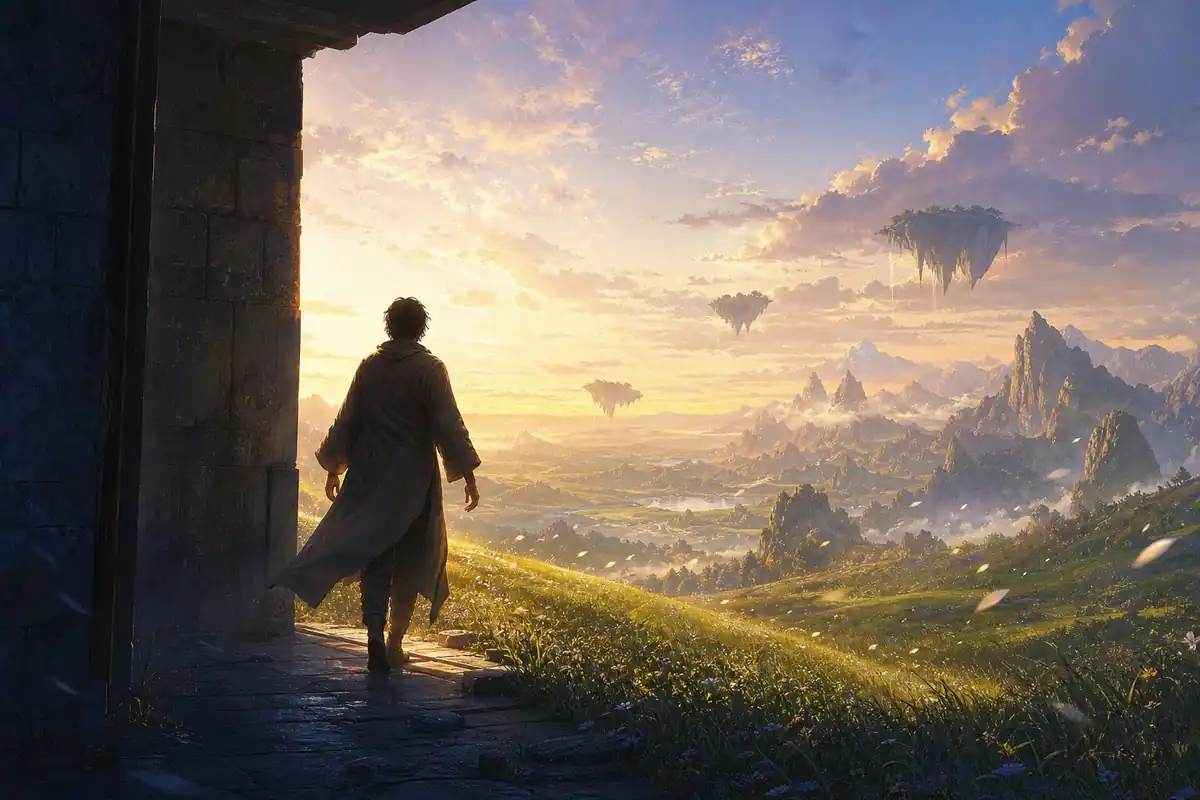
In When Fantasy Takes the Place of the Real World, we spoke about the mind seeking refuge in imaginary worlds. Here the question is brighter, though not simpler. We do not always enter fantasy to hide. Sometimes we enter it because something inside us has become compressed, and the invented world gives it room to unfold.
Freedom Means the Ceiling Is Lifted
Everyday life is not made only of hard things. It is also made of repetition: the hour, the route, the role, the answer expected of us, the tone we must use, the face we learn to wear so the day can continue. A person does not always live inside obvious prisons. Sometimes the prison is simply what everyone calls normal.
Fantasy enters precisely there. A door opens. A forgotten name is spoken. A forest appears at the end of an ordinary street. A small person discovers that the world is wider than the story they were handed. That widening is not only a narrative event. It is a psychological experience. The reader, player or viewer feels that perhaps they too are not only the role the everyday has made for them.
In real life we are constantly managed by limits. Be reasonable. Be useful. Be adult. Speak at the right volume. Keep imagination under control. Fit into shapes that may have been prepared before we arrived. Fantasy does not break every shape in order to worship chaos. It moves the shapes aside so we can ask which ones are necessary and which ones are only habits disguised as law.
Why Imaginary Worlds Can Feel Lighter
A fantasy world may be dark, violent or tragic and still feel lighter than the real world. That sounds strange until we notice one thing: in fantasy, meaning is often more visible. In real life, suffering is frequently shapeless. A person does not always know what they are fighting: anxiety, memory, loneliness, exhaustion, the future, the past, the quiet sense of not being enough. Fantasy gives these faceless pressures a body. Fear becomes a shadow. Power becomes a ring. Hope becomes a lamp in the forest. Choice becomes a road between two gates.
When pain has an image, the human being becomes a little freer. Not because the pain disappears, but because it can finally be faced. It is no longer only fog inside the chest. It has a contour. It can be named, approached, resisted, misunderstood, returned to. Fantasy is a language for making the invisible touchable. In What Is Fantasy?, we said that fantasy is not just the presence of magic. Here we can go further: one of magic's oldest tasks is to give form to pressures that ordinary language cannot hold.
That form brings relief. The mind moves from endurance into relation. It can relate to fear, to longing, to wounds, to hope. It can say: this is not all of me, but it is something in front of me.
Agency Is Returned to the Self
One of the deepest sources of freedom in fantasy is agency. In many imaginary worlds, characters face choices that are heavy but clear. The road is dangerous, but it is a road. The door is locked, but perhaps there is a key. The curse is cruel, but it has a pattern. The darkness is vast, but one can stand before it.
In life, we rarely receive such clarity. Often we cannot tell where the wound begins or which choice is truly ours. We stand between options that do not feel like freedom at all. Fantasy, even when it is not simple, gives us the experience of agency again: the feeling that I am not only reaction, not only the result of conditions, not only the thing that happened to me. I can still give meaning to a movement of my own.
Psychological theories such as self-determination theory speak about the human need for autonomy, competence and connection. Fantasy works with those needs in symbolic form. The hero must choose, learn, fail, find companions, and discover what is worth protecting. Watching a fictional character choose can awaken in us a quiet sense of movement. The choice is not ours in a literal way, and yet something in us remembers that choice is possible.
Fantasy Does Not Separate Us from the Body
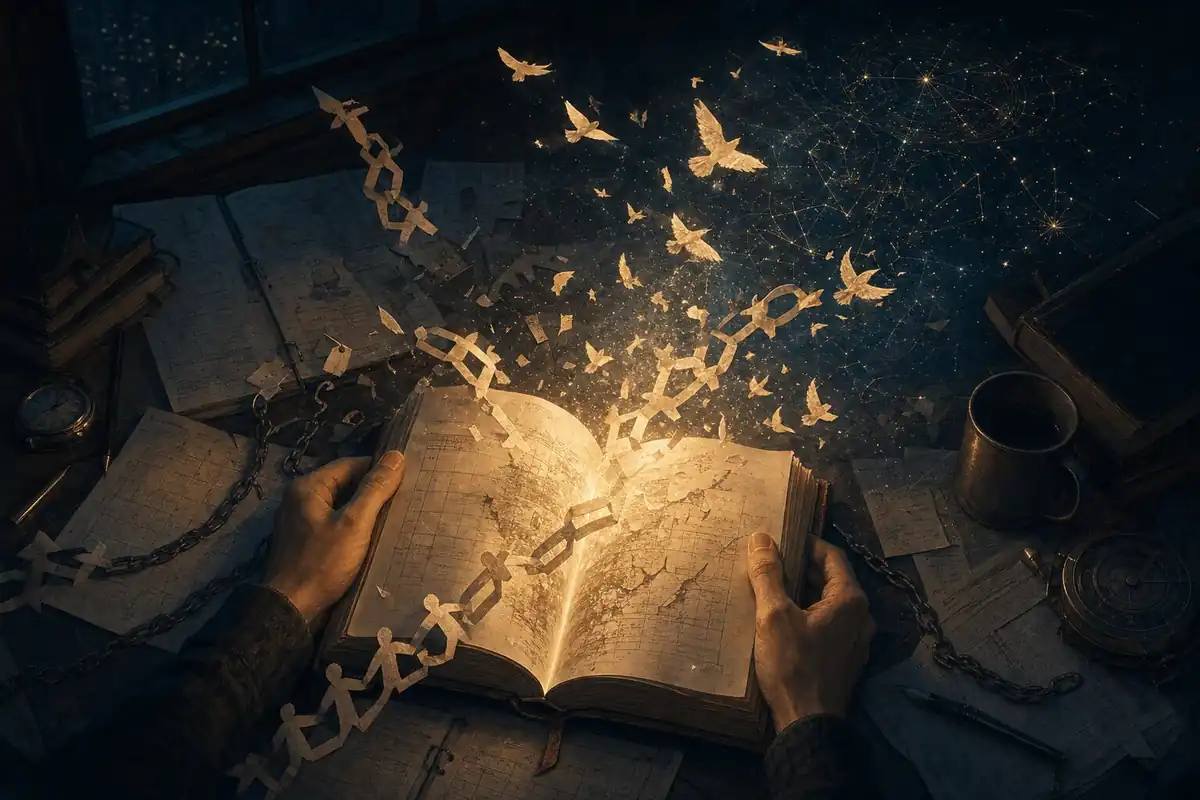
The freedom of fantasy is not only intellectual. The body often understands it first. When an orchestral theme rises, when a camera moves beyond a mountain and reveals an unknown city, when a game leads us out of a cave for the first time and the open plain appears, something physical changes. The shoulders lower. Breath changes. The eyes stop clinging to near things and find a horizon.
The horizon matters. Human beings grow tired without horizon. Not only without success, comfort or certainty, but without a sense that there is still an elsewhere. Fantasy gives the body a symbolic elsewhere. It offers wind where the room was stale. It gives scale where the day had become flat.
This does not mean fantasy is always gentle. Sometimes freedom arrives through terror, loss or battle. A dark forest can still free the mind if it proves that the world is not finished. A haunted kingdom can still feel like air if it carries depth, danger and meaning where daily life had become numb.
Escape Is Not Always Cowardice
Fantasy is often accused of escape. The accusation is sometimes fair. Any beautiful thing can become a way of refusing life. A story can become a locked room. A game can become a place where time disappears without returning anything to the person who entered. We should not romanticize every retreat.
But escape is not always cowardice. J. R. R. Tolkien famously defended escape by asking what kind of people are most hostile to it: jailers. The point is not that every escape is noble. The point is that escaping from a narrowing condition may be the first movement of sanity. A person trapped in a burning room should not be praised for staying loyal to the furniture.
The real question is not whether fantasy lets us leave. It is what happens when we return. Does fantasy make us more absent from life, or more awake inside it? Does it turn us away from responsibility, or does it restore the inner space without which responsibility becomes only exhaustion? Does it teach us to despise the real world, or to see which parts of the real world have left no room for possibility?
Fantasy should not occupy the place of life forever. Its deeper value is that it returns to life and wakes something there.
Immersion: When the Border Softens
Studies of narrative transportation describe how deeply engaged readers or viewers may enter a story through attention, feeling and mental imagery. This idea matters for fantasy because fantasy is rarely only a plot. It often builds an environment where the mind can live for a while. We do not merely understand what happened. We feel where we are.
When the border between "I am reading" and "I am there" softens, freedom becomes more possible. Not because real identity disappears, but because the rigid everyday version of the self loosens its grip. The person who must always be useful, quick, sensible, predictable or strong may become, for a while, a witness, a wanderer, an apprentice, a mage, a traveler, or someone whose name has not yet been found.
This change of role is not childish play in the shallow sense. It can be a way of meeting parts of ourselves that daily life has no room to receive.
Imaginary Worlds Borrow Courage for Us
Part of fantasy's liberation comes from the way an imaginary world lets danger be experienced at a bearable distance. We sit in relative safety, but we cross the gate with the character. We fear, choose, fail and rise with them. This does not replace real action, but it can keep the emotional language of action alive.
Sometimes a person has been so worn down by reality that even imagining movement becomes difficult. Fantasy can then offer a small force to the imagination: not a promise of victory, not a slogan about hope, only the image of someone taking one more step in the dark. Sometimes that image is enough to keep something in us from going silent.
This is why fantasy often lives near sadness. Its freedom is not always bright or loud. Sometimes it is quiet, like someone opening a window after a long cry.
Freedom from the Finality of the World
In Why Our Own World Is Fantasy, we spoke about the strangeness of reality itself. Here we can add one more thought: fantasy frees us because it breaks the false finality of the world. Everyday life acts as though everything has already been decided. You are this. Life is this. The future will follow this road. The world is only this large.
Fantasy suspends that verdict. It says perhaps a tree is not only a tree. Perhaps names have power. Perhaps borders contain cracks. Perhaps the small thing carries a destiny larger than anyone knows. These "perhaps" moments become shallow when they are careless, but when they are well made, they free the mind.
Human beings do not need answers only in order to live. They also need the right to ask again.
Return: Freedom Must Give Something Back
The best fantasies do not keep us forever. They change us and send us back. After a story ends, the room may still be the same room, but the gaze may have shifted. The street may still be crowded, but the sky may no longer feel completely empty. The problems may remain, but a person may sense that somewhere inside them there is a place not yet surrendered.
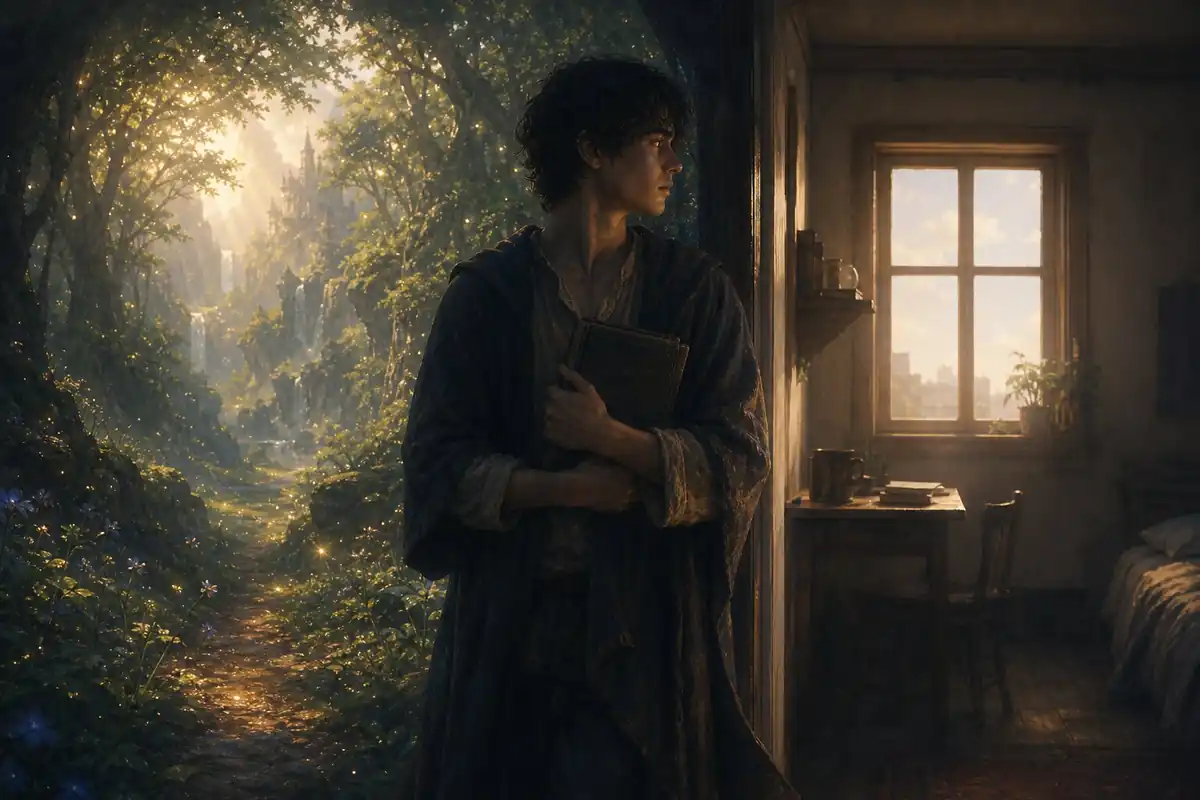
Return is part of liberation. If freedom were only departure, it could end in disappearance. But if departure renews the gaze, it can become a way of living more deeply. Fantasy is not at its best when it says abandon reality. At its best, it says do not read reality only in the language of fatigue.
Conclusion
The feeling of freedom in fantasy comes from the way imaginary worlds allow us to become spacious again. In them, fear receives a face, hope receives a shape, choice becomes meaningful, the horizon opens, and for a while the self steps out of the narrow roles of the ordinary. The experience may be fictional, but its effect is real.
We need fantasy not because reality is worthless, but because reality can become heavy under habit, pressure and facelessness. Fantasy opens a window. The air changes. And when we return, if we are fortunate, we have not merely come back from another world. We have come back with a freer part of ourselves.
Further Reading
- Tolkien Estate: On Fairy-Stories for Tolkien's discussion of escape, recovery and fantasy.
- Self-Determination Theory for autonomy, competence and relatedness as core human needs.
- Green & Brock: The Role of Transportation in the Persuasiveness of Public Narratives for narrative transportation.
- Stanford Encyclopedia of Philosophy: Imagination for imagination, possibility and mental experience.
- Encyclopaedia Britannica: Fantasy for a broad definition of fantasy as a narrative genre.