Essays
Fantasy Is Not Escape from Reality; It Is the Repair of Reality
Why imaginary worlds can become a way of returning to the real world with a deeper gaze.
One of the easiest accusations against fantasy is that it is escape from reality. The accusation sounds sensible at first. A person opens a book and is no longer in the room. They enter a game and walk through a country that never existed. They watch a film, and for two hours the body remains on a chair while the mind moves through forests, ruins, towers, spells and impossible skies. From the outside, the act looks like departure.
Sometimes it is. Fantasy can become a closed shelter. It can become a beautiful way of refusing the body, the unfinished conversation, the work, the grief, the apology, the responsibility waiting outside the page. Any powerful inner world can become a room with no door back.
But that is not the whole truth. If fantasy were only refusal, human beings would not keep returning to it across ages, languages and cultures. We do not come back merely because we want to see less. Often we come back because we want to see better. The mind sometimes has to step away from reality to understand the shape of what reality has done to it. A person leaves the room not to deny the room, but to understand why breathing there had become so difficult.
At Fantasya, fantasy is not treated as the enemy of reality or as a simple substitute for it. Fantasy can be a workshop for repairing reality: a place where faceless pressures receive form, suffering receives language, hope receives an image, and the human being returns with some part of the self still refusing to surrender.
This essay continues several earlier paths. In Why Our Own World Is Fantasy, we looked at the strangeness of reality itself. In When Fantasy Takes the Place of the Real World, we asked why the mind seeks refuge in other worlds. In The Feeling of Freedom in Fantasy, we saw how imaginary worlds can lift the low ceiling of everyday life. Here the next question is sharper: if fantasy sometimes saves us, perhaps it does so not by taking reality away, but by repairing the way reality can be seen.
Why the Charge of Escape Feels So Easy
The charge of escape feels easy because fantasy visibly resembles leaving. The reader is not where they were. The player is not only in the city where their body sits. The viewer gives attention to a kingdom, a curse, a war or a wounded world that has no legal address in ordinary life.
Yet not every leaving is betrayal. Distance is not always weakness. A doctor may need to uncover a wound to see it. A painter steps back from a canvas to understand the whole image. Human beings also need distance from reality when reality has become too close to be seen. When life presses directly against the face, we stop perceiving it. We merely endure it.
Fantasy, at its best, creates a distance for recognition. Not distance for irresponsibility, but distance for diagnosis. It says: look at this fear; look at this desire; look at power, death, loneliness, delayed justice, fragile hope. Bring them out of fog. When something is seen, it is not yet solved, but it is no longer nameless.
Reality Is Not Always Digestible as Raw Experience
This sentence needs care. It does not mean reality is bad and fantasy is good. It means raw reality is not always digestible for the human mind. Life happens, but meaning does not always arrive with it. A person suffers, yet suffering may have no shape. Someone dies, but absence is not an object we can set on a table and say: here it is. We fear the future, but the future has not yet come close enough to answer. We live under power, but power rarely wears a dark crown.
Fantasy gives form to this facelessness. Evil can become a dragon. Temptation can become a ring. Corruption can become a city in decline. Hope can become a lamp in the forest. Suffering can become a long road whose steps carry meaning, even when the road remains painful.
This transformation does not make reality simple. It makes reality visible. In ordinary life many forces are scattered, nameless and diffuse. In fantasy those forces may receive a body, a voice, a history and a place. The human being then moves a little out of paralysis, because what has shape can be approached.
When the Wound Receives an Image
One of fantasy's deepest tasks is turning the wound into an image. This should not be confused with simplification. If a story says suffering is only a monster and the monster merely needs to be killed, the work remains shallow. Human pain is usually more complex than an external enemy. But fantasy can create a space in which pain becomes encounterable without being reduced.
Imagine a fear that has lived in the body for years. In a fantasy story, it may become a forest the character must cross. The forest is not only a metaphor. It is an environment where fear can be experienced. It has darkness, sounds, false paths and perhaps a distant light. The audience understands that fear rarely disappears because someone gives the right advice. It must be entered, misread, endured, returned from, and sometimes carried differently.
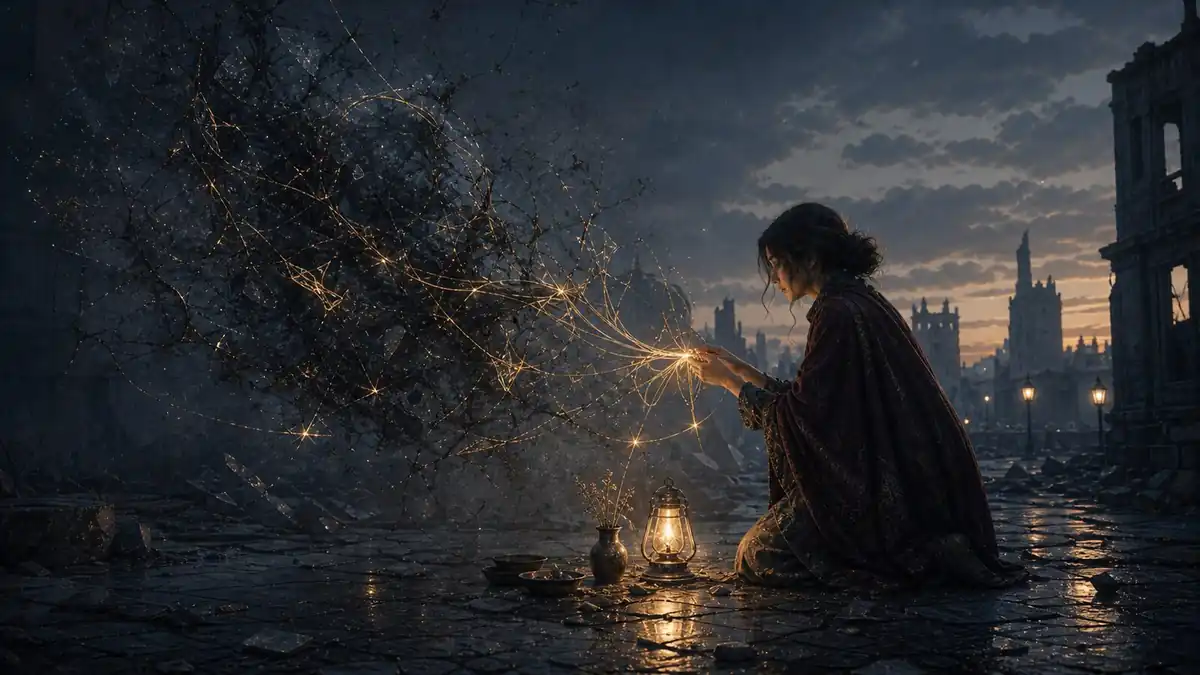
This is where fantasy approaches repair. Repair does not mean destroying pain. It means forming a new relation to it. Something that was only pressure begins to acquire language. Perhaps grief cannot be defeated, but it can be known. We can learn where it begins, what it is trying to protect, and why it still lives inside us.
Repair Is Not Denial
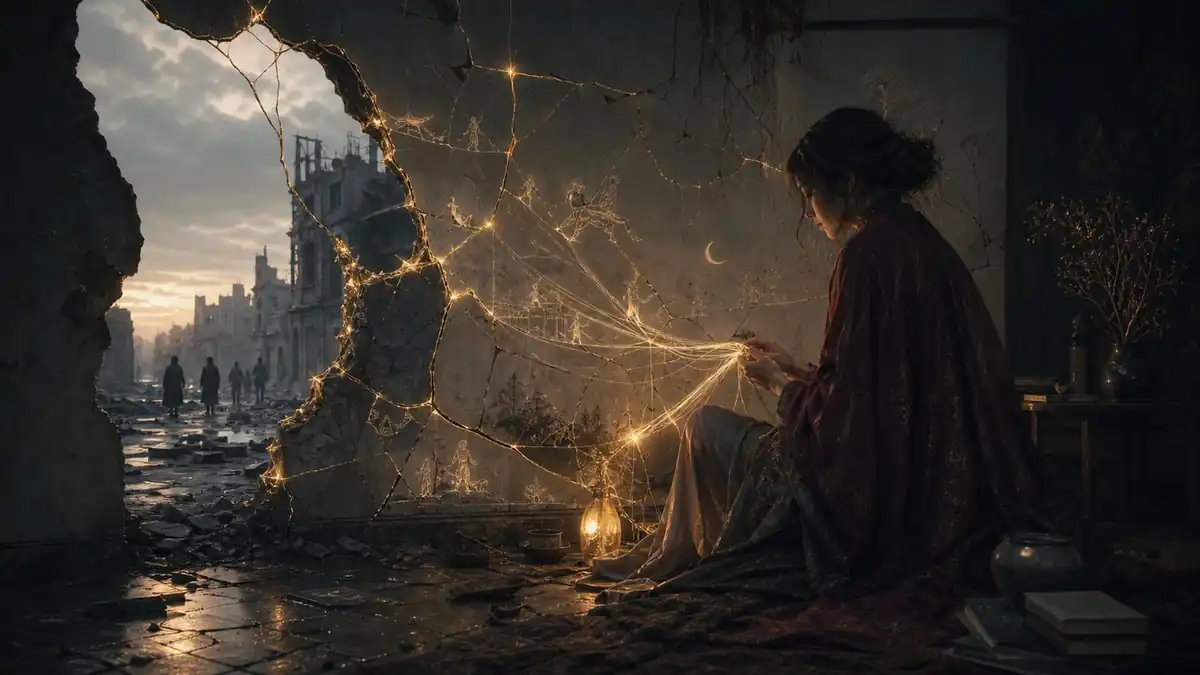
Repair is different from denial. Denial says the crack is not there. Repair says the crack is real, but it will not be allowed to become the only definition of the wall. Denial wants to erase the world with raw wishing. Repair wants to make the world habitable again through meaning, attention and relation.
Weak fantasy removes reality. Strong fantasy returns reality from a different angle. A good imaginary world does not carry us away from life in order to keep us forever. It carries us outside the blind habits of life so that, on return, we may notice what daily pressure had made invisible.
Tolkien's defense of fairy-stories famously includes the idea of recovery: regaining a clear view of things that have become invisible through familiarity. That is central to Fantasya's understanding of the genre. Fantasy is not only the invention of strange things. Sometimes it makes familiar things strange again: the room, the tree, death, bread, friendship, the road, the home, the name. When these are freed from habit, they regain weight.
Fantasy Repairs Justice Without Promising Easy Happy Endings
One of reality's wounds is that justice does not always arrive on time. Sometimes it does not arrive at all. The real world is full of faceless evils: systems, silences, fears, small decisions, forms of power that wear no crown. Facing such forces, a person may feel handless. Where is the enemy? Which road is the road? Does standing still matter? Does resistance matter?
Fantasy can turn the hunger for justice into an image: a sword, a tribunal of kings, a curse broken, a fortress falling, a hidden flame preserved in darkness. Mature fantasy knows that justice is not simple. Victory may cost something. The hero may lose what cannot be returned. The curse may break, but the wound left by it may remain.
This is not childish justice. It does not promise that everything will be made right. It says that the desire for things to be made right is not meaningless. Even when reality does not answer, fantasy can keep that desire from going numb. In a world where injustice can make the heart cold, keeping the desire for justice alive is already a form of repair.
Fantasy Rescues Hope from Slogan
Hope becomes thin when it is spoken too easily. "Everything will be fine" may not help; sometimes it feels cruel, because many things do not become fine, or become fine only through time, loss and cost. Fantasy rescues hope from this flatness by giving it a body.
Hope can become the last lantern in a besieged city. A hand reaching in the moment of falling. A seed growing in cursed soil. These images do not make hope easy. They make it bearable. Hope is no longer a sentence printed on a wall. It is something inside the story that resists.
That is why even dark fantasy, when it is made honestly, is not necessarily hopeless. Sometimes its darkness exists so that a small light can become serious. Hope in a harmless world may be decoration. Hope in a wounded world has weight.
Where Fantasy Becomes Dangerous
If we defend fantasy, we should not hide its danger. Fantasy can become a room without return. It can become endless consumption of invented worlds: this game, that series, another book, another realm, without anything in real life being touched. In that form, fantasy is not repair. It is beautiful numbness.
The boundary matters: after fantasy ends, does it give anything back to our gaze? Does it make us more sensitive to the suffering of others? Does it lend language to our fears? Does it awaken a desire to build, choose, love, apologize, endure or continue? Or does it carry us farther from everything until the real world feels less worthy of attention?
There is no simple answer. The same work may be a window for one person and a wall for another. The issue is not fantasy alone, but our relation to it. Fantasy repairs when it makes return more possible, not less.
Return Is the Forgotten Part of the Journey
In many fantasy narratives, the hero does not only depart. The hero returns. Return is not always triumphant. Sometimes it is quiet. Sometimes the one who returns has nothing to show except a changed gaze. The home is still the home, but not entirely. The world is still the world, but its cracks are no longer only signs of ruin. They may also be places where light passes through.
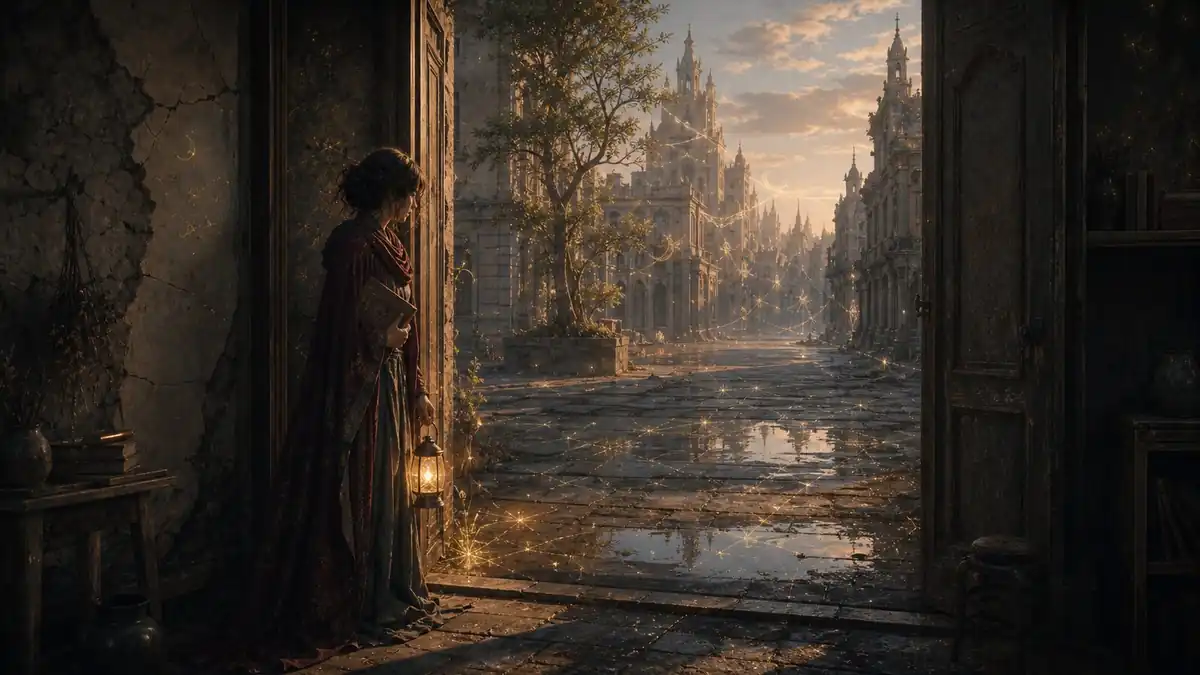
Return matters because it reveals that fantasy's purpose is not the erasure of life. The best imaginary worlds do not swallow us forever. They alter us and send us back. After the return, we may still need to work, apologize, care, decide, mourn or continue. But perhaps fatigue is no longer the only instrument we possess.
At its best, fantasy does not change the real world directly. It changes us enough that the real world can be seen, endured and sometimes built again.
Conclusion
Fantasy is escape from reality only when we use it merely to avoid seeing. In its deeper form, fantasy creates distance for vision. It gives suffering an image, fear a face, hope an experience, justice a language, and the self a way out from beneath the low ceiling of habit.
This repair is not instant magic. Fantasy will not pay the bills, remove grief or make the world just. But it can repair something in the gaze: the ability to perceive possibility when reality has become narrow. Perhaps this is why human beings cannot live reality fully without fantasy. Not because reality is worthless, but because reality must be seen again and again by creatures who need meaning.
The threshold of this question opens again in The First Gate.
For a quieter meditation on fragile hope, continue with We Are Flickers of Light Afraid of Storms.
Further Reading
- Tolkien Estate: On Fairy-Stories for recovery, escape and consolation in Tolkien's defense of fantasy.
- Self-Determination Theory for autonomy, competence and relatedness as human needs.
- Green & Brock: Narrative Transportation for absorption into narrative worlds.
- Stanford Encyclopedia of Philosophy: Imagination for imagination, possibility and mental experience.
- Encyclopaedia Britannica: Fantasy for a broad definition of fantasy as a narrative genre.