Essays
Why Is Fantasy Still Waiting for a King?
The broken sword is reforged and the lost heir returns—but behind the dream of the rightful ruler lies an older question about legitimacy, responsibility, and repairing a world.
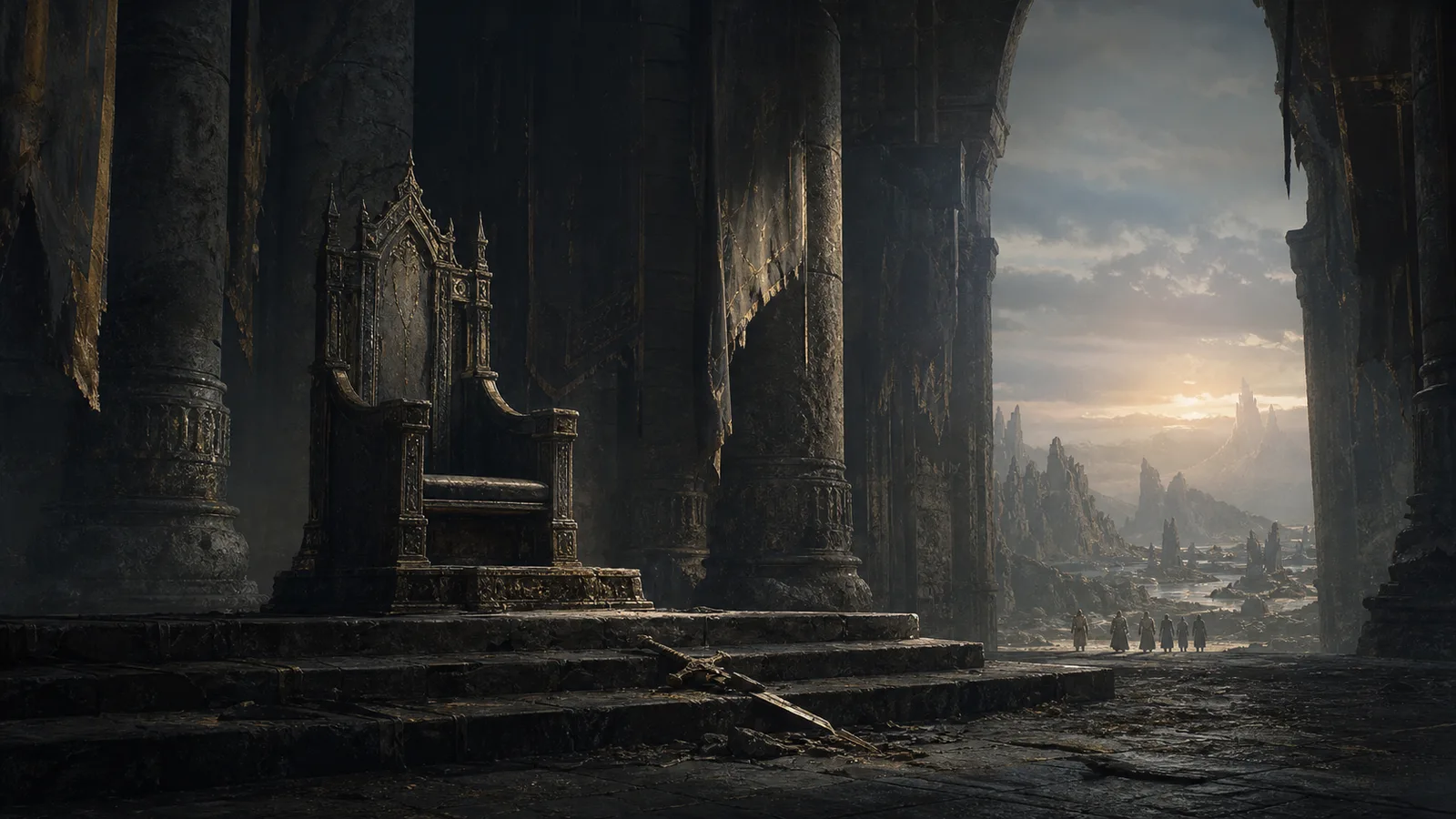
Imagine a ruined hall. The throne still stands, but no one sits upon it. The banners have rotted, a broken sword lies across the steps, and beyond the walls the roads no longer meet. Then a name is heard from far away: the heir lives. Those images awaken one of fantasy's oldest hopes. We distrust inherited power in life; why does the rightful king's return still make something in us rise?
Fantasy does not necessarily dream of restoring monarchy. In many of these stories, the rightful king gives human form to a more difficult desire: that power, worth, responsibility, and the memory of a world might meet again. The crown promises someone who must leave their name beneath every decision and treat the land's wound as their own. Yet the promise is dangerous. Once blood, goodness, and the right to rule become the same thing, ordinary people can become distant spectators at a coronation.
A Crown in an Age of Distrust
Much of epic fantasy builds a world in the image of the past: castles, houses, oaths, banners, and dynasties. Its reader, however, is usually a modern citizen, for whom legitimacy should be divided among law, public consent, institutions, and accountability. Still, a sword reforged or a ruler returning from exile can stir a hope too immediate to dismiss.
We should not resolve this tension with a simple psychological verdict. To care about Aragorn's return does not mean secretly longing to obey a dynasty. Fantasy turns politics into images. What is scattered through law, administration, history, and dispute in the real world can be gathered into one empty crown. Before we judge a form of government, we see the absence at the center.
Fantasy's King Did Not Step Straight Out of History
Fantasy's castles and crowns are not photographs of the Middle Ages. Oxford research on fantasy and medievalism, with Dimitra Fimi's work on the past as an imaginary world, traces an imagined past made from romance, legend, later revivals, and modern retellings. The fantasy king is less a historical reconstruction than the literary heir to centuries of desire, fear, and revision.
Medieval kingship itself was hardly the seamless machine of absolute rule that sometimes occupies the background of fantasy. Cambridge research on kingship, law, and counsel examines questions that belonged to the historical debate itself: inheritance against election, the king's relation to law, the right of resistance, deposition, and the role of counsel. “The blood spoke, and everyone obeyed” is a narrative shortcut, not a faithful summary of the past.
In Fantasy, Legitimacy Must Be Visible
Real power often has an indistinct face. A decision is made, yet responsibility dissolves among committees, regulations, and “circumstances.” Legitimacy cannot be placed on a table and pointed to. Fantasy gives it a body: a sword only its owner can draw from stone, a wound quieted by the true ruler's hand, a mark revealing the forgotten house.
In such worlds, magic gives politics a clarity reality withholds. A dispute over sovereignty may end when a blade gives light or an ancient name is recognized. The same force explored in When Metaphor Becomes Real—where invisible meanings become laws of the world—makes “right” visible here. That is the pattern's beauty. It is also its danger. What can be seen begins to feel more certain than what ought to be argued, tested, and consented to.
The Wounded Land and the Absent Ruler
In parts of the Grail-romance tradition, the Fisher King's wound is bound to the ruin of his realm. This is no universal law of history, but a powerful narrative invention: a private injury becomes weather, field, and river. The world declares that public catastrophe has an owner.
For anyone who has watched a river poisoned, a village abandoned, or a war end without anyone accepting responsibility for the ruin, the image offers a severe consolation. If the land's wound is tied to the ruler's, healing can at least be imagined. The broken divinity of Elden Ring's Lands Between gives this desire a darker form: when sacred order shatters, geography cannot remain innocent.
The Lost Heir as the World's Living Memory
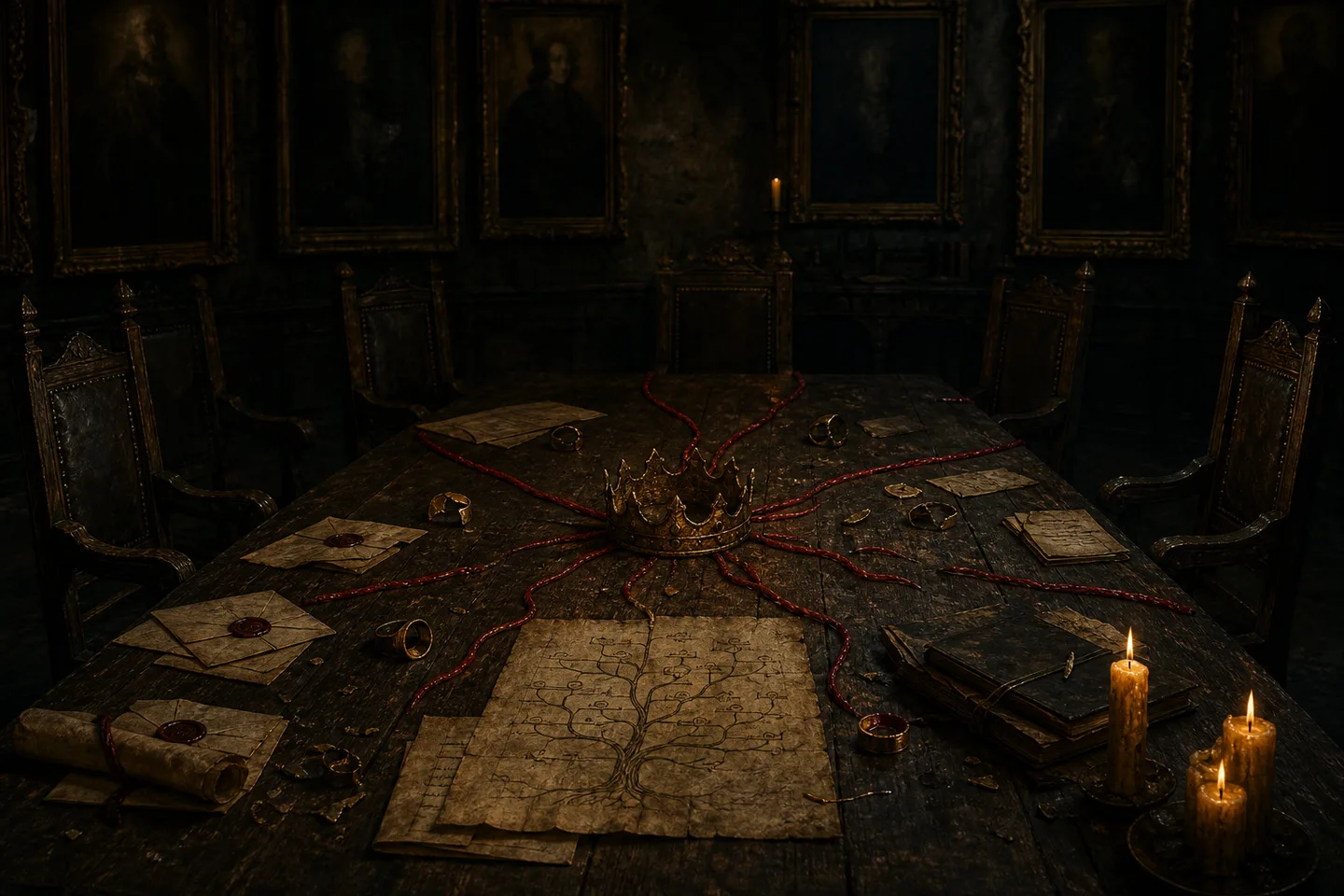
In her discussion of restoring the rightful heir in romance, Helen Cooper shows that the hidden child, unknown lineage, and distance between present identity and future inheritance long predate today's fantasy novels. With one movement, the pattern resolves two disorders: the hero discovers who they are, and society discovers who might bring its chaos to an end.
The lost heir is more than proof in a genealogy. Their survival says that history has not been severed completely. The fortress burned and its names were forbidden, yet a child lived; someone remembers the old lullaby; the other half of the sword is found. In the deep time of Middle-earth, lineage matters because the past feels like stone beneath the present. The heir's return makes continuity possible again—not proof that the old world was just, but evidence that the world still remembers.
Arthur: Justice Exiled to the Future
Arthur is one of the most enduring shapes of this expectation, though his legend has never been one consistent story. Writers have made him warrior, sovereign, failure, near-saint, and returning danger. In Layamon's account of the death of Arthur, the wounded king goes to Avalon to be healed, leaving the hope of his return alive.
The power of the image does not lie in a government working well now. The waiting Arthur is a promise repeatedly postponed until tomorrow: one day the lost union of justice and splendor will come back. The legend's sorrow grows from that distance. If he has not returned, perhaps the world is still unworthy of him. Or perhaps no future can truly restore the imagined past. The throne remains empty, and every generation sees in it a new likeness of its own absent king.
Aragorn Before the Throne
In his letter to Milton Waldman, Tolkien describes the epic's ending as the return of the rightful king. Yet that same grand design insists upon the incalculable deeds of small and forgotten people. Aragorn does not save the world alone. His return would be impossible without Frodo, Sam, Rohan, Gondor, and those whose names receive fewer lines in the songs.
His descent is not the only reason he can be accepted. Long before the coronation, he travels, watches over the defenseless, bears danger, commands when needed, and shows no hunger to seize power too soon. Research on councils and kings in Tolkien's world likewise shows that rule there cannot be reduced to an uncontested line of blood. Aragorn's ancestry opens the door, but conduct must carry him across its threshold.
The King's Hands Must Heal
One of Aragorn's most beautiful signs is not his sword, but his healing hands. Before the rightful ruler wears the crown, he is found among the wounded in the Houses of Healing. Authority is not proved there by the ability to impose a will. The right to rule must be able to recognize those whose bodies the war has crossed.
This also helps explain why The Lord of the Rings still feels like a world. A crown has no meaning in a void; its dignity comes from a relationship with memory, land, and people. Yet the image is not a complete political answer. One person's kindness and courage matter, but private virtue alone cannot tell us how law, succession, and restraint will endure after that person dies.
Narnia and the Return of the Right Season
In The Lion, the Witch and the Wardrobe, Aslan's return, the end of winter, and the children's coronation arrive as parts of one great movement. Michael Ward's analysis of Jupiter and Narnian kingship shows how images of feasting, thrones, Christmas, and recovered order shape the atmosphere of the book. The coronation feels less like reforming an office than the coming of spring.
This rule cannot be carried untouched into real politics. Aslan's kingship belongs to Narnia's religious cosmos, while the children's crowns are moral obligations rather than prizes. Edmund becomes “the Just” after betrayal and forgiveness. His justice does not arise from innocence, but from knowing his own fall. Narnia's doorway into moral wonder follows the same bond between enchantment, responsibility, and return.
Perhaps We Are Not Looking to Obey
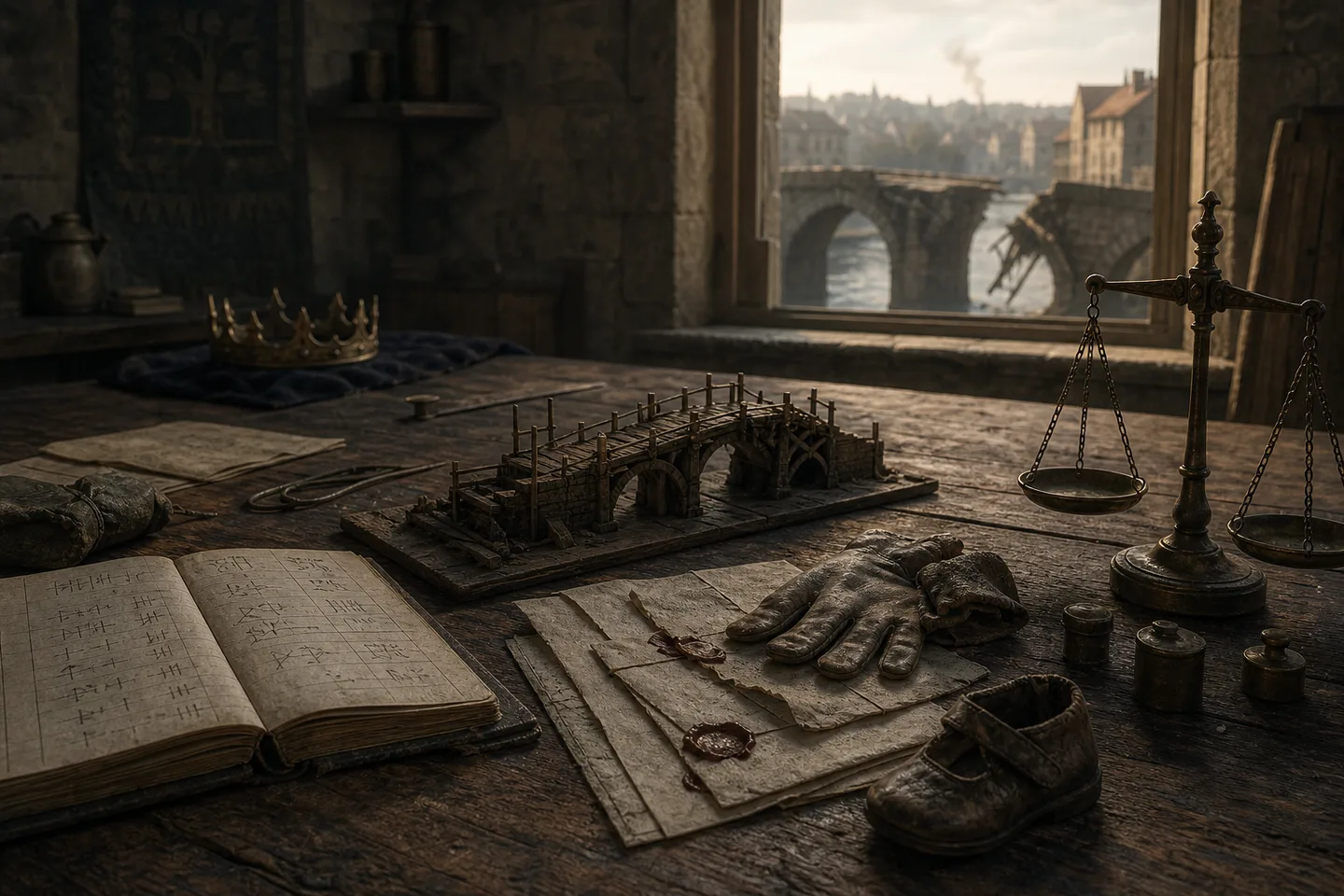
In ordinary life, someone often holds power while no one holds responsibility. A letter travels through several rooms. A decision changes a family's life, but its signature belongs to a system. A bridge falls, and every official points elsewhere. Against this diffusion, the legendary king has a body and a name. He cannot disappear behind the mechanism.
Perhaps the crown's attraction does not begin in a wish to submit. Perhaps it begins in the desire for someone who cannot say, when everything fails, “It was not my concern.” The crown's splendor comes from gold and distance, but its weight is painfully earthly: your name stands beneath the burned harvest, the soldier without a hand, the hungry child, and the covenant that was broken. Promises that become heavier than life draw their force from the same place. Responsibility becomes real when the road of escape has closed.
The Dream of Goodness and Power Made One
Yet good power and a good human being are different things. The story of the rightful king can briefly erase the distance between them. It can suggest that once the worthy person is found, structure ceases to matter. Descent, virtue, and victory fall upon one another; whoever wins the crown appears to have proved, by winning, that it was always theirs.
Here consolation approaches deception. An honorable person may be poorly informed, choose the wrong advisers, or build an institution that becomes a weapon for a worse successor. The historical theory of the King's Two Bodies describes the sovereign's mortal body as distinct from the “body politic” and the office's continuity. Fantasy sometimes binds them together again, fastening a world's health to one person. The image is magnificent. It is also brittle.
The People Below the Tower
A coronation is seen from the top of the stairs: trumpets, light, banners, and resonant names. Lower the gaze, and other things appear. A farmer whose field both armies crossed. A woman who does not know which claimant took her husband to war. A child learning the color of the new banner because it may reveal which gate the soldiers will use this time.
For these people, the difference between two genealogies is not always as clear as it seems in the council chamber. The rightful ruler's return may truly bring peace. But if the story sees only the arrival, it turns the suffering along the way into scenery for an epic. The price of power in Game of Thrones looks upward at the throne from this ground.
Westeros and the War of Incompatible Claims
A Song of Ice and Fire does not discard the legend of the rightful heir. It breaks the legend into competing pieces. Stannis appeals to the law of succession, Renly to alliance and practical strength, Robb becomes a king through the acclaim of northern lords, and Daenerys treats the restoration of a deposed dynasty as her right. Joffrey and Tommen possess the outward legality of descent, while that very descent is the heart of the crisis. Each claimant has a story that can sound convincing to those who follow them.
In the world of A Song of Ice and Fire, blood, law, conquest, acceptance, and dynastic memory operate at once and contradict one another. Right is no longer a magical object waiting to be found. The crown changes from an answer into a question—and may become the reason catastrophe lasts.
Blood Is the Shortest Answer, Not the Fullest
Blood is narratively efficient. It tells us where someone came from, what was stolen, and why an enemy fears their survival. A secret birth can resolve identity and political disorder at once. This is why the hidden heir returns so often beside the chosen one and fantasy's other heroic forms.
But being chosen to save is not the same as being entitled to rule. The strength to kill a dragon, endure a curse, or carry an ancient name does not automatically grant the right to decide how others must live. Blood is the shortest answer to a crisis of legitimacy because consent, law, and institutions need not be placed upon the stage. It is not the fullest answer. Sometimes it silences the question before anyone has truly heard it.
Rule Begins After the Story Ends
On his official site, George R. R. Martin points readers to a Rolling Stone interview about the questions that follow victory, including his famous challenge about Aragorn's tax policy and the difficulty of governing. The point is not that fantasy should replace wonder with bookkeeping. The deeper question is how a good intention becomes a good decision.
After the coronation, grain must reach a besieged city. A bridge destroyed in war must be rebuilt. Victorious soldiers must be disarmed. Taxes, famine, courts, and succession do not vanish when the final music rises. In Macmillan's description of The Goblin Emperor, an unwilling heir enters a court where the crown's splendor gives way to the hard work of trust, listening, and survival. Government is the scene after the epic.
The Heir Who Refuses the Crown
Carrot, in Terry Pratchett's City Watch novels, bears many of the signs of a rightful heir, yet his moral force appears most clearly in his refusal to claim the crown. He remains in the Watch and serves a law that is not meant to become an extension of his private will. University of Canterbury research on Pratchett's subversion of fantasy motifs places this play with ancient patterns within the wider design of his satire.
The inversion does not merely mock the myth. It reveals the question hidden within it. If someone is truly worthy of power, should they build a world capable of working without them? Perhaps the purest sign of legitimacy is the refusal to become the answer to every question.
Worlds Without a Crowned Savior
Fantasy does not always travel toward deliverance by way of a throne. Some works distribute survival among a group of people, a community, forgotten knowledge, or a network of responsibilities. The Fifth Season presents a crisis larger than any single usurper. The official Little, Brown introduction likewise places civilizational ruin and human survival at the center, rather than the discovery of the correct royal blood.
Other works transform Arthur's return from a wish into a threat. Once & Future from BOOM! Studios imagines how a national myth, torn out of history and made an instrument of present power, might release the monster meant to save us. Fantasy's grandeur does not depend upon a throne.
The Return of the King, If Responsibility Returns with Him
Still, removing the crown does not tell the whole truth. In the finest versions, the king is not worthy because he stands above others; he must prove unable to turn from their suffering. Legitimacy is not gained once at a coronation and preserved forever in blood. It is made again each morning—in hearing bad news, limiting oneself, and accepting consequences.
Research from the University of Technology Sydney on monarchy in epic fantasy shows how centrally this pattern occupies the genre's political imagination. Its persistence, however, does not mean that the question has been answered. Perhaps this is one of fantasy's great powers: it gives a body to the impossible hope that power and responsibility can become one, then allows the created world to reveal what that hope costs.
Perhaps We Are Not Waiting for One Person
Return to the ruined hall. The throne is empty, the broken sword still on the steps. We may want someone to speak their true name, lift the blade, and restore everything to its place. The story may make that moment glorious. Some wounds really do require the return of responsibility.
But no good body can forever take the place of law, collective memory, consent, and the power to hold a ruler to account. No crown can promise that the hand which heals today will not give an unjust order tomorrow, or that the next heir will bear the same burden. At the deepest layer of the legend, perhaps we are not waiting for a king. We are waiting for a world in which power can be seen again, judged again, and made to answer for what it has done.
That is the crown's enduring sorrow. For one moment, it promises that a single human being can complete the bond. Then the story ends, and the throne—with all its beauty and all its danger—passes to the next generation.
Sources and Further Reading
- Fantasy, Medievalism and Oxford English
- Dimitra Fimi: The Past as an Imaginary World
- Helen Cooper: Restoring the Rightful Heir
- Cambridge: Kingship, Law and Counsel
- Cambridge: The King's Two Bodies
- Oxford Research Archive: Divine Right in the Early Modern Period
- Layamon: The Death of Arthur
- Tolkien's Letter to Milton Waldman
- Ford and Reid: Councils and Kings
- Michael Ward: Jupiter and Narnian Kingship
- George R. R. Martin: Rolling Stone Interview
- Shiloh Carroll: Medievalism in A Song of Ice and Fire
- University of Canterbury: Pratchett's Subversion of Fantasy Motifs
- BOOM! Studios: Once & Future
- Macmillan: The Goblin Emperor
- Little, Brown: The Fifth Season
- University of Technology Sydney: Monarchy in Epic Fantasy Fiction