Worlds
The Lands Between: A World Built from Ruin, Death, and Broken Divinity
A reading of Elden Ring’s world as a sacred landscape after collapse: the Golden Order, stolen death, wounded demigods, holy architecture, rot, stars, and the terrible beauty of a realm that keeps breathing after its gods fail.
The Lands Between feels sacred before it feels safe. That is the first wound the world gives the reader or player. The horizon is enormous, the sky is full of ruined gold, towers still reach upward with the confidence of old worship, and yet almost every beautiful thing seems damaged by the very power that once made it holy. This is not a world where evil simply attacks order from outside. It is a world where order itself has cracked, and the crack has entered stone, blood, death, family, religion, and memory.
The sharper question is not how to finish Elden Ring, but how The Lands Between functions as a fantasy world. Why does it feel mythic even when no one explains it plainly? Why does its beauty seem inseparable from theological failure? Its ruins do not merely decorate a game; they behave like evidence left after a sacred system failed.
The answer begins with one brutal idea. The Lands Between is not merely a place where gods exist. It is a place where divinity has become infrastructure. The sacred is not locked in temples. It grows as a tree, writes law into bodies, arranges inheritance, changes death, marks the sky, and leaves its arguments in architecture.
A World After the Sacred Center Breaks
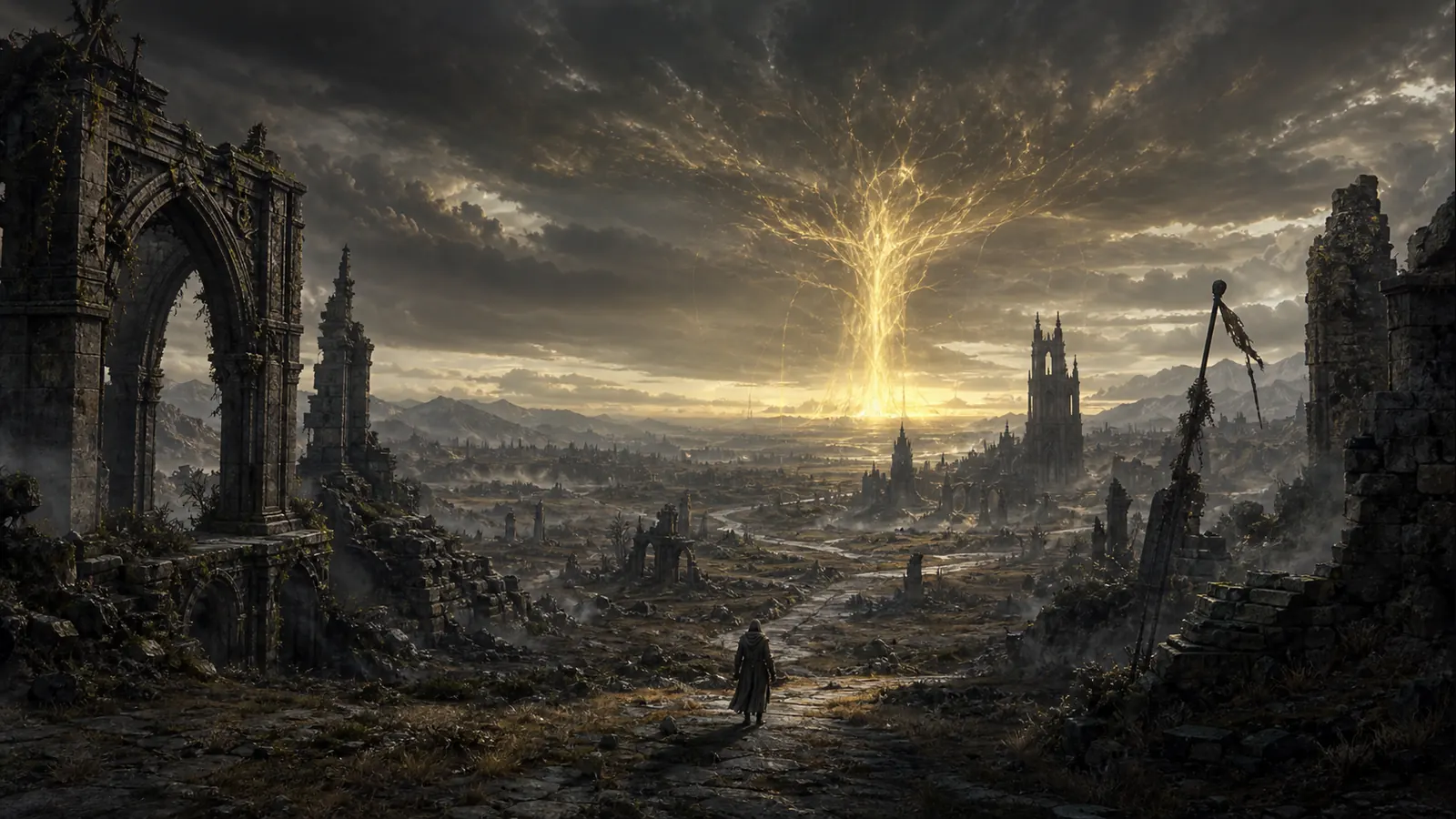
Many fantasy worlds are organized around a lost throne, a dark lord, a war, or a prophecy. The Lands Between is organized around a broken center. The Elden Ring functions as the metaphysical grammar of the realm rather than as a treasure at the end of a quest. When that grammar shatters, the world does not become merely chaotic. It becomes grammatically injured. Things still speak the old language of order, but the sentences no longer hold.
That is why the land carries a strange mixture of authority and sickness. Castles still stand, but they feel exhausted. Roads still connect regions, yet they often lead into war, madness, or abandonment. Churches, towers, and royal halls do not simply decorate the map. They show that the world once believed it knew what holiness meant.
The official Bandai Namco pages frame the setting around the Lands Between, the Shattering, demigods, and the quest of the Tarnished. For a world-study, the plot summary matters because of the feeling it creates: the audience enters after a sacred system has already failed, and the journey is less a beginning than an arrival at the scene of a cosmic accident.
The Golden Order as Climate
The Golden Order matters because it is more than a religion. In many fantasy settings, faith appears as temples, priests, and rituals. In The Lands Between, sacred order seems to have become climate, biology, monarchy, architecture, and public law. The world shines with its residue. Gold is everywhere, but the gold is not simple comfort. It can bless, blind, preserve, dominate, and refuse decay.
This gives the world a more frightening depth than a standard kingdom in crisis. If a king falls, another king can rise. If a church becomes corrupt, another faith can challenge it. But if the metaphysical order of life and death has been altered, every body becomes political. Every grave becomes a theological problem. Every return from death becomes evidence that something fundamental has been rearranged.
That is where The Lands Between touches the deeper bond between fantasy and reality. In Magic Systems in Fantasy, power becomes serious when it has cost, limit, and worldview. The Golden Order is powerful because it is a worldview made physical. It does not sit behind the world. It presses through the world.
Death Removed from the World
One of the most disturbing ideas in Elden Ring lore is not a monster, a blade, or a battlefield. It is the possibility that death itself has been handled as an object of governance. Bandai Namco’s Age of the Gods article discusses the Rune of Death and the formation of the Golden Order. The philosophical horror is clear: if death can be removed, sealed, stolen, or administered, then mortality is no longer the natural horizon of life. It becomes a law written by power.
Fantasy often dreams of immortality. The Lands Between asks what happens when immortality is not a gift but a damaged policy. A world without ordinary death does not automatically become paradise. It can become stagnant, swollen, undead in spirit, unable to conclude its own wounds. People linger. Bodies return. Dynasties rot without ending. The world cannot bury itself.
That is why death in The Lands Between feels different from death in many dark fantasies. It is not merely abundant. It is broken. A battlefield full of corpses is tragic; a world where the meaning of dying has been tampered with is metaphysically sick.
Demigods as Wounds in Human Shape
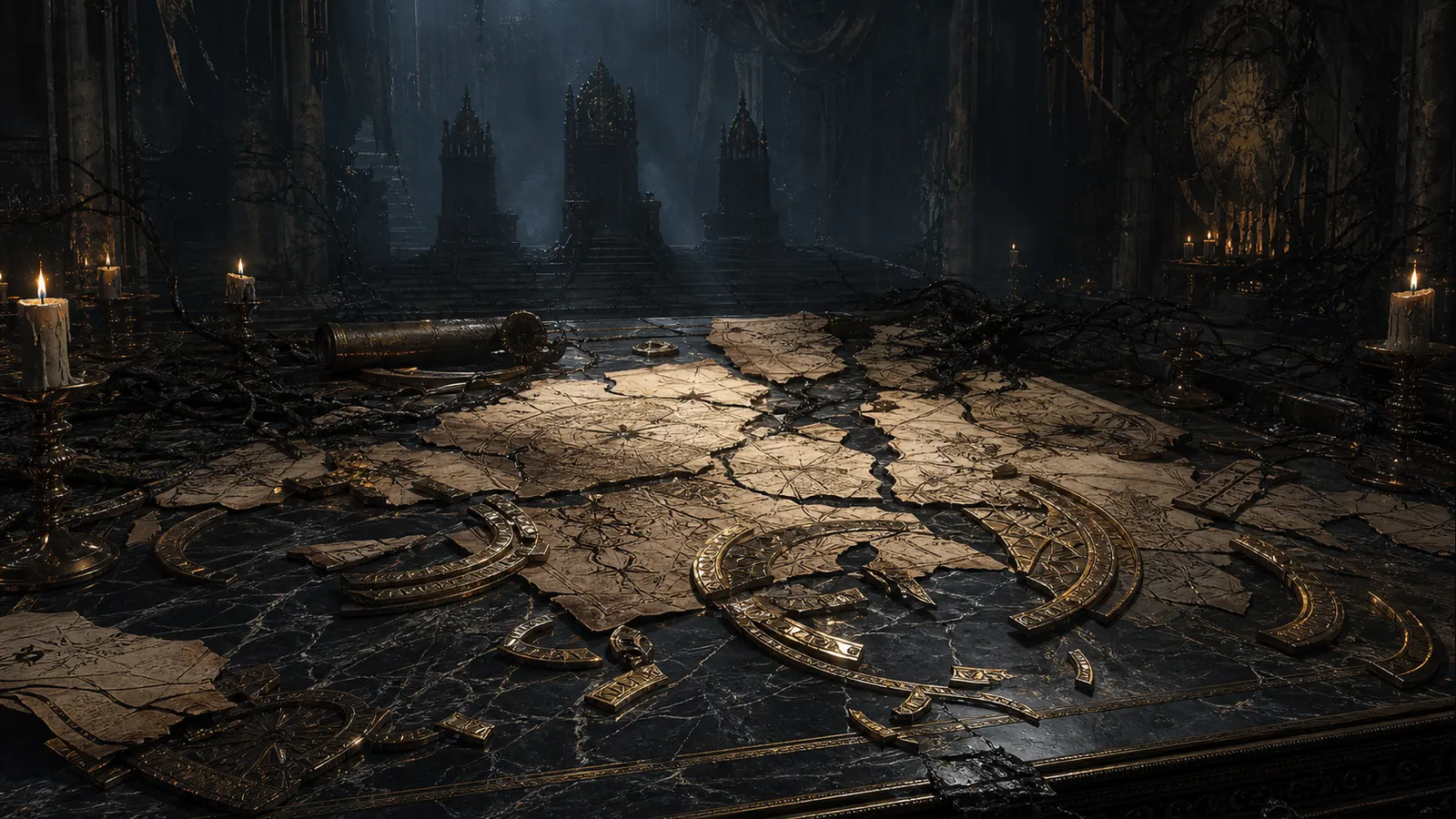
The demigods are often remembered as bosses, but for a world-reading they matter as symptoms. Their role exceeds that of powerful figures occupying strongholds. They are fragments of a broken sacred inheritance. Their bodies, ambitions, curses, loyalties, and deformities turn political collapse into mythic flesh.
This is one of the reasons George R. R. Martin’s involvement mattered. In his own note about the project, he described writing material set long before the game’s present, a deep backstory of myth and power. Hidetaka Miyazaki’s interviews also emphasize Martin’s contribution to the mythos behind the world. The result feels less like a plot invented from level design and more like a civilizational disaster remembered through descendants.
The demigods make power intimate. War is not simply armies crossing borders. It is family history, divine favor, broken bloodlines, hunger for legitimacy, and the humiliation of beings who were born too close to the sacred. The Lands Between understands a painful truth: when power is inherited as holiness, failure does not remain private.
The Erdtree and the Ambiguity of Light
The great tree at the center of the world gives Elden Ring one of its strongest images. Yet its power comes from ambiguity. A sacred tree could have been an easy symbol of life, renewal, and shelter. In The Lands Between, the golden tree-light feels magnificent and unsettling at once. It is beautiful, but beauty does not guarantee mercy.
This is essential to the world’s emotional architecture. Light is often used in fantasy as shorthand for goodness. Elden Ring refuses that shortcut. Gold can sanctify a scene while also making it feel trapped under an old verdict. A chapel under gold light can be less comforting than a dark cave, because the cave at least does not pretend to be the center of meaning.
In What Makes a Fantasy World Believable?, a world becomes convincing when its laws change behavior. The Erdtree does exactly that. It is not a background object. It organizes reverence, geography, political imagination, death, and the emotional temperature of the horizon.
Ruins That Do Not Explain Themselves
The Lands Between is full of ruins, but its ruins are rarely passive. They do not say, “Here is old scenery.” They say, “Something here was believed, fought for, consecrated, betrayed, and abandoned.” The map functions like an archaeological field where the player reads with movement instead of footnotes.
This is where Elden Ring’s famous restraint becomes worldbuilding. The story is scattered through names, items, enemy placement, environmental design, and half-buried visual patterns. A less confident world would explain every shrine. The Lands Between trusts the audience to feel pattern before possessing certainty.
Marco Caracciolo’s Eludamos study is useful here because it reads Elden Ring as an archaeogame: material traces, nonlinear history, and interpretive openness turn exploration into the work of assembling a past. A world like this becomes powerful because the audience does not merely receive lore. The audience excavates it.
Rot, Stars, Blood, and Competing Laws
The Golden Order dominates the atmosphere, but The Lands Between is not a single-note world. Other forces press against it: rot, blood, stars, moons, beasts, dragons, underground peoples, old wars, and powers that appear older or stranger than the ruling order. This multiplicity keeps the world from becoming a diagram.
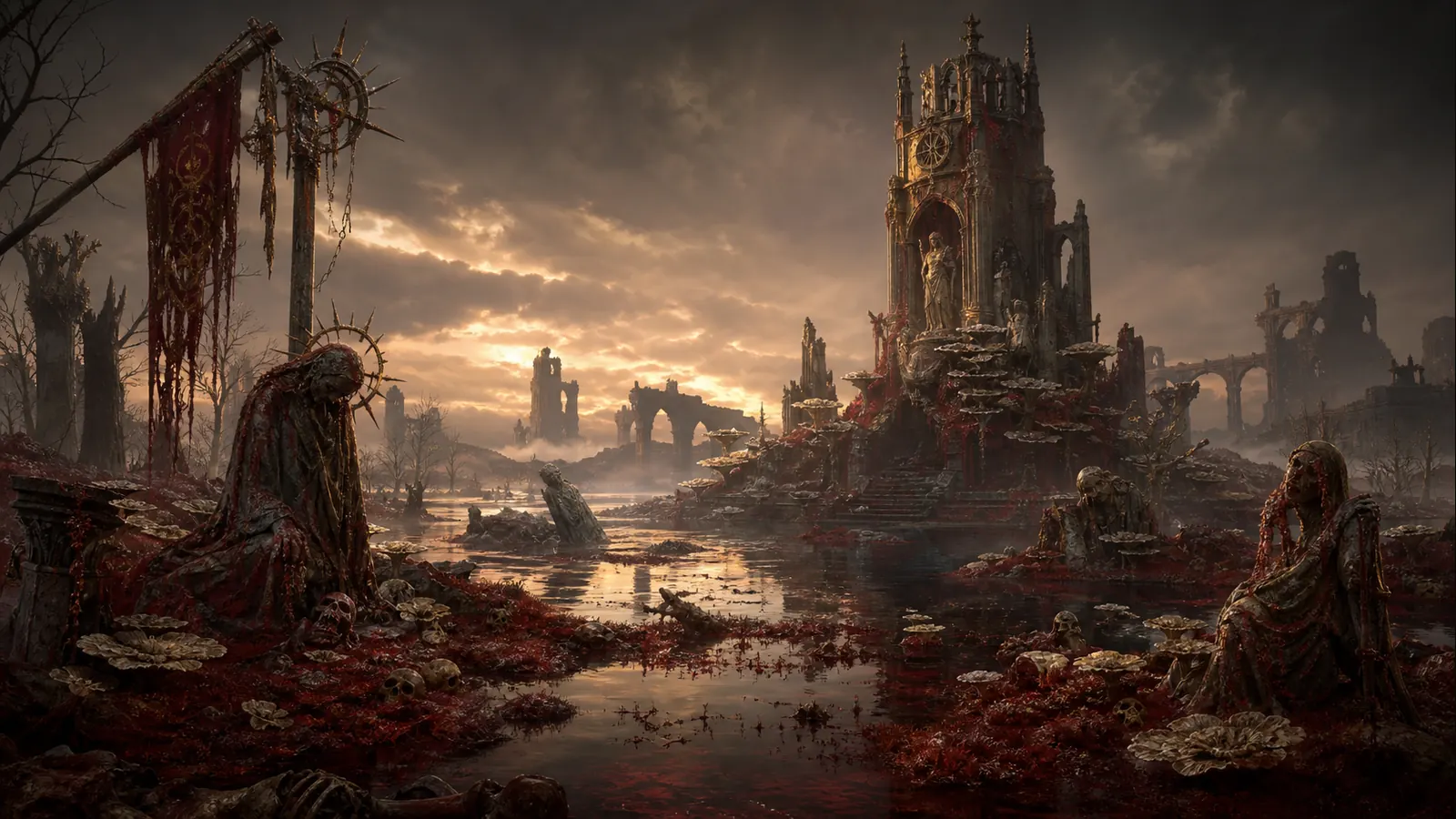
Scarlet rot is especially important because it gives decay a sacred counter-language. It is not ordinary disease. It has beauty, color, patience, and terror. A swamp or ruined region touched by rot does more than threaten health. It suggests that reality contains rival principles, rival holinesses, rival futures.
This is one reason the world feels alive. A weak fantasy setting often has one law and one rebellion against it. The Lands Between has layered laws, wounded laws, buried laws, and laws trying to return. It resembles Middle-earth’s deep time in one sense: the present is crowded by older pressures. But Tolkien’s world often mourns the fading of ancient beauty, while The Lands Between trembles under sacred systems that refuse to die cleanly.
The Tarnished and the Politics of Return
The Tarnished are more than a neutral vessel for the player. As an exiled people recalled by grace, they expose a contradiction inside the realm: the broken order must summon those it once expelled in order to imagine succession. Return is therefore political and theological before it becomes heroic.
Their mandate turns every possible ending into a question of world law. A Tarnished may inherit, alter, reject, or destroy an order, but none of those acts begins outside history. Each one enters a realm already divided by burial, bloodline, worship, exclusion, and competing claims to cosmic authority.
Those laws are felt by the person playing as death, return, fragmented knowledge, and uncertain choice. Within the world itself, they reveal why The Lands Between belongs to dark fantasy: darkness emerges from institutions and sacred rules, not merely from hostile creatures.
Why the World Feels Philosophical
The Lands Between is philosophical because it turns abstract questions into places. What is law after faith breaks? What is death if rulers can alter it? What is beauty if it belongs to a violent order? What is family when divinity becomes inheritance? What is freedom when every road is built from someone else’s failed age?
These questions are not presented as lectures. They appear as towers, roots, graves, swamps, sealed doors, broken roads, and figures too proud or too ruined to explain themselves. That is the special force of fantasy worldbuilding. Philosophy becomes walkable. Metaphysics becomes weather.
A fantasy world is not valuable because it contains many names. It becomes valuable when those names create pressure on the human imagination. The Lands Between makes the reader feel what a broken sacred order might do to bodies, roads, kings, and hope.
Sacred Damage Written into Geography
The Lands Between becomes legible when sacred damage is followed across regions. Limgrave holds the exhausted margins of lordship. Liurnia preserves a conflict between academy, moon, and crown. Caelid turns rot into climate. Altus and Leyndell monumentalize the authority of the Erdtree, while the Mountaintops preserve forbidden fire and the violence required to contain it. Beneath the surface, rivers and buried cities hold peoples and histories excluded from the golden center.
These regions are not interchangeable biomes. Each one gives a different material form to law, memory, worship, and defeat. Roads climb toward authority, descend toward buried rivals, or stop at wounds that the reigning order could not absorb.
The deeper pattern is a system of sacred damage: broken law, diseased holiness, divine inheritance, and horizons full of gold that no longer know how to save. The severe lesson is visible before it is stated. Collapse does not always look dark. Sometimes it shines.
Conclusion
The Lands Between endures because it gives ruin a sacred scale. It is not simply a dangerous map. It is a realm where divinity has entered infrastructure and then failed inside it. The Golden Order, the Rune of Death, the demigods, the Erdtree, the ruins, the rot, and the stars all participate in one enormous question: what remains when the holy center of a world breaks?
The answer is not clean. What remains is beauty with blood under it. Law with cracks in it. Faith with teeth. Memory without peace. A road still open through a world that should have ended. That is why The Lands Between feels larger than its quests. It is a fantasy world where theology becomes landscape, and landscape keeps asking whether broken gods can leave anything worth inheriting.
Sources and Further Reading
- Bandai Namco Europe: Elden Ring for the official overview of the Lands Between, the Tarnished, and the core world premise.
- Bandai Namco US: Elden Ring for official product framing and exploration language.
- What Is Elden Ring About? for Bandai Namco’s current summary of the story and lore foundations.
- A Look into the Age of Gods for official discussion of the Rune of Death, the Golden Order, and mythic prehistory.
- Elden Ring — Story Summary Explained for Bandai Namco’s current account of the Shattering, the Tarnished, and the central conflict.
- Shadow of the Erdtree official page for the expanded world context and the Land of Shadow.
- George R. R. Martin: Long, Long Ago for Martin’s account of creating deep backstory for the game world.
- Xbox Wire: Miyazaki and Martin Present Elden Ring for early official interview context around mythos and collaboration.
- Eludamos: Materiality, Nonlinearity, and Interpretive Openness for a scholarly framework connecting archaeological materiality, nonlinear history, environmental evidence, and interpretive openness.