Worlds
Earthsea: True Names, Balance, and the Mercy of Power
A reading of Ursula K. Le Guin’s archipelago as a fantasy world where magic is language, power requires restraint, dragons remember freedom, and the deepest victory may be learning when not to command.
Earthsea is a quiet answer to one of fantasy’s oldest temptations: if magic exists, why not use it to master everything? Ursula K. Le Guin’s world refuses that hunger. Its magic begins with language, but it does not end in control. To know the true name of a thing is to touch its being, and therefore to become responsible for the damage that touch might cause. In Earthsea, power is never cleanly separated from listening.
Earthsea is more than a famous sequence of books. It is a complete moral weather system. Its islands, sea roads, dragons, mages, graves, schools, names, silences, and changing histories all ask the same difficult question: what should a person do with power once they know power is real? Beside the deep time of Middle-earth and the sacred collapse of The Lands Between, Earthsea gives fantasy another center: balance.
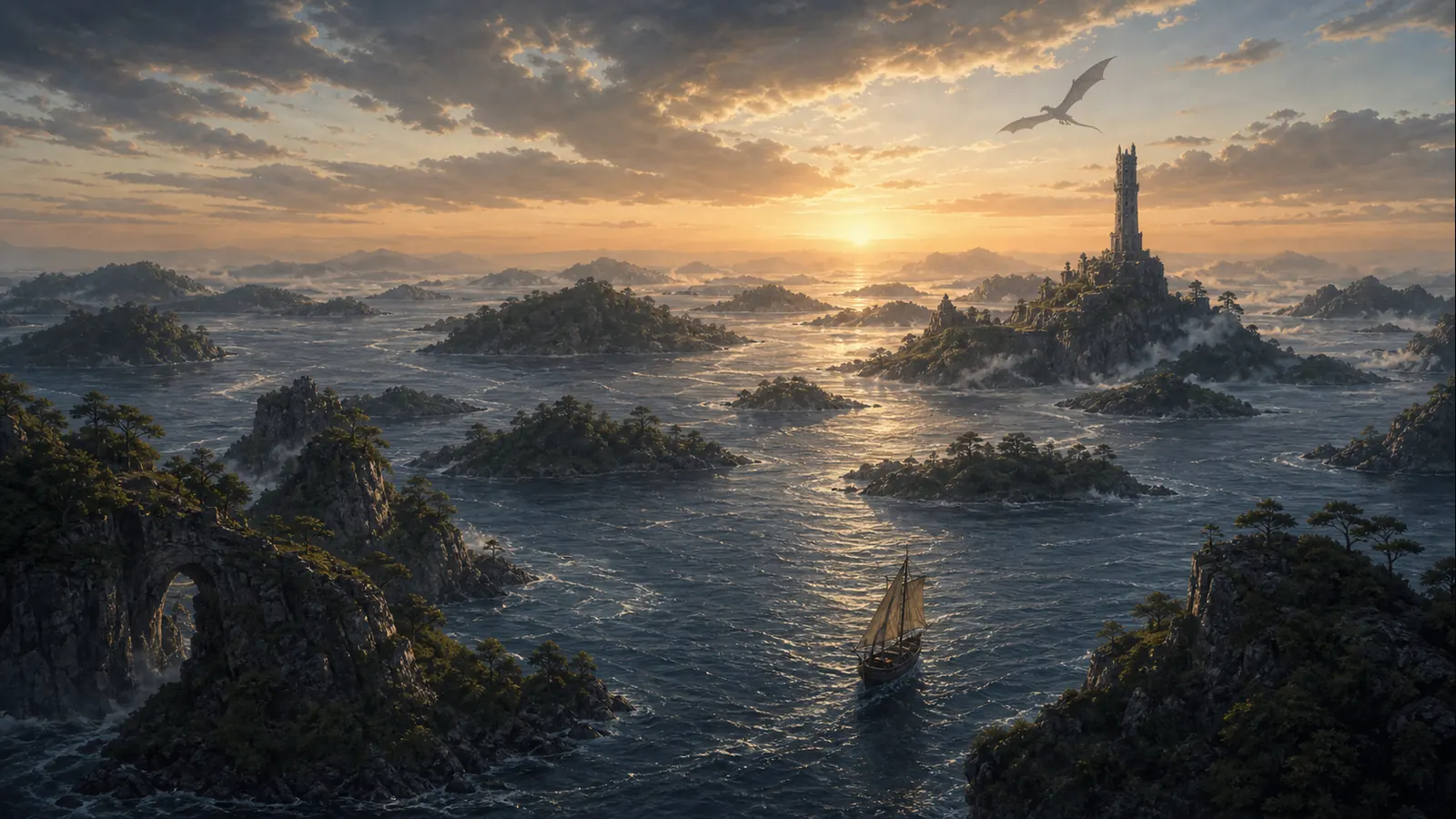
The official Le Guin site presents Earthsea as an archipelago and gathers the six major books into one larger design. That geographical fact matters. Earthsea is not a continent of conquest. It is a world of islands, passages, names, returns, and limits. The sea does not merely divide places. It teaches measure.
An Archipelago Against Empire
Earthsea’s map is one of its first arguments. A continent tempts the imagination toward empire: roads, borders, armies, centers, frontiers, expansion. An archipelago has another grammar. It forces relation without absorption. Islands remain separate, but no island is complete without the sea routes that connect it to others.
This gives Earthsea a very different rhythm from many heroic fantasy worlds. Power cannot simply march in a straight line. Knowledge travels by boat, rumor, weather, apprenticeship, migration, fear, and story. Distance is not decorative. A voyage is a moral and physical event. The traveler must cross uncertainty, and the sea keeps every ambition aware of scale.
In What Makes a Fantasy World Believable?, geography becomes convincing when it shapes behavior. Earthsea is a pure example. Its geography discourages total possession. Even the greatest mage is still a person in a small boat beneath sky and wind.
Magic as Language, Not Fireworks
The most famous idea in Earthsea is true naming. This is one of the deepest magic systems in fantasy because it treats language as reality’s hidden structure rather than as decorative spellcraft. A name is not a label pasted onto a thing. It is an intimate relation to what that thing is.
That gives magic ethical weight. If speech can alter the world, careless speech becomes dangerous. If naming reveals being, knowledge becomes more than information. The mage’s vocation is not to accumulate tricks; it is to learn the shape of things and the cost of changing them.
This is why Earthsea belongs beside Magic Systems in Fantasy as a central example. Its magic has rules, but the rules are spiritual as much as technical. The true name opens a door, yet the question remains whether the door should be opened.
The School at Roke and the Discipline of Restraint
Roke could have been written as a place of power fantasy: a school where gifted students become magnificent and bend the world to their will. Le Guin makes it sterner and wiser. The school teaches knowledge, but its deeper lesson is proportion. A young mage must learn that the world is not raw material for his desire.
This is a radical fantasy idea. Many stories reward the hero for becoming stronger. Earthsea asks whether strength without balance is only another form of ignorance. The student who learns names without humility becomes dangerous. The student who learns silence begins to understand the world.
The result is a fantasy education that feels inward as well as magical. Training becomes moral shaping as much as practice. The real lesson reaches beyond casting a spell; it asks how to live after discovering that a spell is possible.

Ged and the Shadow of the Self
A Wizard of Earthsea begins from a wound that feels ancient and adolescent at once: pride. Ged’s early mistake matters because it is not random. He wants to prove himself, and the world answers. The shadow he releases is terrifying because it is not merely outside him. It carries the shape of something he must recognize.
That is why the story remains powerful beyond its plot. The monster is also a moral consequence. The chase across Earthsea becomes a journey through fear, responsibility, and self-knowledge. Ged cannot defeat the shadow by simple domination, because domination is part of what opened the wound.
Here Earthsea turns fantasy into a way of understanding the human mind. In Why Our Own World Is Fantasy, wonder returns when familiar reality becomes strange again. Earthsea makes the self strange. It asks whether the enemy we flee may be a name we have refused to speak.
Balance as the World’s Deep Law
Balance in Earthsea is not bland moderation. It is a law as severe as any sword. Every act ripples. Every spell changes relation. Every gain may require loss elsewhere. The world is alive with correspondences, and wisdom means perceiving those relations before breaking them.
This separates Earthsea from fantasies where magic exists mainly as power escalation. Le Guin’s magic is ecological, linguistic, and moral. The world is not a warehouse of usable forces. It is a living arrangement. To change one thing is to disturb a wider field.
That idea feels more urgent now than ever. Earthsea’s restraint is not weakness. It is a heroic discipline for a species tempted by command. The mage who refuses an unnecessary spell may be acting with more courage than the mage who reshapes a mountain.
Dragons and the Memory of Freedom
Earthsea’s dragons are not pets, mounts, or simple monsters. They belong to an older scale of being. They are dangerous because they are free, intelligent, proud, and difficult to reduce to human categories. Their presence keeps the world from becoming purely human.
In Dragons in Fantasy, dragons can stand for power, fear, desire, ancient grandeur, or the untamed world. Earthsea’s dragons carry all of that, but they also carry language and distance. They remind readers that some forms of life should not be domesticated by the human need for usefulness.
This matters for Earthsea’s philosophy of power. A world that contains dragons cannot finally belong to human management. The dragon is a living refusal of total administration. It says: the world is older and stranger than your schools.
The Sea as Moral Space
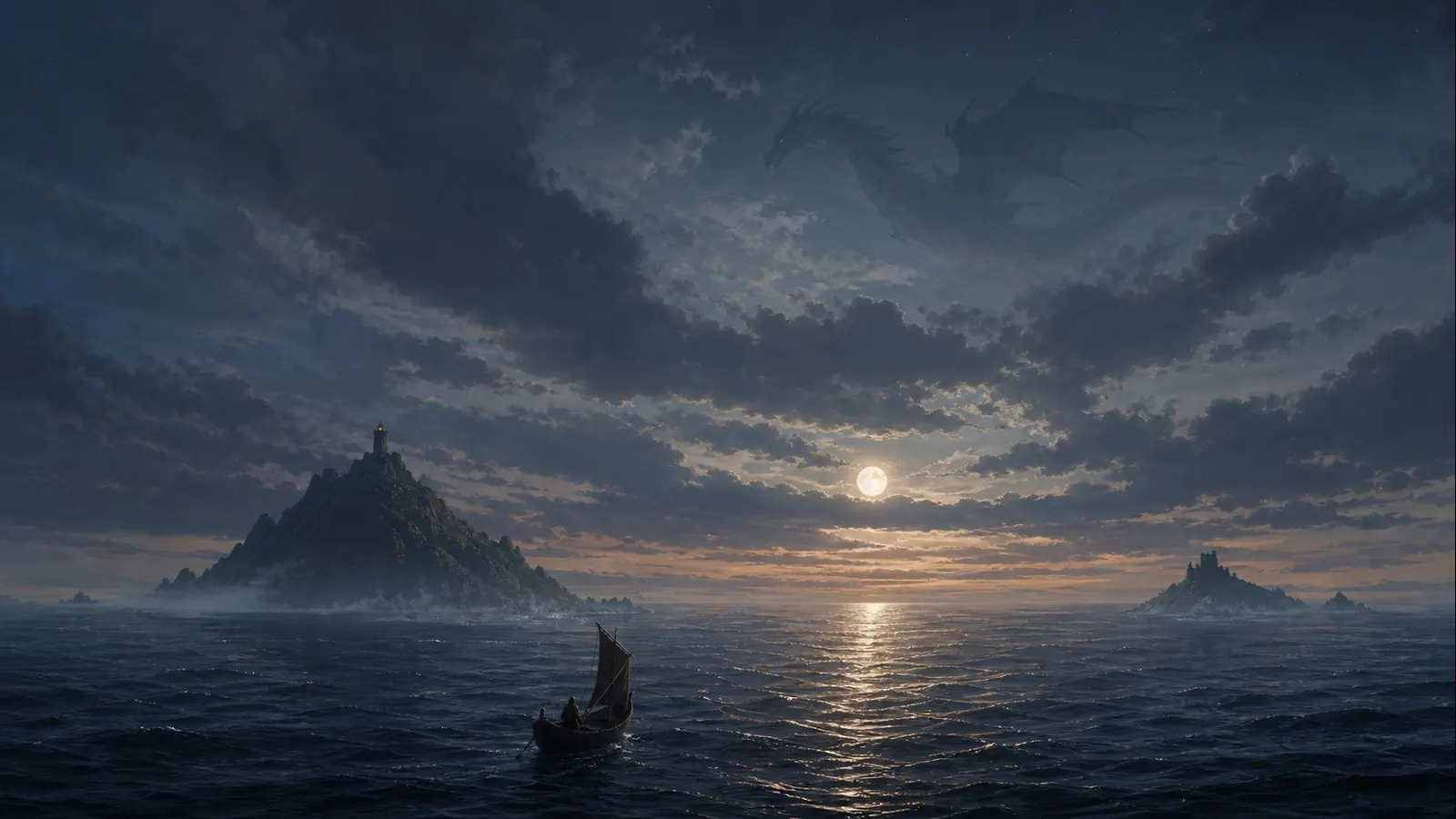
The sea in Earthsea is not empty blue between meaningful places. It is the world’s breath. It slows the story, exposes the traveler, and makes every destination feel earned. To cross water is to accept vulnerability. A boat is small. Weather is larger. The horizon keeps reminding the hero that human desire is not the measure of all things.
This is why Earthsea’s journeys feel so different from map-clearing adventures. The crossing itself matters. The sea gives the world silence, distance, and humility. It is a geography of pause.
The official Maps of Earthsea page is valuable because it shows how deeply map and story belong together. Le Guin’s archipelago is not interchangeable scenery. It is a way of thinking.
Tehanu and the Revision of Power
Earthsea becomes even deeper because Le Guin returned to it and changed its center of gravity. Tehanu and the later works do not merely extend the setting; they interrogate it. The official essay Tehanu: A Return to the Source describes how the later books altered the whole rather than simply adding to it.
That willingness to revise is part of Earthsea’s greatness. A world becomes more alive when it can question its own earlier assumptions. Power that looked noble from one angle may look exclusionary from another. Institutions that seemed wise may also hide injury.
That point is crucial. A living fantasy world should not be a museum of its first ideas. It should be able to deepen, regret, correct, and open rooms that were previously closed.
Why Earthsea Feels Philosophical
Earthsea is philosophical because it transforms metaphysics into ordinary action. What is a name? What does it mean to know? When does power become harm? Can a person be whole after facing the part of themselves they most fear? Can a world remain balanced if its institutions exclude part of reality?
These questions appear through boats, schools, villages, graves, dragons, and weather. Le Guin does not need to interrupt the world with theory. The theory is in the world’s behavior.
That is why Earthsea remains readable for young readers and inexhaustible for adults. Its sentences can be clear while its implications keep widening. It is not obscure; it is deep.
Why Earthsea Still Feels Vast
Earthsea shows fantasy at its most disciplined. It does not need endless spectacle to feel vast. A name, a boat, an island, a shadow, a dragon, and a choice can carry the weight of a world.
Beside Middle-earth and The Lands Between, Earthsea clarifies a different kind of grandeur. One world may draw power from deep time, another from sacred collapse; Earthsea draws power from moral balance. Together they show that fantasy worlds do not all become powerful in the same way.
Earthsea’s strength is inward. It makes power quieter, and then makes that quiet feel immense.
Conclusion
Earthsea endures because it understands that magic is most dangerous when it resembles speech. To name is to touch. To touch is to change. To change is to bear responsibility. That chain gives the world its dignity.
Its islands teach limit. Its sea teaches humility. Its dragons preserve wildness. Its school teaches restraint. Its later books reopen the cost of older wisdom. Earthsea is a world where the highest power may be mercy: the mercy to listen before speaking, to know before changing, and to let the world remain alive beyond the reach of command.
Sources and Further Reading
- The Books of Earthsea for the official collected framing of the Earthsea cycle.
- A Wizard of Earthsea for the official book page and the opening shape of Ged’s story.
- Maps of Earthsea for the archipelago map context and Le Guin’s own mapmaking.
- Ursula K. Le Guin Bibliography for publication order and the full Earthsea listing.
- Interview with Karabatak for Le Guin’s comments on returning to Earthsea after the first book.
- Tehanu: A Return to the Source for critical context on how the later books alter the whole.
- The Cusp of Change for official context around Earthsea’s later state and returning tensions.
- Tales from Earthsea or Gedo Senki for Le Guin’s own response to adaptation and her sense of the world’s meaning.
- Awards and Honors for recognition of The Books of Earthsea and Le Guin’s broader career.
- Britannica: Ursula K. Le Guin for a general reference overview of her life and literary significance.