Worlds
Harry Potter: The Child Who Found a Home at Hogwarts
The enduring magic begins before the first spell, when a forgotten child discovers a place that knows his name and notices when he is gone.
Spoiler warning: this discussion follows all seven Harry Potter novels and refers to parts of the ending.
The letter that reached Harry did more than tell him magic was real. It knew something stranger and more intimate: the boy living at number four, Privet Drive, slept in the cupboard under the stairs. Before Harry learned a spell or looked up at the enchanted ceiling of the Great Hall, someone had seen exactly where he was. In a house where his presence was merely tolerated, an envelope had arrived with his name written correctly.
Hogwarts became Harry's home, though the castle was never safe or flawless. It became home because, for the first time, his absence would be noticed. His choices carried weight. Other people made room for him beside them. The enduring magic of the series begins there, in the passage of a child who believes he is an extra burden into a world capable of recognizing his empty chair.
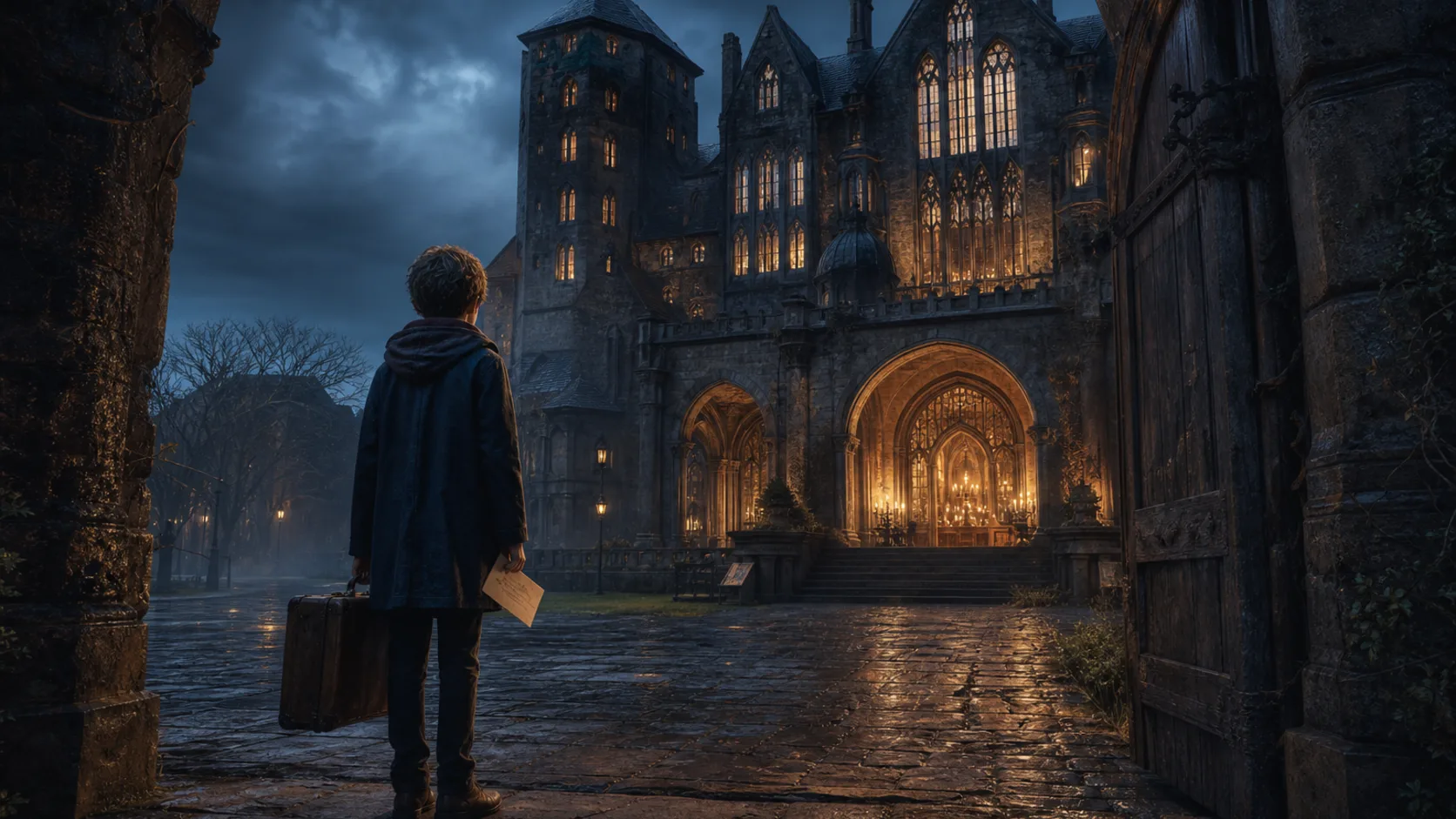
A tidy house with no room for Harry
Privet Drive is not chaotic. The dishes are put away, the lawn is clipped, and the Dursleys work hard to resemble every other “normal” family on the street. Yet none of that order gives Harry safety. The cupboard, Dudley's cast-off clothes, and the mornings when he must work before everyone else teach him to take up less space and ask for less.
A child rarely learns the meaning of home from walls or a name on a deed. Home is formed by recurring experiences. Does anyone listen when you speak? If you come back late, does someone ask where you were? Does a mistake end affection, or open the possibility of repair? Harry has a roof at Privet Drive, but he does not belong there. The difference between shelter and belonging is the emotional foundation of the whole story.
Classic research on the “need to belong” defines belonging in terms of lasting relationships and repeated, caring interaction rather than the mere presence of other people. That is why a vast castle of cold stone can feel warmer than the Dursleys' spotless house: relationships continue inside the castle.
The letter that knew the address of the cupboard
The Hogwarts letters create one of the story's funniest storms. They slip through the letterbox and chimney, multiplying faster than Vernon can hide them. Beneath the comedy lies a serious experience. The envelope bears Harry's name and identifies the exact place where he sleeps. For a child who has received almost nothing of his own, that small act of recognition is revolutionary.
The letter promises no friendship, competence, or happier future. It says only that the Dursleys' account of him is incomplete. Perhaps his strangeness is not a defect. Perhaps the events he could never explain belong to a language he has yet to learn. Why do humans still dream of magic? begins with the same longing: the hope that the world might hear us, and that something nameless within us might one day acquire meaning.
Harry is invited to a school. More deeply, he is given the chance to interpret his life again. That new reading of his life begins before he reaches the castle.
The road toward his new home starts before the Great Hall. At King's Cross, Molly Weasley helps a boy she has never met find Platform Nine and Three-Quarters. Her red-haired son shares a compartment with him. Sweets spread across the seat, and an awkward conversation becomes the beginning of a friendship.
These moments are convincing because they are small. Imaginary worlds come alive when their grand laws enter ordinary behaviour, as What makes a fantasy world believable? explores. In Harry Potter, magic sits beside a train ticket, a shopping list, loose change, homemade sandwiches, and the dread of a first day at school.
Harry finds his first friend before he knows which house will claim him. The order matters. Real belonging does not begin with a label. It begins when someone says, in words or by moving a bag from the seat: you can sit here.
Small rituals turn the castle into a home
Hogwarts stays in the imagination through its towers, staircases, and enchanted ceiling, but it becomes a home through quieter things: voices in the corridor, unfinished homework, a match everyone discusses at breakfast, and the nightly return to the same common room. The school calendar gives the story its pulse. Autumn means arrival; winter brings celebration and loneliness together; summer always carries the threat of separation.
Academic work on the British school-story tradition shows how the series joins fantasy to an older boarding-school pattern. Lessons, house rivalries, forbidden midnight excursions, and friendships formed away from parents create a small society in which children test who they might become. Rowling makes that familiar structure strange with magic, while the emotional need beneath it remains ordinary.
Most readers have never studied in a castle. They still recognize the relief of returning to a known corridor, sitting beside the same friend, or wishing the school year would not end. The grandeur of the world draws strength from the repetition of daily life.
Harry, Ron, and Hermione do not begin as an effortless, perfectly matched trio. Jealousy, pride, quarrels, and words that should have gone unsaid travel with them. Those faults save the friendship from becoming a decorative emblem. They hurt one another, withdraw, return, and eventually find themselves doing homework side by side again.
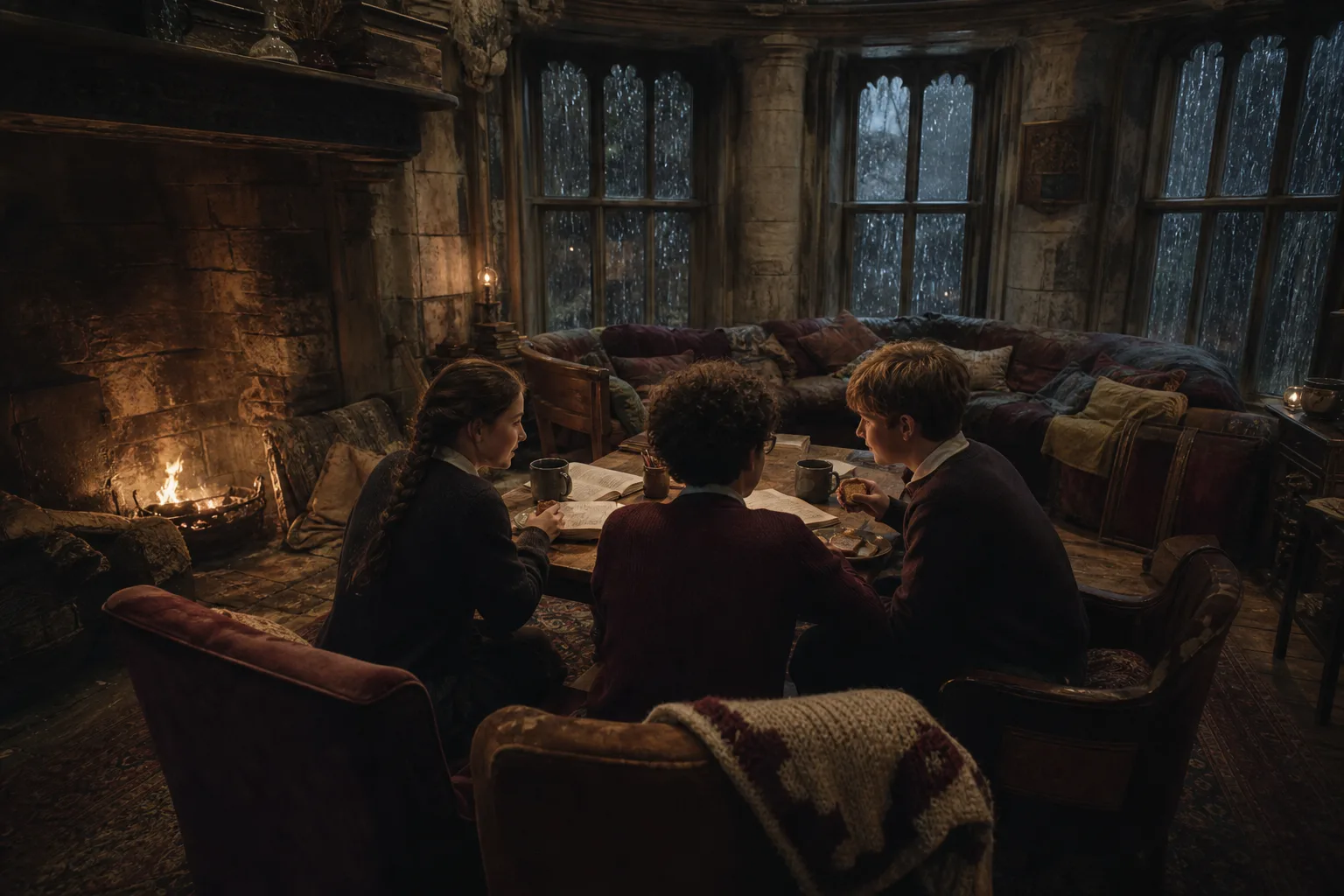
A chosen family is rarely made by one magnificent vow. It grows through quiet acts: sharing food, staying awake to find an answer, becoming angry at a friend's reckless decision without abandoning the friend. The evenings by the fire matter as much as the battles because they show that Harry no longer has to defend himself alone.
That is also the hope, and the warning, in When fantasy takes the place of the real world. An imagined world becomes a refuge when it leaves room for relationship and return. It becomes an anaesthetic when its only purpose is to numb us to the life outside it.
The Burrow leaned, but it had another chair
If Hogwarts is home on a grand scale, the Burrow is its earthier form. The house is crooked, crowded, and short of money. Breakfast may include an argument, an owl, moving dishes, and a worry no one can quite afford to name. There is still room for Harry. A jumper arrives with his initial on it. Someone asks whether he has eaten. After an ordeal, an adult embraces him before demanding that he become brave again.
The Burrow shows that love does not always appear graceful or orderly. Molly can be overbearing, Ron can be jealous, and the Weasleys are no more immune to fear than anyone else. What distinguishes the house is that its bonds survive conflict. Here, failure does not cancel your right to remain.
In Fantasy is the repair of reality, imagination does not erase the wound; it allows us to picture what life might have been, and might still become. The Burrow offers that kind of vision. Poverty has not vanished, but there is still room for one more person at the table.
The mirror revealed what home could not replace
The Mirror of Erised does not show Harry surrounded by fame or power. It gives him the family he never had the chance to know. The scene makes clear that Hogwarts has not filled every absence. A child may have friends, a bed, and a school, yet continue to grieve his parents.
Official writing on the mirror stresses the danger of surrendering life to an impossible desire. Harry must walk away from the image, but walking away is not the same as forgetting the dead. Research on bereaved children uses the idea of “continuing bonds”: memory, objects, and stories can preserve a transformed relationship with someone who has died. This thread runs through the mirror, the photographs, the Patronus, and the Resurrection Stone without turning any of them into a cure or a literal restoration.
What does fantasy do with death? follows the same boundary. Fantasy cannot repeal death. It can give absence a shape, so that a person may carry it without being consumed by it.
Harry and Tom: two children, two meanings of home
Harry and Tom Riddle both grow up among Muggles without parental care. Both arrive at Hogwarts and receive an explanation for their difference. The school becomes crucial to each of them, but the importance of a place cannot decide a person's moral life on its own.
Before Hogwarts, Tom already frightened other children and kept their possessions as trophies. At school he gathered followers rather than friends. To him, belonging did not mean entering a reciprocal relationship; it meant possessing a place, its history, and the people within it. Harry has anger, vengeful impulses, and serious failures of his own, yet he repeatedly accepts help and acknowledges that other people are free to choose.
Their difference should not be reduced to the good orphan and the bad orphan. Suffering makes no one pure, and it condemns no one to cruelty. The decisive question is what each child does with the opportunity to be seen. Finding a home teaches Harry to make room for others. Finding power teaches Tom to carve his name into every door.
Houses can offer shelter and build walls
The Sorting Ceremony is one of Hogwarts' most ingenious rituals. Within minutes, a frightened newcomer is given a House, finds a table, and is no longer alone in the hall. Harry's Sorting also establishes that desire and decision have a place in identity; personal qualities are possibilities, not sentences handed down by fate.
The same system creates dangerous borders. The points competition, Slytherin's reputation, and prejudice about family teach children to classify one another before they have met. Types of fantasy heroes places Harry within the tradition of the chosen one, but his life shows how little a title can tell us about character. Even being chosen can become a cage.
Belonging that depends on excluding someone else is loneliness in a softer disguise. Hogwarts becomes a home when its tables leave paths between them.
Hogwarts is not innocent
Nostalgia likes to keep the candles, Christmas snow, and star-filled ceiling while allowing the rest to blur. The school, however, repeatedly exposes children to dangers adults ought to control. Some teachers humiliate their pupils. Essential information is withheld. A detention may send first-years into the Forbidden Forest at night.
Even the feasts in the Great Hall depend on the invisible labour of house-elves, beings bound to service within a society that largely regards their condition as natural. A home that liberates one child can conceal another creature's suffering below the kitchen ceiling.
That contradiction deepens rather than erases Hogwarts' meaning. Loving the place becomes a more serious act when affection does not prevent us from noticing who receives less safety, dignity, or freedom inside the walls. Once a home is placed beyond criticism, it slowly becomes the property of those who hold power.
Dolores Umbridge's rule is frightening because the school keeps its familiar shape. Lessons continue, decrees appear in frames, and the old corridors remain. What changes is the air: questions become dangerous, pain is denied, and authority tries to replace the students' lived experience with official language.
Literary research on surveillance and power at Hogwarts examines how house points, prefect status, punishment, and Ministry intervention make school life into a network of obedience. The Room of Requirement becomes vital because the building itself seems to open a crack in that system. Students create a place where access to knowledge no longer depends on permission from above; they share it with one another.
Home is more than the place that accepts us. Sometimes it is the place whose humanity we must defend against an unjust order.
Grief never left the grounds
Hogwarts does not seal Harry away from his past. Dementors bring the final voices of his parents into the present. Cedric's death destroys the promise that a school tournament will end safely. Sirius's death fills Dumbledore's office with an anger no calm explanation can extinguish.
There is little value in assigning a clinical diagnosis to a fictional child. The power of these scenes lies in what they recognize: grief does not end after a single bout of tears. Its meaning changes as a child grows. Developmental research on childhood bereavement likewise shows that loss is understood again at different ages, and that the surrounding care matters.
The Patronus gives this process a luminous form. Memory does not remove pain; it becomes a source of presence and protection. Harry hears the dead, then chooses to fight for the living. That choice separates him from Voldemort, who tears apart his soul and every human bond in his attempt to escape death.
When the castle was wounded, home remained in its people
By the end, Hogwarts is no longer the intact refuge of Harry's first year. Walls have broken, the hall is a battlefield, and people who once sat together in lessons must defend the school. Home separates from architecture. If the castle mattered only as stone, its meaning would end with its first ruin.
The illustration below is a symbolic reading, not a scene narrated in the books. Students and teachers repairing the hall at dawn stand for the slower work that follows victory: tending the wounded, mourning the dead, and rebuilding trust.
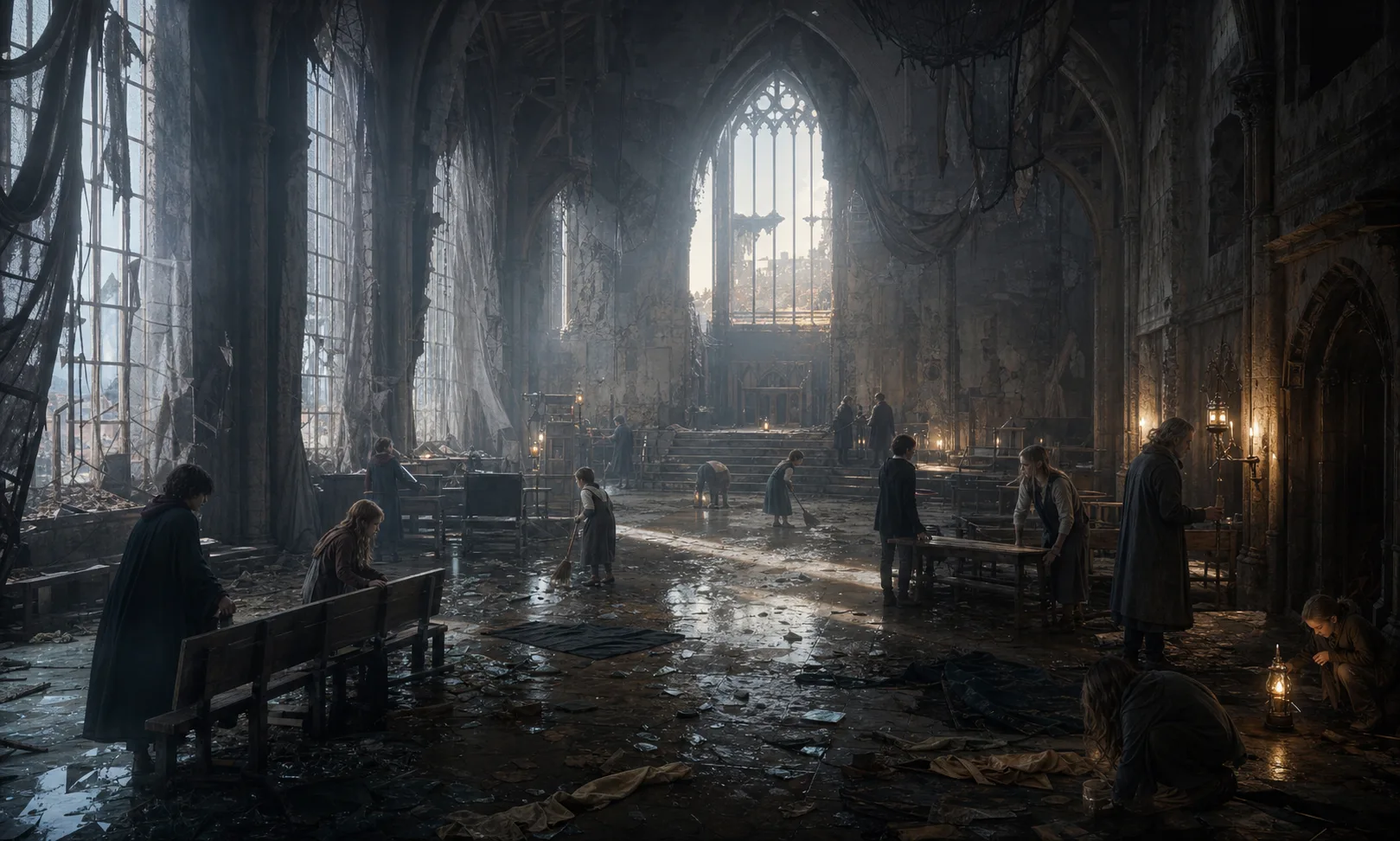
After the battle, home survives in the people who care for the wounded, mourn the dead, and remain beside one another in the shattered hall. The defence of Hogwarts is not simply the defence of a magnificent building. It protects the possibility of a world in which a child like Harry need never return to a cupboard.
In Narnia: the doorway that teaches us to return, the journey into another world is completed when the child carries an inner change back into ordinary life. Hogwarts cannot remain Harry's final destination either. School must end, so that what he learned there can be tested in a home yet to be made.
It is tempting to read the story as a dream of escape: a letter arrives, a door opens, and the old room can be left behind forever. Harry's growth cannot be completed by taking permanent shelter in the castle. He has to leave, make decisions without its timetable, and eventually make a home for other people.
Hogwarts was the first proof that rejection was not his destiny. The Burrow showed him that family could expand by choice. Friendship taught him that disagreement need not destroy a bond. The dead remained in memory without taking the place of the living.
This is how the child who folded himself into a cupboard so as to occupy less space becomes an adult capable of making space. Home, in the end, is not somewhere the hero finds and hides forever. It is knowledge he carries onward.
Home is where your absence is understood
Adult readers return to Harry Potter for its ordinary details—supplies, the train, shared meals, holidays, and the yearly return—and for the memory of a world larger than the explanations around them. Few slept beneath the stairs, but many have felt too much, somehow wrong, or unseen. As Why do humans build imaginary worlds? argues, imagined worlds let us test other forms of life; returning to Hogwarts can also mean asking what kind of home we can make now.
The story's final movement brings Harry back to King's Cross. Years earlier, Molly Weasley showed a lost boy how to reach Platform Nine and Three-Quarters. Now Harry walks the same route beside his frightened son. Albus is afraid of the Sorting and of being placed in Slytherin. Harry bends down, listens, and tells him that one of the headmasters whose names he carries belonged to that House, and that the Sorting Hat can take a child's wish into account.
The boy who once needed a stranger to show him the way now stays beside another child at the same threshold. Hogwarts did not become home because it spared Harry from suffering. It became home because his suffering no longer happened in a void: someone saw it, someone objected, and someone stayed. At King's Cross, Harry passes that gift onward—not the promise of a flawless castle, but the assurance that fear can be spoken, heard, and accompanied.
Sources and further reading
- Bloomsbury: Harry Potter and the Philosopher’s Stone for the publisher's information on the first novel.
- Scholastic: Harry Potter press kit for the seven-book structure and Harry's years at Hogwarts.
- HarryPotter.com: The power of letters in Harry Potter for the letter and Harry's experience of being seen.
- HarryPotter.com: locations that defined the characters for the cupboard and Privet Drive.
- HarryPotter.com: characters who found home at Hogwarts for Hogwarts as home to Harry and Tom.
- HarryPotter.com: analysing Tom Riddle's choices for the distinction between friendship, followers, and domination.
- HarryPotter.com: the chapter that made us love the Weasleys for daily life at the Burrow and Harry's welcome there.
- HarryPotter.com: The Mirror of Erised for family longing and the danger of remaining inside an impossible desire.
- HarryPotter.com: The Patronus Charm for the role of memory and hope in the Patronus.
- HarryPotter.com: House-elf fact file for house-elves and invisible labour in wizarding society.
- Oxford Handbook of Children's Literature: Blending Genres and Crossing Audiences for fantasy, school fiction, and the coming-of-age novel.
- Harry Potter and the public school narrative for Hogwarts and the British boarding-school tradition.
- Baumeister and Leary: The Need to Belong for stable relationships and repeated interaction as foundations of belonging.
- Clabburn et al.: continuing bonds in bereaved children for children's continuing relationships with someone who has died.
- Developmental manifestations of grief in children and adolescents for the changing understanding of grief across development.
- Springer: surveillance and power at Hogwarts for discipline, surveillance, and authority at the school.