Essays
Why Do We Still Wish for Magic?
Behind the dream of magic is a simple wish. We want to change what ordinary life leaves beyond our reach.
Human beings still dream of magic because we want a world capable of answering us. We want a true word to open what force cannot, grief to leave some mark beyond the body, courage to matter before victory is certain, and injustice to encounter a law deeper than the laws written by the powerful. Beneath the spectacle of spells lies an intimate wish: that reality might recognize meaning.
That wish survives because ordinary life so often feels indifferent. A child can whisper for a sick parent to recover; an adult can stand beside a hospital bed with the same helpless desire, stripped of childish language but unchanged at its core. Magic imagines that intention can cross the distance between the inner life and the outer world. It gives form to the hope that love, knowledge, sacrifice, or a rightly spoken name might become an event.

The Small Wish Beneath the Grand Spell
Fantasy gives magic towers, runes, dragons, schools, staffs, and storms. Yet the first magical wish is usually smaller. Let this fever break. Let the lost person come home. Let me know what is hidden. Let tomorrow be different from today.
These wishes belong to daily life before they belong to literature. We feel them while waiting for a message, sitting outside an operating room, holding an old photograph, or walking home after a humiliation we cannot undo. Most of the time we know that wishing is not causation. Knowledge does not abolish the wish. The mind still reaches toward a reality in which care has force.
This is why magic cannot be reduced to a fantasy weapon. Fireballs and enchanted blades may be thrilling, but they are later inventions built around an older ache. The dream begins when a human being encounters a limit and imagines that the limit might listen.
A World That Answers
Real power often feels remote. Weather ignores prayer. Time does not negotiate. Illness enters bodies without asking what those bodies deserve. Institutions may hear a truthful voice and continue unchanged. Under such conditions, magic imagines responsiveness.
A magical world is a world of correspondences. A name reaches the thing named. An oath binds the future. A wound in the king appears in the land. A broken promise changes the weather. These connections can be frightening, yet they answer a deep human intuition: events should mean something beyond their immediate physical effects.
Our own lives already contain weaker forms of this hunger. We keep letters because ink can carry a person. We speak to the dead at graves. We wear an object given by someone we love and feel less alone. None of this requires a claim that matter violates physics. It reveals how naturally humans invest the world with relationship. As Why Our Own World Is Fantasy argues from another direction, reality becomes strange the moment habit loosens its grip.
Magic intensifies that strangeness until relationship becomes law. The universe no longer watches in silence. It remembers, refuses, forgives, demands, and sometimes replies.
Why Words and Names Carry Power
Language is the closest thing to magic that ordinary life permits. A judge speaks and a prisoner is freed. Two people make a promise and their future changes. A doctor names an illness, and terror gains an edge that can be examined. An insult spoken in seconds can remain in the body for decades. Words do not move mountains, but they repeatedly alter the human world.
Fantasy takes this real power seriously enough to make it physical. Secret names expose hidden nature. Songs shape stone. A sentence written in the correct script becomes a door. Tolkien connected fantasy with the human power of language to make a Secondary World, while his idea of recovery describes how imagined things can return familiar reality to clear sight.
Earthsea gives this desire one of its finest forms. Knowing a true name creates power, but true speech also demands attention to what a thing is. Ged’s greatest acts cannot be separated from restraint, balance, and his willingness to face the shadow released by his own pride. The deeper exploration of true names and balance in Earthsea shows why naming there is closer to responsibility than possession.
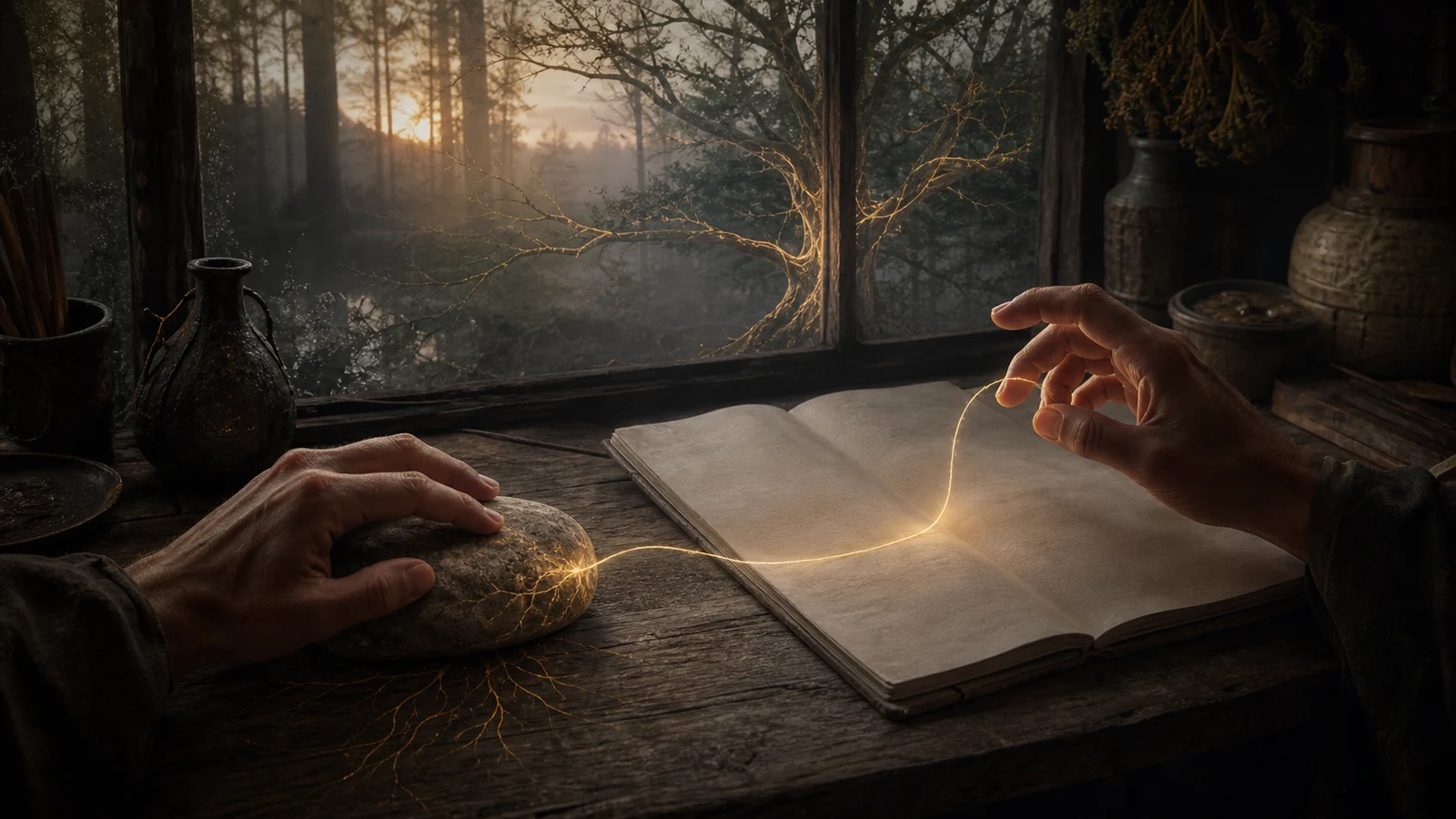
The fantasy of the powerful word contains a moral hope: perhaps truth, spoken with enough precision and courage, can still change what brute force has made.
Magic After Disenchantment
Modernity is often described as the age in which magic disappeared. Science explained the heavens, machines multiplied human strength, and bureaucracies replaced spirits with procedures. The story is tidy; history is not. Jason Ā. Josephson-Storm’s The Myth of Disenchantment traces how occult interests, spiritualism, and magical ideas persisted within the very cultures that declared themselves disenchanted.
Karl Bell’s history of nineteenth-century urban England reaches a related conclusion from ordinary streets. Magical imagination adapted to industrial cities and gave people ways to orient themselves, resist pressure, and experience agency amid rapid change. Magic did not simply survive as a fossil from a vanished age. It changed clothes.
The same movement continues. Horoscope apps appear on devices built by advanced engineering. People make private rituals before an exam, a match, or a dangerous journey. Fiction fills technologically sophisticated societies with witches, gods, enchanted schools, and sacred landscapes. These practices are not identical, and fantasy should never be used to excuse fraud or replace evidence. Their persistence nevertheless unsettles the claim that explanation satisfies every human need.
Science can tell us how rain forms. It does not decide what rain means at a burial, after a drought, or on the morning someone returns home. The dream of magic lives in that remaining distance between mechanism and meaning.
The Hunger for Agency
Magic becomes especially attractive where control is thin. People develop rituals around uncertain events because uncertainty is hard to inhabit. Psychological research on the illusion of control shows that healthy people can sometimes attribute agency to accidental correlations between action and outcome. That finding deserves care: it does not prove that every ritual is foolish, nor that the love of fictional magic is a clinical error. It shows how intently the mind searches for the boundary between what it does and what happens next.
There is dignity as well as danger in that search. A powerless person does not merely want domination. They may want one meaningful action. Light the candle. Speak the name. Draw the sign. Carry the charm. The action creates a shape for attention when fear would otherwise scatter it.
Fantasy makes the shape visible. A healer places both hands over a wound; a traveler remembers the one phrase that will guide them through the dark; a frightened apprentice draws a circle and chooses to remain inside it. The spell says that presence matters. Someone can still do something.
This explains part of magic’s endurance, but agency alone is insufficient. A machine also extends agency. Magic becomes emotionally distinct when the world responds as a participant rather than behaving as a neutral instrument.
Power Must Meet Resistance
The childish version of magic grants everything. The mature version asks what the wish costs, whom it changes, and what refuses it. Unlimited fulfillment soon becomes empty because desire gains meaning from the world it must encounter.
This is where the human meaning of magic touches the craft discussed in Magic Systems in Fantasy. Rules explain how magical power works through sources, limits, and consequences. A deeper question remains: why do limits and costs feel necessary at all? Because the dream is not truly about effortless victory. It is about entering a meaningful relation with resistance.
A spell that requires memory may ask how much of the self a person will surrender. Healing that transfers pain turns compassion into burden. Prophecy may reveal the future while taking away innocence. Even a benevolent power becomes serious when using it exposes character.
The cost protects magic from becoming a decorated command button. It restores the very thing the fantasy sought: a world with depth, capable of answering human desire with an answer other than yes.
Magic as an Ethical Relationship
Some of the richest fantasies treat magic as participation in a living order. Power depends on listening—to land, language, ancestors, spirits, seasons, or the concealed nature of things. The magician’s failure is then a failure of relationship: taking without hearing, naming without understanding, commanding what should have been approached.
Ariel Glucklich describes magical experience through an awareness of interrelatedness. Whatever we conclude about supernatural claims, this idea clarifies why magic in fiction can feel sacred. It imagines a universe in which actions travel through bonds. Nothing powerful remains purely private.
The Lands Between offers a darker image of the same truth. There, sacred power has become infrastructure. Law, bodies, death, inheritance, and landscape bear its pressure. Divinity is never a harmless visual effect; it reorganizes existence and leaves wounds when its order breaks.
Ethical magic therefore begins with a question that technology can postpone: what kind of relationship does this act create? A person may possess enough power to force the world and still lack the wisdom to live in the world afterward.

Why Living Magic Is More Than Imaginary Technology
Many fictional spells operate like tools. A gesture produces light; a portal shortens distance; a potion changes the body. There is nothing wrong with this. Clear magical mechanisms can create elegant problems and satisfying solutions.
Yet living magic carries an excess that machinery does not automatically provide. It changes the meaning of the user as well as the state of the world. A sword may cut whoever lifts it. An enchanted sword may judge, remember, tempt, inherit a crime, or refuse an unworthy hand. Its function cannot be separated from a story about belonging.
Brian Attebery argues that fantasy can revise models of reality and test new forms of understanding. Magic is central to that work because it makes values operative. Mercy may break a curse. Greed may deform a body. A false name may divide the self. Such events are not scientific proposals. They are experiments in moral visibility.
Technology asks whether a result can be produced. Magic often asks whether the person seeking it has understood the result. The distinction is imperfect, and good fantasy may deliberately blur it, but the emotional difference remains. We dream of magic when efficiency is too small a word for the change we desire.
The Danger of Getting Everything We Want
Every dream of magic casts a shadow. If desire can rewrite reality, whose desire rules? The lonely person may call it love when they erase another person’s freedom. The grieving ruler may call it mercy when they prevent the dead from leaving. The reformer may call it justice when dissent becomes impossible.
Fantasy repeatedly returns to corrupted wishes because human beings know that longing does not become good merely by becoming powerful. The hand that can heal can also redesign people without consent. The word that reveals truth can destroy privacy. The power that protects a homeland can turn every stranger into a threat.
This danger is part of magic’s honesty. We want the world to answer us, yet a world forced to echo one voice would be a prison. The highest magical power in many stories is therefore refusal: the decision not to dominate, not to resurrect at any price, not to speak the word that would make every other will smaller.
Restraint does not extinguish wonder. It gives wonder moral scale.
Why We Still Dream of Magic
We still dream of magic because explanation has not ended helplessness, and convenience has not ended grief. Our machines perform acts that earlier centuries might have called miraculous, but they cannot guarantee that justice arrives, that love remains, or that death becomes intelligible. The oldest questions have learned to live beside electric light.
Magic gives those questions a language. It imagines that the inner life and the outer world are separated by a door rather than an abyss. Sometimes the door opens through knowledge, sometimes through sacrifice, mercy, courage, or a name spoken without deceit. Sometimes it stays closed, and the refusal teaches more than fulfillment would have done.
The dream does not require us to mistake fiction for fact. It asks us to notice what the fiction protects: the desire for agency without isolation, power without domination, knowledge without contempt, and a universe in which meaning is woven into consequence.
Perhaps no spell will stop the rain over a grave. Still, a story may teach us to stand there together, to speak the dead person’s name, and to feel that remembrance is an action rather than an empty sound. Magic begins in the impossible wish. Its lasting human value may lie in what the wish asks us to become when the world does not obey.
Further Reading
- Jason Ā. Josephson-Storm, The Myth of Disenchantment — University of Chicago Press, a history challenging the idea that modernity simply eliminated magic.
- Karl Bell, The Magical Imagination — Cambridge University Press, on magic as an adaptive cultural resource in urban England.
- Ariel Glucklich, The End of Magic — Oxford Academic, on magical consciousness, experience, and interrelatedness.
- Brian Attebery, Fantasy: How It Works — Oxford Academic, on how fantasy creates meaning and tests models of reality.
- Verlyn Flieger on Tolkien’s “On Fairy-Stories” — The Tolkien Estate, for Secondary Worlds, recovery, escape, and consolation.
- Ursula K. Le Guin, A Wizard of Earthsea — official author site, for power, true names, shadow, and restored balance.
- Margaret Mahy, “Speculations on the Earthsea Stories” — official Le Guin site, on naming and the continuing moral life of Earthsea.
- Yon, Bunce, and Press, “Illusions of Control Without Delusions of Grandeur” — PubMed Central, a careful study of how perceived agency can arise from incidental correlations.