Essays
Why Our Own World Is Fantasy
Sometimes the strangest magic is the thing we have learned to call ordinary.
We woke inside a world that was already here. No one asked us whether the sky should be above us, whether time should move, whether bodies should hunger, age and ache, or whether the night should fill with stars so old that their light feels almost like memory. We arrived late, learned the names of things, and slowly mistook those names for explanations. We called the sky sky, the body body, the morning morning, and because the words became familiar, the miracle grew quiet.
That quiet is not proof that the miracle is gone. It only means habit has done its work. Habit is necessary; without it we could not live. If every breath stunned us as if it were the first breath ever taken, we would never make breakfast, answer a message, cross a street, or survive a day. But habit also covers the face of the world. It makes the impossible-looking things usable. It turns existence into background noise.
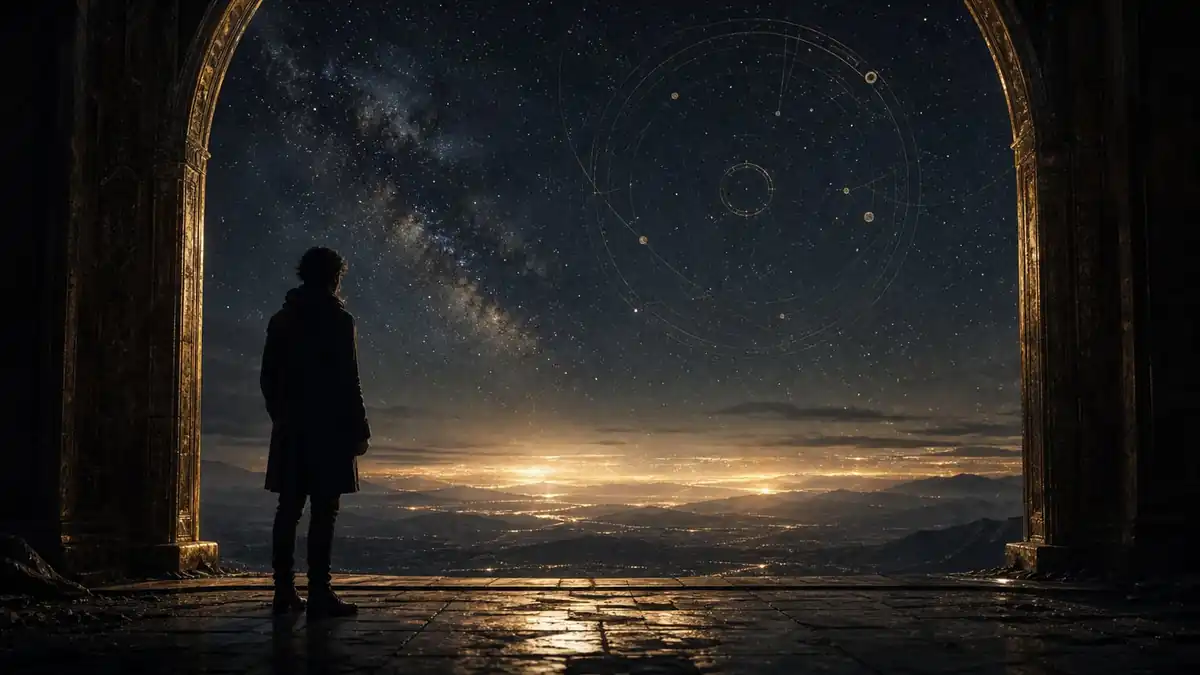
This essay is not claiming that the world is literally enchanted in the childish sense, or that science is a veil hiding convenient spells. That would be too easy, and too careless. The point is quieter and more severe: if fantasy is not merely falsehood, but a way of returning wonder to what has become numb, then reality itself is a deeper fantasy than many invented worlds.
Before Dragons, Being Itself Is Strange
When people hear the word fantasy, they often think of dragons, hidden kingdoms, impossible doors, ancient curses and magic spoken in a language older than cities. Those things matter, but they are not the beginning of wonder. Long before the dragon, there is the stranger fact that anything exists at all.
The old philosophical question sounds almost too simple: why is there something rather than nothing? Its simplicity is part of its weight. We can speak about the birth of stars, the evolution of life, the structure of matter, and the laws that describe motion, heat and light. Yet beneath every explanation remains a quieter astonishment: why is there a stage on which any of this happens?
In fantasy, wonder usually begins when the ordinary cracks. A door opens where no door should be. A map reveals a land erased from memory. A sword speaks. But in our world the impossible element is already present. Time exists. Law exists. Consciousness exists. A creature made of matter can ask why it is here. If we look at that without the shield of habit, we do not need to leave reality to find strangeness.
Habit Is the Silent Spell
Habit does not destroy wonder; it hides it so we can function. The danger begins when we confuse the hidden thing with an absent thing. We say a day passed, as though time were simple. We say a person died, as though death were ordinary because it happens often. We say I am here, as though selfhood were not one of the most unsettling sentences a mind can produce.
Fantasy, at its best, loosens the spell of habit. It does not always take us away from the real world; sometimes it returns the real world to us with its face uncovered. After walking through a fictional kingdom, a reader may look at a window, a road, a grave, a cup of water, or their own hand with slightly more attention. The invented world has made the actual world visible again.
This is why fantasy can be serious without pretending to be science. It can turn our attention back toward the overlooked. It can say: do not let repeated things become weightless. The fact that something happens every day does not make it shallow.
Reality Is Not the Opposite of Fantasy
If we define fantasy only as what is not real, we make it too small. It is true that fantasy often contains worlds, powers and creatures that do not exist in ordinary life. But its deeper work is not simply adding impossible objects. It gives shape to experiences that are real but hard to see.
Fear may become a forest. Power may become a crown, a ring, a blade, a curse. Grief may become a land of winter. Desire may become magic, because magic is one of the oldest images of the human wish to change reality by will. In this sense fantasy does not deny reality. It translates it.
That is where the real world and fantasy approach one another. Both deal with wonder, fear, mortality, longing and meaning. The fictional world may have dragons, but our world has something no less strange: a being who knows it will die and still asks about beauty, justice, memory and love.
Wonder Must Stay Careful
There is a cheap way to use wonder. It says: because the world is strange, any strange claim must be true. Fantasya should never do that. Wonder is not a permission slip for confusion. The fact that existence is mysterious does not make every mystery equally credible. A serious sense of wonder should make us more precise, not more gullible.
The real world becomes fantasy-like not because we abandon evidence, but because evidence itself stands inside a deeper astonishment. Science gives us some of the most powerful ways to understand reality. Philosophy asks what kind of reality could be understood at all. Fantasy reminds us that understanding should not always flatten the feeling of being alive.
The World Is Hidden by Being Too Near
Distant things are easy to find magical: a floating city, a cursed mountain, a ruined kingdom under moonlight. Near things are harder. A room. A breath. A name. A face we love becoming older. A memory returning without permission. The closer something is, the more likely we are to stop seeing it.
Fantasy creates distance. It lets us step outside the room so the room can become strange again. We leave the world not because it is empty, but because it is too close. Through an invented landscape, we return to the unnoticed depths of the real one.
The Ethics of Seeing
Wonder is not only a mood; it can become a responsibility. If being is strange, then other people are not small either. Their fear is not ordinary just because fear is common. Their grief is not simple because grief has happened before. Every person stands at the center of the same mystery: a mind awake for a while inside time.
Weak fantasy often loves scale: a larger castle, a larger war, a darker monster. Deeper fantasy understands that scale without human attention becomes hollow. The most astonishing thing in a world may not be the mountain, but the person standing beneath it, trying to go on.
Wonder Also Lives at a Small Scale
Fantasy often teaches us to recognize greatness in images larger than life, yet its deepest lesson may be smaller. A candle in a ruined hall, a hand on a closed door, a name spoken after years of silence, a road disappearing into rain: these images stay with us because they make scale intimate. They remind us that wonder does not always arrive as thunder. Sometimes it arrives as attention.
The real world is full of such small thresholds. A childhood room. A hospital corridor at night. The pause before someone answers a difficult question. The ordinary street after rain. Fantasy trains the eye to feel that these moments are not empty. They are doors without handles, places where the surface of reality becomes thin for a second. The more carefully we learn to see them, the less the world feels spent.
This kind of seeing does not make life easier in a shallow sense. It makes life less mute. Even sorrow becomes less blank when it is seen as part of a larger, stranger field of meaning.
The Next Doors
This essay is a beginning, not a final answer. A clearer definition of the genre belongs in What Is Fantasy?. The more intimate question of why a person may need another world belongs in When Fantasy Takes the Place of the Real World. Another path will ask whether fantasy is not escape from reality, but a way of repairing the reality we are given.
Conclusion
Our world is fantasy-like not because it is unreal, but because it is so real that habit has hidden its depth. The sky, time, memory, death, consciousness, longing, and the small fact of saying I am here: all of them are older and stranger than the names we give them.
Perhaps fantasy remains necessary because it teaches us to be astonished again. It opens a door, and when we return, we may discover that the first enchanted country was the one we had been standing in all along.
Further Reading
- Stanford Encyclopedia of Philosophy: Principle of Sufficient Reason for the philosophical background of the question of why anything exists.
- Stanford Encyclopedia of Philosophy: Cosmological Argument for major debates about the world, cause and explanation.
- Encyclopaedia Britannica: Fantasy for a general definition of fantasy as a narrative genre.
- Tolkien Estate: On Fairy-Stories for the idea of recovering familiar things through fantasy.