Works
Skyrim: Why Some Worlds Become Livable
Why Skyrim is not remembered only as a game to complete, but as a place to wander, return to, build a home in, hear the mountain wind, and briefly live inside a world that never existed.
Some games are completed and left behind. Others remain in memory even after the main story is over, not only because of an ending, a villain, or a heroic role, but because they have made a place inside us. Skyrim belongs to that second kind. Its name does not only call up quests, dragons, dungeons, and skill trees. It calls up snow, mountain wind, a warm inn after a cold road, and the strange feeling that an imaginary world can be briefly lived in.
This article is not an attempt to declare Skyrim flawless. It has repetition, simple systems, rough edges, and moments that show their age more clearly now. But the endurance of a world does not always come from perfection. Sometimes it comes from return. A fantasy world becomes livable when it gives the player not only goals, but habits, routes, refuge, and memory.
In Elden Ring: A Broken World, Death, and the Beauty of Ruin, the world felt as if it began after the collapse of myth. Skyrim creates another feeling. It is dangerous and mythic, but it is also habitable. Elden Ring often makes the player small before the majesty of ruin. Skyrim more often invites wandering, dwelling, and the making of a private mental home.
Playing Is Not the Same as Living
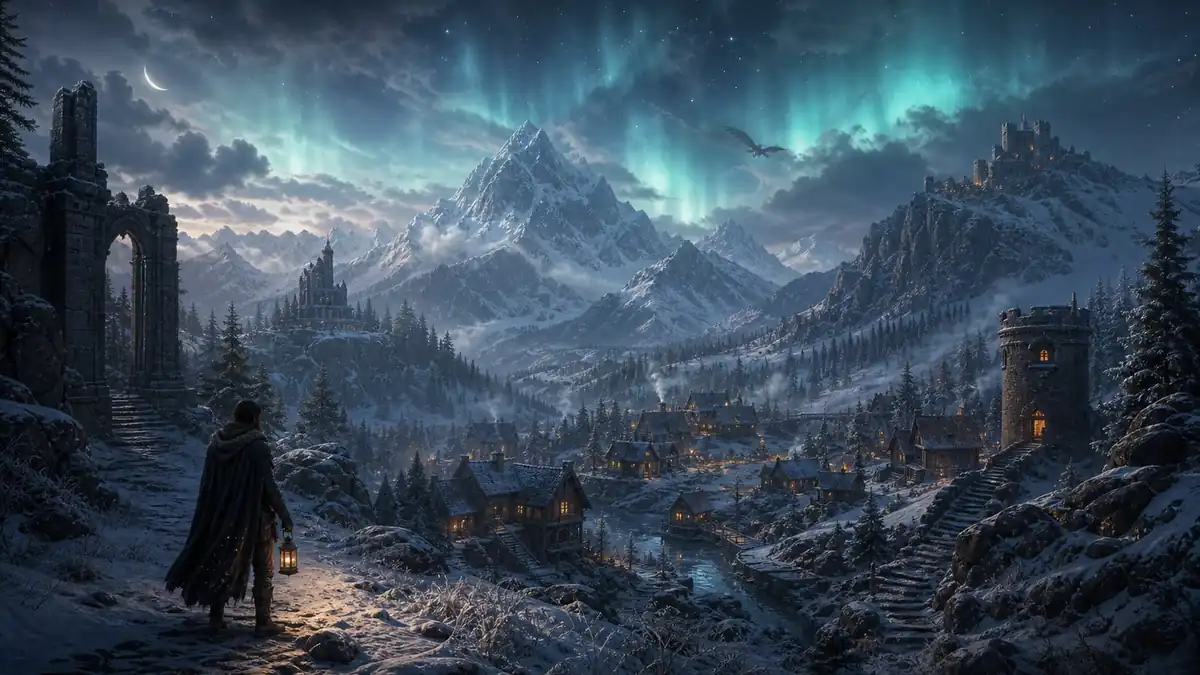
To play is to pursue objectives, complete tasks, gain power, move forward, and win. To live inside a world is to forget the objective for a while and simply be there. Skyrim leaves that door open from the beginning. You can follow the main story and take the return of dragons seriously. But you can also leave the road, enter a nameless cave, sell something in a small town, listen to music inside an inn, climb down from a mountain, or follow a river just to see where it goes.
That freedom changes the world from a quest system into a mental place. When a player feels that every moment does not have to be efficient, the world begins to breathe. The moments without great achievement often become the most lasting ones: walking through snow, seeing village lights in the distance, hearing water under ice, or stopping near a fire.
That is where Skyrim touches a larger Fantasya question: why do human beings need imaginary worlds? Not only to escape, but to experience another form of being.
Nature That Is More Than Background
Skyrim would not feel the same without its mountains, snow, and northern sky. Nature is not just decoration here. Mountains direct the player, create distance, hide danger, and give weight to travel. Rivers, cold forests, stone paths, blue nights, and aurora lights give texture to the world. The player does not only see the land. They feel it as air, distance, silence, and cold.
Many fantasy worlds have maps, but not all of them feel like territory. Territory means that places have relationships. It means the road between towns matters. It means a mountain is not only a background image, but a barrier, a landmark, a memory, and a promise. Skyrim is strong at creating that bodily sense of geography.
In What Is High Fantasy?, a secondary world needed its own laws, geography, and sense of history. Skyrim may not be the most philosophically complex fantasy world, but as a place to inhabit, it turns geography into experience.
Small Towns and Warm Refuges
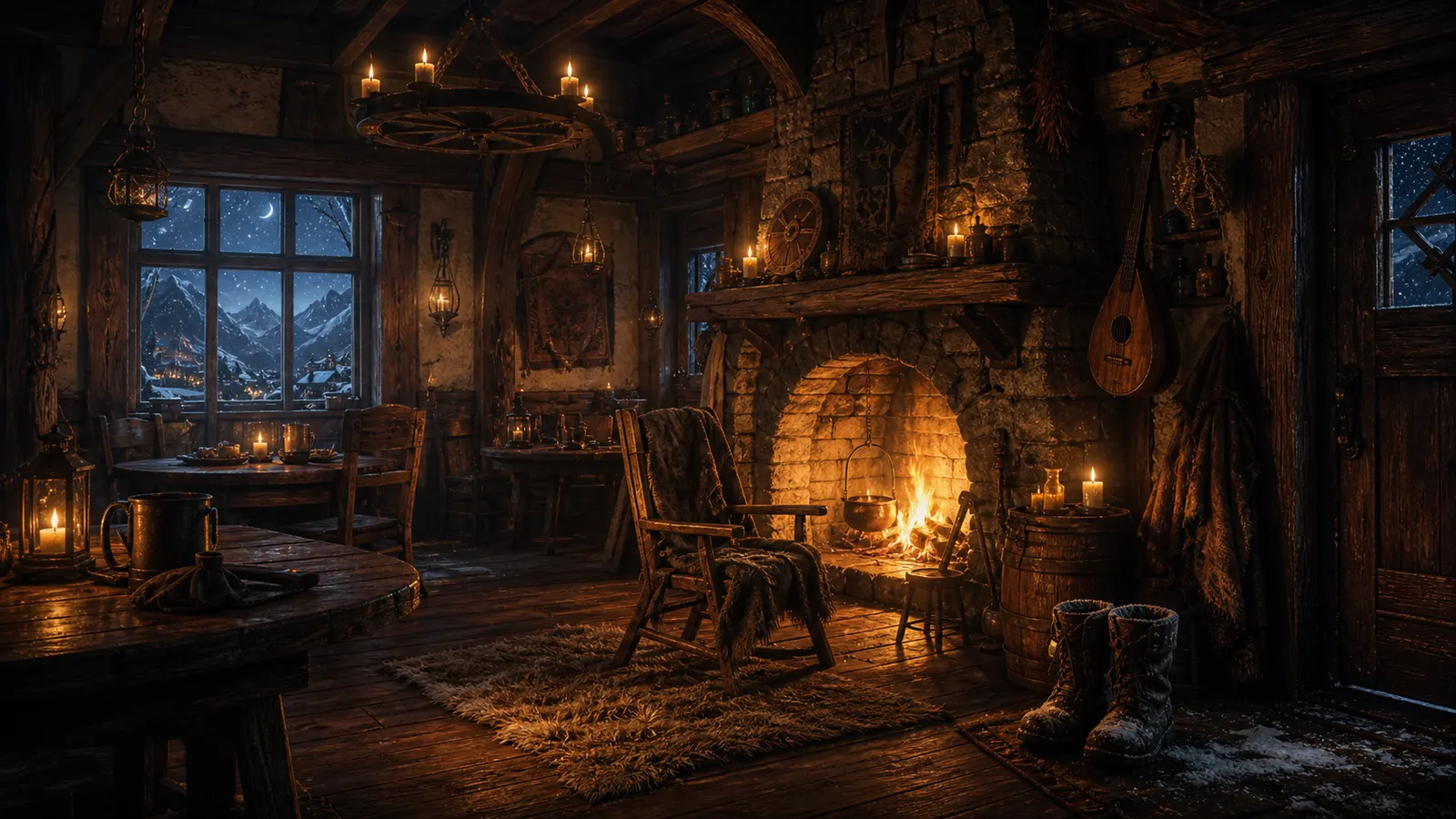
A world made only of danger does not become livable. To live in a world, there must also be refuge. Skyrim builds that with towns, villages, inns, blacksmiths, small markets, and timber houses. These places are not always mechanically deep, but emotionally they do important work. They give the world a rhythm of return.
After a cave, a storm, an attack, or a long road, entering an inn has meaning. Fire is not only light; it is the opposite of cold. A chair is not only an object; it is permission to pause. Repeated voices can become funny after years, but repetition also makes familiarity. A mental home is rarely built only from grand moments. It is built from small returns.
Small Quests, Small Lives
If everything is only about saving the world, the world soon becomes smaller. Skyrim lasts because it places small troubles beside the great threat: a family dispute, a closed mine, a letter to deliver, a rumor in a town, a cave nobody returned from, or a person who simply wants their pain heard.
These small quests are not always masterpieces of writing, but they do something essential. They suggest that the world was not made only for the hero. Ordinary people live there too. They trade, fear, lie, love, complain, work, and age. Fantasy becomes alive when everyday life stands beside myth.
In Dragons in Fantasy, the dragon could stand for power, fear, desire, or ancient grandeur. In Skyrim, dragons bring myth back into the sky. Yet the world is not alive because of dragons alone. It breathes through blacksmiths, guards, travelers, farmers, innkeepers, and the repeated routines of ordinary people.
Dragons Matter Because They Land Beside Daily Life
Skyrim would not have the same force without dragons. They wake the mythic scale of the world. They remind us that beneath wood, snow, trade, and village roads lies something ancient and dangerous. But their power grows because they appear beside ordinary life. When the sky over a village suddenly darkens, myth leaves the book and casts a shadow across rooftops.
That mixture matters. If the world were only dragons, prophecy, and shouting to the heavens, it would become distant and theatrical. If it were only houses, trade, and local errands, the fantasy would fade. Skyrim moves between both. You can be pulled into the fate of the world and then return to iron, food, a house, a road, or a safe bed.
That is what makes the world inhabitable. Real life is not made only of great moments. It is made of errands, weather, work, routine, and return. Skyrim rebuilds that rhythm in fantasy form.
Music and Sound: A Home You Can Hear
Much of Skyrim's feeling is not visual but sonic. Quiet music while wandering, wind over snow, an inn fire, footsteps on wood, river sound, and the long silence of mountains all carve the world into memory. Years later, a few notes can bring back an entire road.
Games that stay in memory are often not only seen. They are heard. Sound gives place depth. It lets the world continue in the mind after the screen is off. This is why Skyrim is not only a collection of fantasy images. It has rhythm, breath, and a kind of auditory nostalgia.
Many people return to Skyrim even when they do not expect to find new content. Sometimes the return is not for content. It is for atmosphere. It is for the feeling of being somewhere known.
Getting Lost as Experience
Skyrim lets the player get lost. That is not a failure. Some of the best memories come from leaving the main road and finding something you did not intend to find: a cave, a tower, a view, a sudden enemy, or only the light of a house in the distance.
Freedom alone is not enough. A world needs signs. It needs shapes in the distance that call to the player. Skyrim often does this through mountains, broken towers, side roads, far villages, dark entrances, and paths that bend out of sight. There is usually something that pulls you away from the efficient route.
In a livable world, deviation is part of the experience. If you only optimize, you may finish the game. If you allow yourself to wander, you remember the world.
Nostalgia for a Place That Does Not Exist
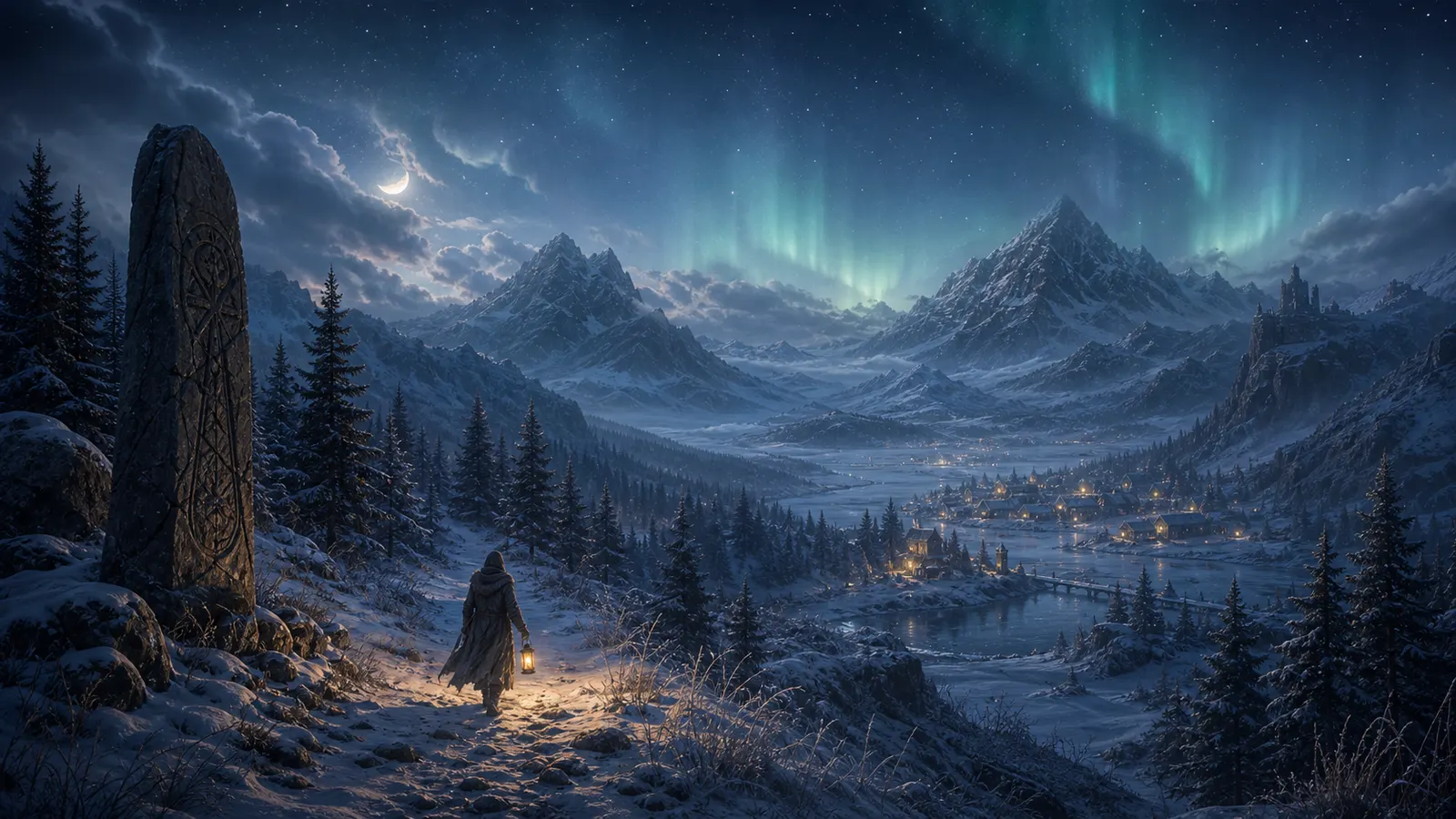
One of fantasy's strangest powers is that we can miss a place that is not real. Skyrim has become that kind of place for many players. Not because everything in it is better than reality, but because it combines danger, refuge, freedom, cold, music, and habit into something that begins to feel like home.
A mental home is not always perfectly safe. It may be filled with dungeons, enemies, and storms. But it is returnable. You learn its roads. Its cities become familiar. You know where to sell, where to sleep, which road is dangerous, and which ridge has the better view. Those small knowings make the world personal.
In Fantasy Is Not Escape From Reality; It Is Repair of Reality, fantasy was treated as a way to give human experience a more bearable shape. Skyrim does this not by argument, but by allowing the player to stay.
Even Limits Become Memory
Skyrim is not perfect. Some systems are simple, some dialogue becomes repetitive, some quests are thin, and the world can behave mechanically. Yet for many players, even those imperfections have become part of memory. Livable worlds are not always made by flawless polish. Sometimes they are made by habit.
That does not excuse every weakness. It means the endurance of a world is not only the sum of its isolated parts. It is the relationship the audience builds with it. A real home is not perfect either. It has repeated sounds, familiar routes, broken corners, and small irritations. It is home because time has passed there.
Skyrim became something like that for many people: a world whose roughness may be easier to see today, but whose roads the body still remembers.
Why Skyrim Still Matters
Skyrim still matters because it shows that fantasy is not only about grandeur. It is also about dwelling. Sometimes the audience does not only want to finish a story. They want somewhere to return to, even if that place is made of code, image, and sound. If The Lord of the Rings gives fantasy worldhood through history, language, and mythic depth, Skyrim gives game fantasy a feeling of wandering and temporary residence.
The world reminds us that fantasy becomes deep when it makes not only wonder, but habit. Not only battle, but roads. Not only dragons, but an inn to return to after the dragon has passed.
Perhaps that is Skyrim's secret: it does not always demand that we be heroes. Sometimes it simply allows us to be travelers. To walk through snow, hold a lantern, see village light in the distance, and feel that even an imaginary world can become a place of return.
For a practical route through these worlds, see The Best Fantasy Games for Entering Another World.
Sources and Further Reading
- Bethesda: Skyrim 10th Anniversary for the official anniversary page and Skyrim overview.
- Bethesda: Skyrim buy now for official editions and platforms.
- Steam: Skyrim Special Edition for the official Special Edition store description.
- Xbox: Skyrim Anniversary Edition for the official Xbox edition page.
- PlayStation: Skyrim for PlayStation's official game overview.
- Nintendo: Skyrim for the official Switch edition page.