Lore
Dragons in Fantasy: Monster, God, or Mirror of Power?
A guide to the many roles of dragons in fantasy: monster, treasure guardian, ancient force, earthbound god, speaking intelligence, dangerous ally, and mirror of human power.
The dragon is one of those images that seems to have lived in the human imagination before any single story claimed it. We hear the word and something larger than an animal rises in the mind: wings casting a shadow over a valley, scales like armor, eyes older than kings, fire that does not merely burn but judges, and a body that belongs at once to serpent, bird, beast, and mountain.
In fantasy, a dragon is rarely only a monster. It may be the final enemy of a hero. It may guard a treasure that no ordinary hand should touch. It may be an ancient force, almost an earthbound god. It may speak with a mind older than nations. It may become an ally, yet still remain too proud and dangerous to feel tame. When a dragon is written well, it is always larger than its surface role.
In What Is Fantasy?, fantasy was described as a hidden language for fear, hope, power, death, and meaning. The dragon is one of the loudest words in that language. In it, terror and splendor stand together. We see something capable of destruction, yet the destruction itself carries grandeur. That tension separates a dragon from a merely invented beast.
A Working Definition
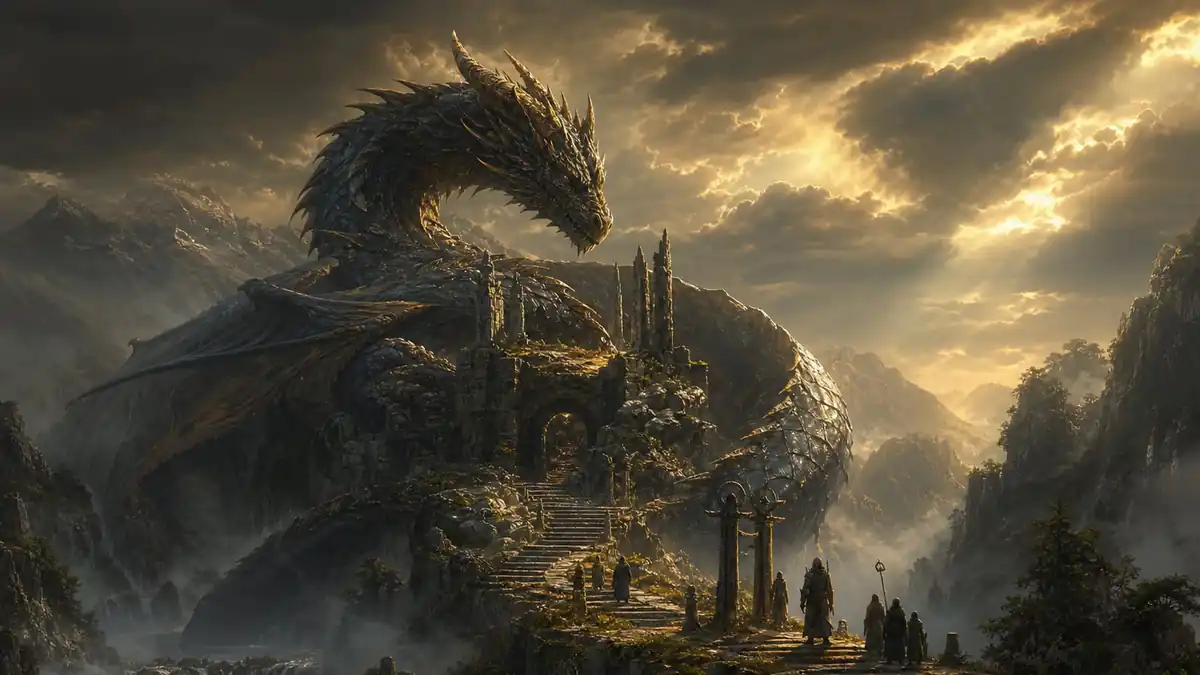
A dragon is usually an enormous, extraordinary, mythic creature associated with serpents, reptiles, wings, fire, scales, treasure, mountains, caves, water, sky, or ancient power. But that definition only describes the outer shell. In fantasy, a dragon is more a role than a fixed body. It may have wings or not. It may breathe fire, command storms, sleep under mountains, speak, or remain utterly alien.
What makes a dragon feel like a dragon is not size alone. It is the creature's relationship to power. A dragon seems larger than the ordinary world. When it enters a story, the air changes. A mountain stops being only geography and becomes the shelter of something old. Treasure stops being wealth and becomes desire protected by fear. A hero stops facing a strong opponent and starts facing the upper limit of danger.
That is why dragons are so useful for creating scale. In What Is High Fantasy?, we looked at secondary worlds, mythic depth, and the sense of another reality. A dragon can establish that scale almost instantly: something ancient, massive, and unwilling to surrender the world entirely to human hands.
Why Dragons Appear Everywhere
Dragons appear in many cultures, but not always in the same shape. In many European traditions, dragons are linked to danger, caves, treasure, fire, and heroic combat. In East Asian traditions, dragons may be associated with rain, rivers, heaven, imperial authority, blessing, and cosmic order. In Greek myth, serpent-like dragons often guard springs, sacred places, treasures, or dangerous trials.
These differences matter because they show that the dragon has no single meaning. It can be fear, authority, nature, chaos, wisdom, test, imperial power, or spiritual force. Yet the forms share something important: the dragon is never easy to ignore. Humanity must fear it, bargain with it, kill it, learn from it, or live under its shadow.
This breadth makes dragons especially rich for modern fantasy. A writer can draw from the European treasure-guardian, the sky-and-rain dragon of East Asia, the serpent guardian of Greek myth, or something entirely new that only carries an echo of older forms. What matters is that the dragon should not appear merely because dragons are popular. It needs weight inside its world.
What the Dragon's Body Means
The dragon's body always says something. Wings are not only for flight; they mark superiority over the ground. Fire is not only a weapon; it is the power to change matter. Scales are not only armor; they make the body a living fortress. Horns, claws, tail, long neck, luminous eyes, and serpentine movement all create a feeling of age and danger.
A wingless dragon often feels more earthly, ancient, or serpent-like. A winged dragon claims the sky. A many-headed dragon can suggest danger that multiplies when attacked. A speaking dragon is no longer merely an animal; it enters the realm of memory, cunning, pride, and wisdom. A dragon without fire but bound to ice, storm, shadow, or water can change the entire mood of a world.
The details should grow from the dragon's story role. If the dragon is a force of nature, its body may suggest mountain, root, cloud, river, or storm. If it represents greed, gold and darkness around it matter. If it is wise, its gaze and silence may matter more than flame. A strong dragon is not only seen; it interprets the world around it.
Dragon as Monster
The simplest dragon role is monster. Monster does not have to mean shallow evil. It means a force that pushes the human being out of safety. When a dragon appears as an enemy, it shows that the hero faces danger beyond ordinary human measure. Courage, sword, plan, and loyalty are tested against something that can make a city feel small.
A dragon monster becomes weak if it is only large. Fear needs meaning. Perhaps it burned cities. Perhaps no one has dared approach its mountain for centuries. Perhaps people sacrifice to keep it sleeping. Perhaps the dragon caused the rise of a kingdom or its fall. Then the dragon is not just a boss at the end of the road. It is a shadow that has shaped human life.
In What Is Dark Fantasy?, darkness mattered because it placed pressure on morality and choice, not because the scenery was black. The dragon as monster works the same way. If it is only something to kill, it remains simple. If killing it has a price, if its treasure has corrupted a city, if people have learned to depend on fear of it, the dragon enters deeper story.
Dragon as Guardian of Treasure and Threshold
One of the most enduring dragon images is the treasure guardian. Yet treasure in fantasy is not only gold. It may be forbidden knowledge, an ancient blade, the true name of a god, a gate into another world, or a power that humanity is not mature enough to carry. In this role, the dragon is not merely an obstacle. It is the guardian of a threshold.
The real question is not simply whether the hero can defeat the dragon. It is whether the hero has the right to cross the threshold. Should the treasure be freed? Will the world be healed by taking it, or will a new shape of greed begin? Here the dragon becomes an ethical lock placed on the world.
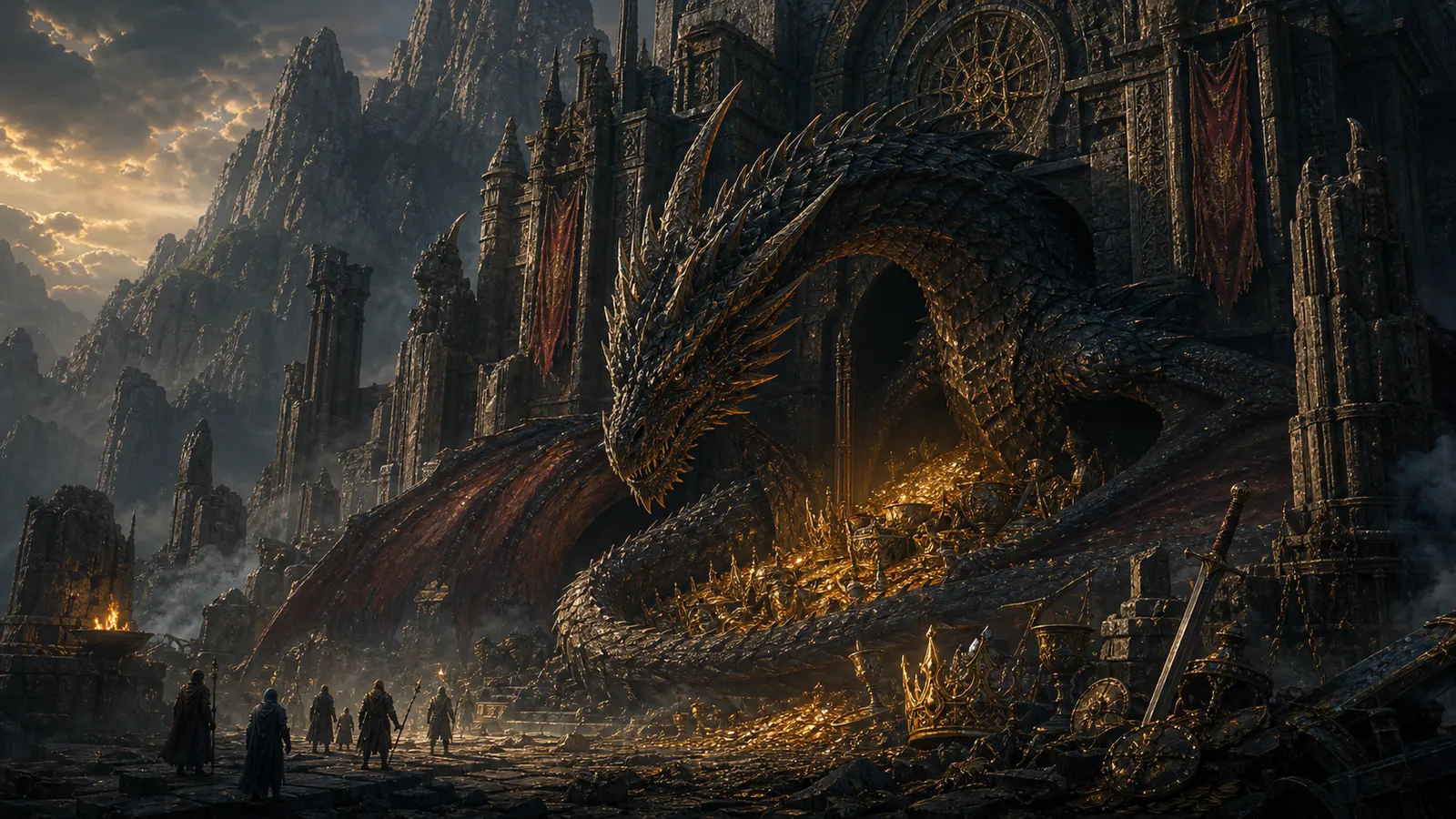
This guardian role is tied to human desire. Gold under a dragon's body is not only wealth. It is a mirror of wanting. We look at the treasure and see the danger, yet we still feel the pull. The dragon seems to ask: is what you want worth walking toward fire?
Dragon as Ancient Force
Some dragons are less like characters and more like living history. Their presence suggests that the world had depth before humans arrived and may continue long after them. Such a dragon may speak little or not at all, yet its silence can be heavier than pages of dialogue. It does not merely live in the world. It feels like part of the world's memory.
This kind of dragon is powerful for worldbuilding. A mountain that holds a thousand-year-old dragon is not just terrain. A royal house that borrows its symbol from a dragon ties politics to myth. If magic is made from dragon bone, dragon blood, or dragon language, the dragon connects directly to the magic system of the world.
At that level, a dragon is not just something to fight. It is evidence that older layers exist beneath the present story. The audience feels forgotten histories and sleeping powers under the surface. That is one way fantasy begins to feel like a world rather than a stage.
Dragon as God or Sovereign of Nature
In many stories, the dragon approaches divinity. Not always a temple god, but an earthbound, violent, ancient, touchable god. It may bring rain, breathe fire, live as part of a mountain, or alter the season with its waking. Before such a being, humanity is not merely brave or cowardly. It is small.
This kind of dragon must keep some distance. If it is overexplained, its majesty shrinks. Perhaps human cultures tell contradictory myths about it. Perhaps no one knows whether it is good or evil. Perhaps, from its own perspective, human lives are too brief to make their judgments meaningful.
A divine dragon gives a story sacred fear. The hero is not simply confronting an enemy. They are confronting an older order of the world. Killing such a dragon may be victory, but it may also feel like the end of an age.
The Wise Dragon
The speaking, wise dragon is one of the most compelling forms. Such a creature can remember more than kingdoms. It has watched rulers rise and collapse. It knows languages humans have forgotten how to pronounce. To the dragon, a human life may be a brief flame: warm, vivid, and gone almost at once.
But a wise dragon should not become a kindly old man with wings. Its wisdom should remain strange. It may tell the truth without human mercy. It may help for reasons no one fully understands. It may be tired of human wars and still retain terrifying pride. A strong wise dragon makes knowledge feel costly.
Sometimes speaking with a dragon is more dangerous than fighting it. A sword threatens the body; a dragon's words can threaten the hero's image of the self. It may show the hero what they did not want to see: greed, fear, vanity, hunger for rule, or the smallness hidden beneath noble language.
Dragon as Mirror of Power
Perhaps the deepest dragon role is this: the dragon as mirror of power. We fear dragons because their power is beyond control. Yet we also stare at them because something in humanity wants to be that magnificent, that unconquered, that free from ordinary need. The dragon is what power might look like if power took a body.
That is why kings, warriors, and empires are so often drawn toward dragons. Not only to kill them, but to borrow their splendor. A crown beneath a dragon's shadow is no longer only a crown. It becomes a claim about the right to rule. Dragon armor, dragon blood, dragon banners, dragon pacts all return to one question: what does a human being do with power greater than the human scale?
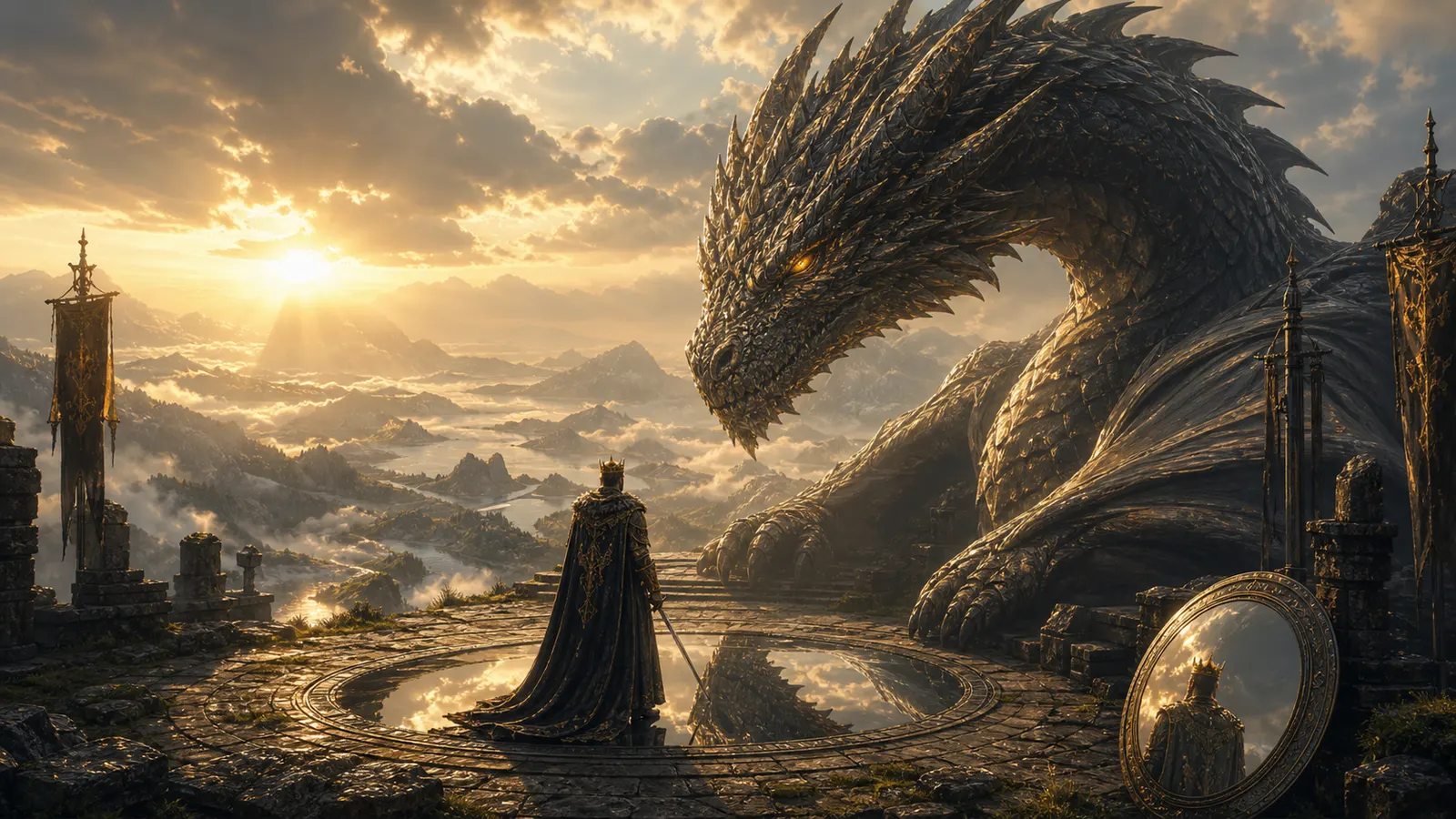
For Fantasya, the dragon is not only an outer enemy. It is an image of the human desire for greatness. Unchecked, that desire burns cities. Understood, it can force a person to face their own limits. The dragon says that power always has two faces: splendor and threat.
Dragon as Ally
Modern fantasy often makes the dragon an ally, companion, or mount. This can be thrilling, but it carries a risk: the dragon must not become a large horse with fire. If it becomes too tame, its majesty fades. Even as an ally, it should keep some distance, pride, danger, and will of its own.
An alliance with a dragon should feel like a pact, not simple ownership. The hero should not merely have a dragon. They should earn trust, pay a price, or enter a relationship with a being that has its own memory, desire, and judgment. A good allied dragon is not equipment. It is a presence that can refuse.
That difference matters. When a dragon becomes a tool, the story flattens its power. When it remains a free and dangerous ally, every flight, battle, silence, and glance keeps weight.
Writing a Strong Dragon
First, know the dragon's role in the world. Is it an enemy, guardian, sacred force, royal symbol, endangered species, part of the magical order, or living memory? If the role is unclear, even a visually impressive dragon may feel decorative.
Second, take scale seriously. A world with dragons should remember them. People may have rituals, weapons, architecture, songs, laws, economies, fears, or political myths shaped by dragons. A dragon should leave marks even when it is not on the page.
Third, know the cliche and choose what to do with it. A fire-breathing treasure guardian can still be excellent if the treasure has meaning and the fire is more than spectacle. A wise dragon can become weak if it only speaks vague riddles. Old roles become alive when they gain fresh choices and real consequences.
Conclusion
The dragon is one of fantasy's strongest images because it gathers fear, wonder, age, greed, sovereignty, nature, and desire into one body. It can be monster, guardian, god, ancient force, ally, enemy, teacher, or mirror. In every form, it is connected to power.
A good dragon does not enter merely to enlarge the scene. It makes the world older, the danger more serious, the treasure more troubling, the hero smaller, and power more visible. When a dragon is truly alive, we do not ask only how it can be defeated. We ask why human beings have always needed such a creature in order to speak about terror, splendor, greed, rule, and the impossible beauty of strength.
For the wider bestiary, continue with Fantasy Creatures: A Guide.
Further Reading
- Wikipedia: Dragon for a broad overview of dragons across cultures.
- Theoi: Dragons in Greek Mythology for examples of drakon figures and guardian creatures in Greek myth.
- Encyclopedia.com: Dragon for symbolic differences between traditions.
- Brewminate: The Dragon in Ancient China for the Chinese dragon's relation to power, blessing, and imperial culture.
- Natural History Museum of Los Angeles County: Year of the Dragon for a concise cultural look at dragons, imagination, and power.