Lore
Why Do We Create Monsters?
Some fears become easier to face once we give them a body and a name.
We create monsters to give shape to fears that are otherwise too large, too quiet, or too uncertain to face. Illness has no footsteps in the corridor. Death does not need to knock. Betrayal can sit across the table and speak in a familiar voice. A monster makes such dangers visible: it crosses a threshold, leaves tracks, carries a smell, and can be given a name.
Yet the creature always carries something besides fear. Its body tells us who has been left outside the firelight and what the people inside have decided to call human. The most enduring monsters eventually turn toward their makers. They show us our dread of pain and disorder, then ask what we have done with that dread.
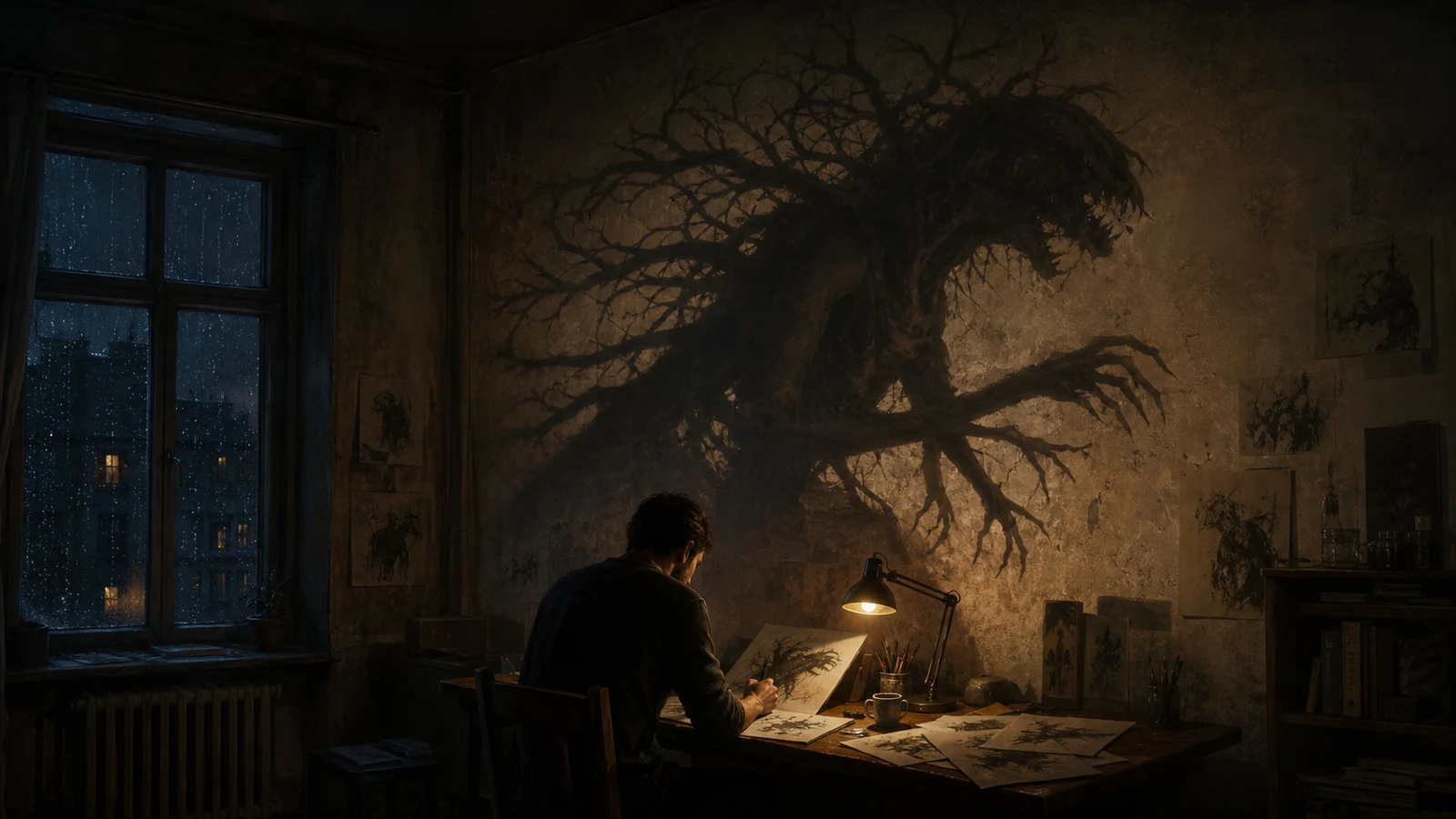
Fear Gets a Face
A person waiting for a medical result may wash the same cup twice. A parent listening to a child cough at three in the morning counts the seconds between breaths. Someone who has lost a job studies an unopened bill as if the paper itself might move. These fears are real, but they are difficult to hold because they have no single body and no clear edge.
Stories give them one. Hunger becomes a mouth that can never close. Isolation becomes a figure watching from the tree line. A violent household becomes a room in which something wakes whenever the floorboards creak. Once fear has a face, a story can approach it, flee from it, bargain with it, or discover that it has been misunderstood.
Jeffrey Jerome Cohen’s Monster Theory describes the monstrous body as a kind of cultural body, formed from the anxieties and prohibitions of the world that imagined it. This does not turn every creature into a simple code. A wolf, ghost, or giant can mean different things in different stories, and sometimes it exists because storytellers enjoy wonder, danger, and scale. Still, patterns matter. What a society repeatedly places outside its door can reveal what it is trying to keep inside.
A guide to fantasy creatures can map dragons, spirits, undead beings, and invented species. The harder question begins after classification: why did this particular creature become frightening here, to these people, at this moment?
The Body Is Afraid Before Reason
The body reads danger quickly. Teeth angled for tearing, eyes fixed from the dark, sudden movement, the odor of decay, a wound that seems infectious: these signs can produce a reaction before a person has formed a sentence. Mathias Clasen’s evolutionary account of horror argues that many successful monsters exaggerate threats human beings have long had reason to notice, including predators, hostile people, contagion, and unsafe environments.
That account is useful when kept modest. It does not prove that every fear is hardwired, that all audiences react alike, or that culture merely decorates an ancient reflex. Experience teaches fear. So do family stories, religious images, local landscapes, films, and the behavior of other people in the room. Biology may help explain why a snapping jaw is easy to notice; it cannot explain the whole life of a vampire, an oni, or Grendel.
Disgust also needs care. It evolved in part as protection from contamination, but human beings have repeatedly turned the language of dirt, disease, and infestation against other people. A scar, disability, limb difference, asymmetrical face, chronic illness, or unfamiliar body says nothing about moral character. Using visible difference as shorthand for evil repeats a cruelty that monster stories should be able to expose. The frightening element should arise from action, atmosphere, impossible nature, or a genuine threat—not from treating an ordinary human body as a warning sign.
The Thing That Should Not Be Possible
Some creatures disturb us because they refuse the categories by which we keep the world orderly. The corpse walks. The child speaks with an ancient voice. A familiar face moves with the wrong rhythm. A body seems human until it opens like an insect. Noël Carroll argues that horror monsters often violate the natural order assumed by the characters around them. They occupy borders that the mind expects to remain closed.
This also separates a fantasy creature from a horror monster. A dragon in a secondary world may be an animal, an ancestor, a speaking person, or a force woven into creation. The inhabitants may fear its fire without believing its existence is an offense against reality. The long history of dragons in fantasy shows how the same broad form can carry greed, wisdom, sovereignty, wildness, or sacred power. Horror begins when the encounter feels like a breach: the world’s own rules appear to have failed.
That distinction matters in dark fantasy, where wonder and dread often share a border. A creature can be beautiful, lawful within its world, and still dangerous. Calling it a monster is therefore a relationship, not a neutral biological diagnosis.
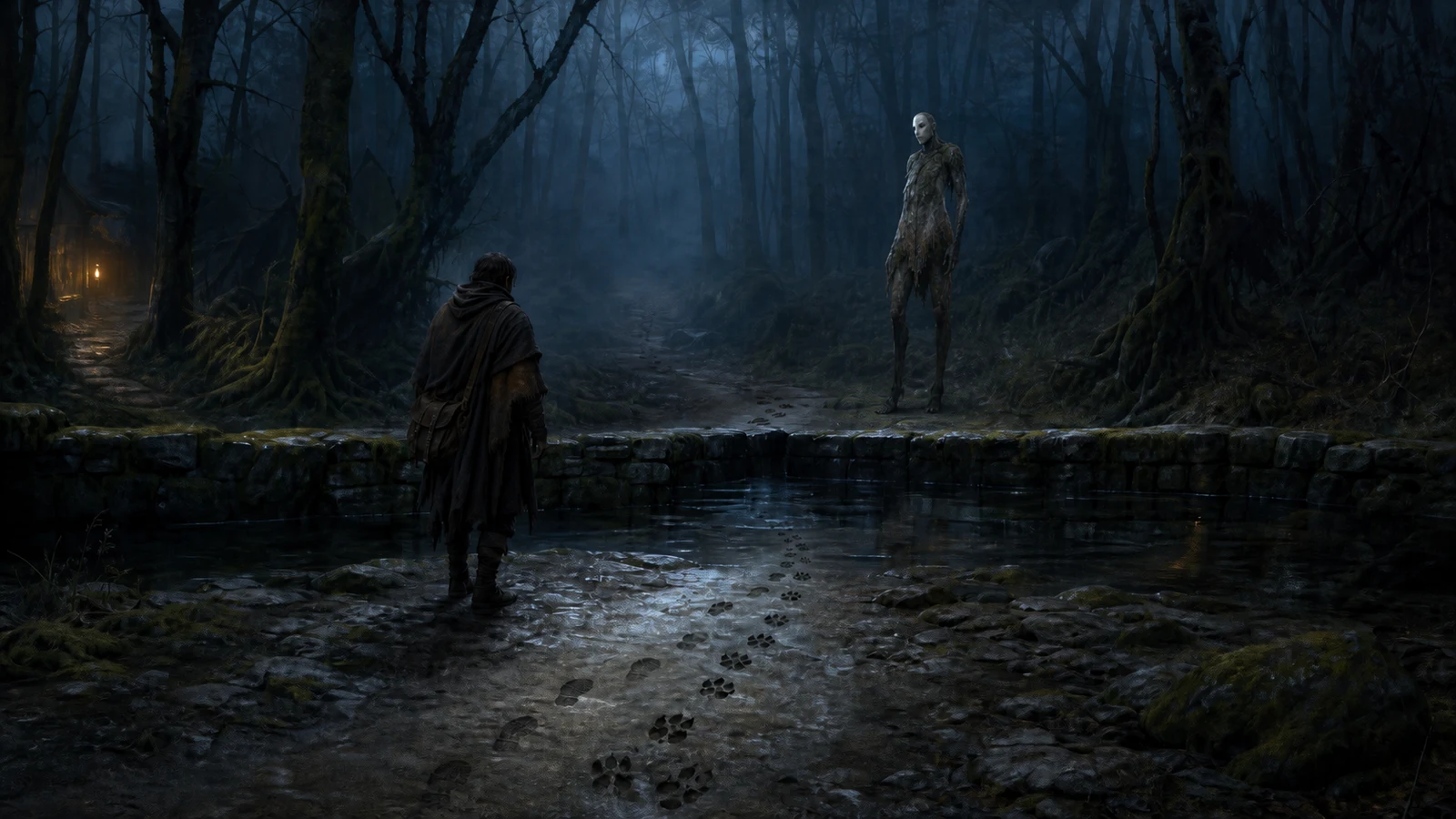
Grendel Outside the Hall
In Beowulf, the bright hall of Heorot holds song, kinship, gifts, memory, and the fragile order built by human hands. Grendel comes from the moors and enters that warmth as a killer. The contrast is powerful because almost everyone knows the small comfort of a lit window on a bad night. The wall says that safety exists here. Grendel proves that the wall can be crossed.
J. R. R. Tolkien’s famous defense of the poem placed its monsters at the center rather than treating them as embarrassing decorations around historical material. Through Grendel and the dragon, the poem gains a larger horizon: human courage matters, yet every hall, king, and body remains exposed to time and ruin.
Grendel should not be softened into an innocent outsider. He attacks sleeping people and has agency within the poem. Nor does his violence prevent us from seeing how the story draws its boundary between hall and wilderness, kin and exile, the grievable dead and the enemy whose death restores celebration. A monster can be dangerous and still reveal the architecture of the community that names it.
The Dead Who Would Not Stay Buried
Death leaves survivors with a terrible mismatch. The person they knew is gone, while the body remains and begins to change. In communities without modern knowledge of decomposition, an exhumed corpse that looked swollen, darkened, or unexpectedly preserved could seem active rather than dead. Paul Barber’s study of vampire folklore shows how observations of bodies, oral transmission, epidemic fear, and burial practices could gather into stories of revenants.
This is evidence for some European traditions of the returning dead, not a master key to every vampire story. No single disease or funeral misunderstanding explains the vampire across centuries. The figure survived because it could absorb new fears: contamination, predatory intimacy, inherited corruption, forbidden desire, and the rich person who remains young by consuming other lives.
The vampire gives death an intention. That may be more frightening than decay, but it is easier to narrate. A village cannot argue with mortality. It can open a grave, identify a suspected revenant, and perform an act meant to end the haunting.
Who Made Frankenstein’s Creature a Monster?
Victor Frankenstein assembles a living being, looks at him, and runs. The abandonment occurs before the creature has chosen cruelty. Mary Shelley then gives him language, loneliness, a desire for companionship, and the capacity for remorse. The Oxford Faculty of English notes that these qualities preserve a painfully human possibility in the figure whom others reject on sight.
The creature later murders. His suffering explains part of his path; it does not erase his victims or relieve him of agency. That tension is why the novel remains alive. Victor is responsible for creating life without accepting care. Other people respond to appearance with fear and violence. The creature turns injury into vengeance. No single verdict can carry all three truths.
There is an ordinary human ache inside this Gothic scale. It is the experience of entering a room and sensing judgment before speaking, of watching a stranger move away on a bench, of learning that other people have built a story around your face. Shelley does not ask us to pretend the creature is harmless. She asks what happens when recognition is refused so early and so completely that rage becomes the only remaining relation.
The Unknown Is Not Always an Enemy
The word yōkai is often translated as monster, yet the International Research Center for Japanese Studies warns that the category is much wider. It can refer to an eerie incident, an unexplained presence, a supernatural being, or its depiction. Even oni does not name a uniformly evil species; its meanings can include spirits of the dead, plague-bearing beings, dangerous ogres, and figures that protect sacred order.
That ambiguity offers a needed correction. The strange thing near the river may mark a dangerous place, preserve a local memory, punish carelessness, invite ritual respect, or remain unexplained. It does not always arrive to become a boss fight. Sometimes the proper response is distance. Sometimes it is an offering, a changed habit, or a story told so children remember where the current becomes strong.
Flattening these beings into a universal catalogue of demons would destroy the very uncertainty that gives them life. Across many traditions, the border between monster, spirit, god, ancestor, animal, and landscape is porous. The unknown can threaten human beings without existing solely as their enemy.
The Monster May Be Sitting on the Throne
The easiest monster stands outside the gate. The more unsettling one designed the gate, employs the guards, and decides whose name appears on the list. Power can become monstrous without changing its face. An order arrives with a seal. A family loses its home by procedure. A prisoner becomes a number, and everyone involved says the rule leaves them no choice.
Monster stories can hide such power by placing evil in a visibly alien body. They can also expose it. The apparent creature may show tenderness while the respectable court feeds on war, inheritance, or fear. Frankenstein moves responsibility toward the creator. Ursula K. Le Guin objected to fantasies that comfortably externalize evil into one villain who can be killed. Her Earthsea keeps returning to pride, possession, imbalance, and the shadow within the self.
This is where moral ambiguity earns its place. It should never mean that cruelty has no moral weight. It means appearance and allegiance do not settle the judgment. The moral grayness of The Witcher often grows from that pressure: the named monster may be capable of restraint, while a frightened crowd or polished ruler chooses harm.
Why We Enjoy Being Frightened
At night, a reader hears a branch touch the window and looks up from the page. The room is familiar. The door is locked. The story has brought danger close enough to wake the body while leaving a path back to safety. That distance can make fear compelling.
Carroll emphasizes how the reactions of fictional characters guide an audience’s response. Clasen argues that horror artists heighten attention by combining familiar threat cues with impossible features. David Gilmore’s comparative work adds the strange mixture of repulsion and fascination: people flee monsters in imagination, then paint them, carve them, wear their masks, and tell their stories again.
Fiction may offer rehearsal, curiosity, shared excitement, or a temporary shape for anxiety. It would be too strong to promise catharsis or therapy to every reader. Sometimes fear simply exhausts us. The crucial freedom is that a safe story can be closed, discussed, revised, and entered again on different terms.
When Killing the Monster Solves Nothing
The cleanest heroic ending places all corruption in one body and destroys it. The village cheers; morning returns; no one examines the conditions that made the terror possible. Such endings can satisfy, especially when the creature truly is an agent of relentless harm. They can also teach a shallow moral habit: find the ugly source, strike it, and call the world healed.
Le Guin’s response to an adaptation of Earthsea was sharp on this point. The darkness within a person cannot be removed by swinging a magical sword. Ged survives his shadow by turning toward it and learning its name. This is not surrender to evil. It is a refusal to pretend that pride, fear, and the hunger for power always belong to someone else.
Moral ambiguity works when it increases responsibility. The dragon may demand a treaty rather than extermination. The spirit may be guarding a wound in the land. The cursed person may need restraint and care at once. A writer does not have to make every monster sympathetic. The deeper task is to decide whether violence answers the truth of the encounter or merely protects the heroes from knowing themselves.
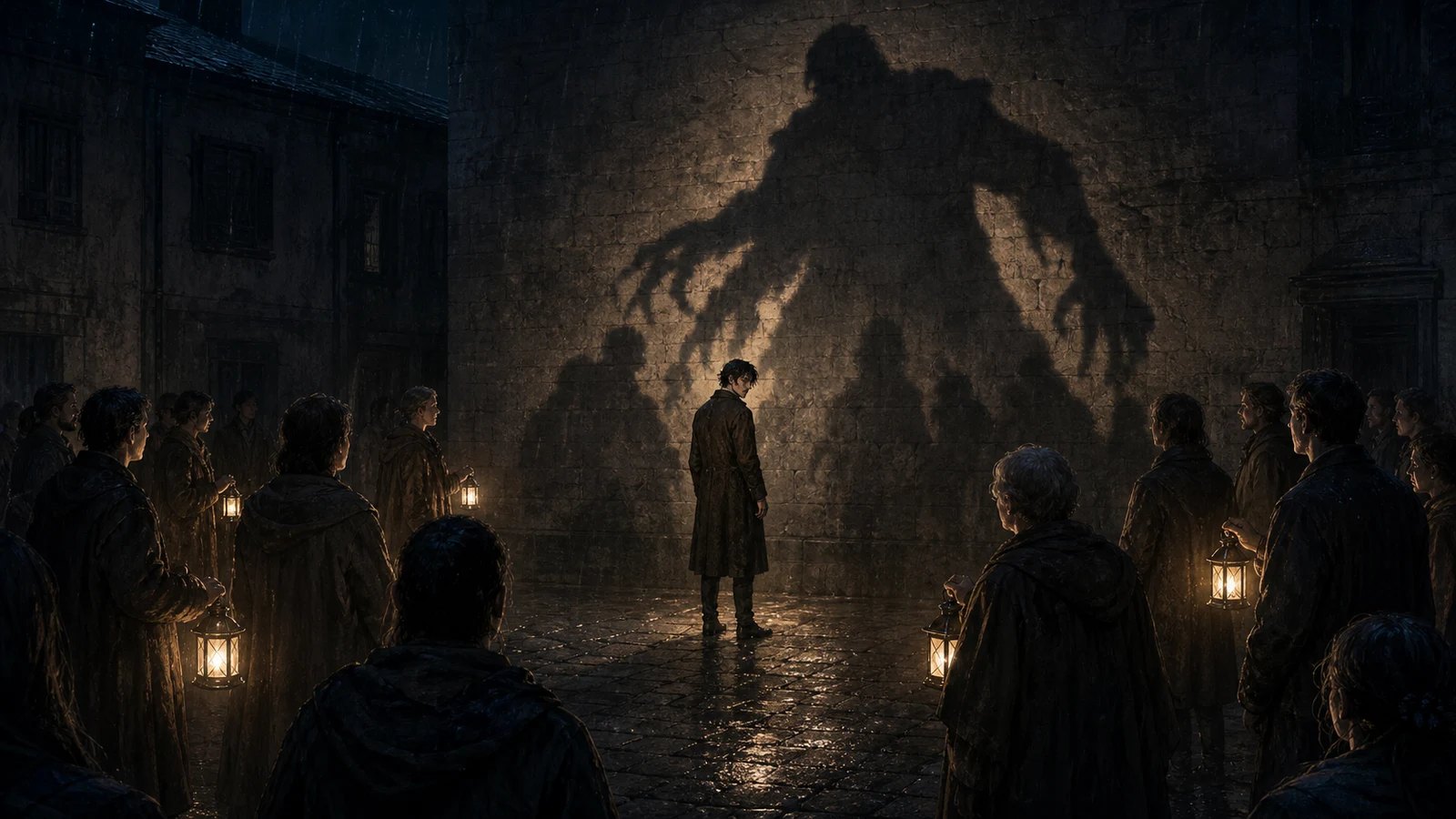
The Real Danger Is Making People Monstrous
Imaginary monsters can help us inspect fear. Turning real people into monsters usually stops inspection. Once a group is described as less than human, naturally diseased, or incapable of moral feeling, ordinary obligations become easier to suspend. The label supplies a simple enemy and lets institutions, leaders, and bystanders disappear from the story of how harm began.
A large study by Alexander Landry and colleagues examined this danger across a meta-analysis of 120 studies involving more than 128,000 participants, several conflict settings, and an experiment. The researchers found that explicit dehumanization was distinct from intense dislike, had a particularly strong relationship with support for intergroup violence, and could increase such support. The result does not mean every insult causes violence or that dehumanization is required for cruelty. It shows why the denial of another person’s humanity cannot be dismissed as colorful speech.
Scapegoating offers emotional relief. If suffering has one inhuman author, the rest of us can remain innocent. We no longer have to examine unequal power, inherited hatred, fear rewarded by politicians, or the small daily choices that prepare a crowd. The invented monster concentrates anxiety; the human scapegoat concentrates blame.
A responsible monster story keeps this boundary visible. It can give the creature terrible power without borrowing disability, ethnicity, illness, or unfamiliarity as proof of evil. It can let frightened people make mistakes without treating fear as moral permission. It can ask who benefits when a person loses a name and becomes a species of threat.
We create monsters because fear wants a body. We keep returning to them because their bodies never remain safely foreign. Sooner or later the shadow reaches our own wall. What stands outside the door matters. So does what we are willing to do after we decide who belongs there.
Sources
- Monster Theory: Reading Culture — University of Minnesota Press
- Noël Carroll, “The Nature of Horror” — Cambridge University Press
- Mathias Clasen, “How Horror Works II” — Oxford Academic
- David D. Gilmore, Monsters — University of Pennsylvania Press
- Tom Shippey on Tolkien’s “Beowulf: The Monsters and the Critics” — Tolkien Estate
- Mary Shelley’s Frankenstein — Faculty of English, University of Oxford
- Paul Barber, Vampires, Burial, and Death — Yale University Press
- The Yōkai Folklore Database — International Research Center for Japanese Studies
- Ursula K. Le Guin on Tales from Earthsea
- Landry et al., “The uniquely powerful impact of explicit, blatant dehumanization” — PubMed