Worlds
His Dark Materials: Dust, Daemons, and the Courage of Consciousness
A reading of Philip Pullman’s multiverse as a fantasy world of parallel realities, visible souls, forbidden knowledge, childhood becoming awareness, and the dangerous beauty of matter learning to know itself.
His Dark Materials begins with a child, a daemon, and a question adults are afraid to ask. That is why Philip Pullman’s world still cuts so deeply. It is full of armored bears, witches, instruments, knives, angels, cities, and northern lights, yet its real center is stranger than any creature: consciousness itself. The world asks what happens when matter begins to know, love, choose, and rebel.
Pullman’s multiverse turns adventure into a philosophical machine: parallel worlds, visible souls, scientific curiosity, religious authority, childhood, loss, and Dust all press against the same question. Narnia opens childhood through moral wonder; Earthsea bends magic toward names and balance. His Dark Materials chooses another axis: awareness.
The official Philip Pullman site describes His Dark Materials as a trilogy following Lyra and Will through parallel universes, with fantasy elements that allude to physics, philosophy, and theology. That combination matters. This is a fantasy world where metaphysics has weather, instruments, particles, schools, churches, and bodies.
A World Where the Soul Is Visible
The daemon is one of modern fantasy’s most brilliant inventions because it makes inward life visible. In Lyra’s world, the soul is not hidden behind the face. It walks beside the body as animal presence, companion, conscience, vulnerability, intimacy, and public truth.
That single rule transforms society. Privacy, childhood, shame, affection, fear, and identity all change when part of the self can be seen. A child’s daemon shifts shape, while an adult’s daemon settles. Growing up becomes visible as form. The passage from possibility to identity is not an abstract idea; it moves beside the person.
This makes the world emotionally dangerous. To touch a daemon is not to touch a pet. It is to violate a boundary of being. Pullman turns the soul into worldbuilding.
Dust and the Scandal of Growing Up
Pullman’s official “What is Dust?” page is crucial because it frames Dust through anxiety, authority, adulthood, knowledge, and the loss of innocence. Dust is feared by the Church in Lyra’s universe, yet Lyra comes to understand it differently: as something connected to what is best in humanity, including love, kindness, curiosity, and development.
That idea gives the world its philosophical voltage. Growing up is no longer merely social or biological. It becomes cosmic. Awareness draws Dust. Curiosity matters. Desire, knowledge, tenderness, and moral perception become part of the structure of reality.
As Why Our Own World Is Fantasy argues, reality becomes strange when existence stops feeling obvious. Pullman pushes the same nerve. Consciousness is not background. Consciousness is a miracle with enemies.
Parallel Worlds and the Refusal of One Reality
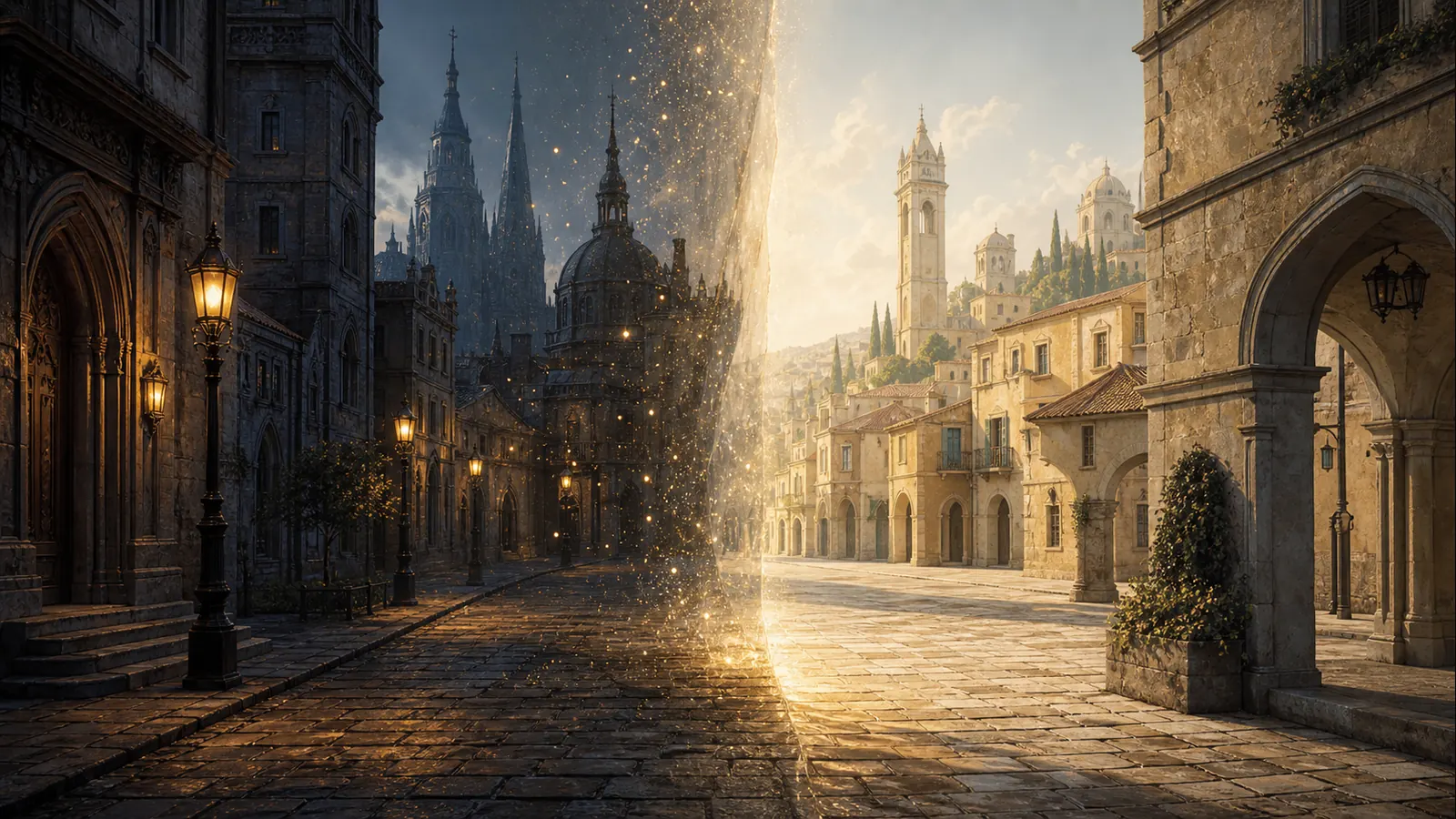
The official “Parallel Worlds” page says the trilogy is based on the idea of parallel universes and the problem of passage between them. In the story, a knife can open the way. For a world-reading, this matters because parallel worlds are not only travel devices. They are a rebellion against the claim that one institution, one doctrine, or one reality can exhaust truth.
Every world widens the moral field. Oxford becomes more than Oxford. A city can be empty in one reality and impossible in another. A sky can contain different laws. A person can discover that their familiar world is provincial.
This is the opposite of a closed map. Pullman’s multiverse is dangerous because it enlarges context. The more worlds exist, the harder it becomes for authority to claim final interpretation.
Instruments of Knowing
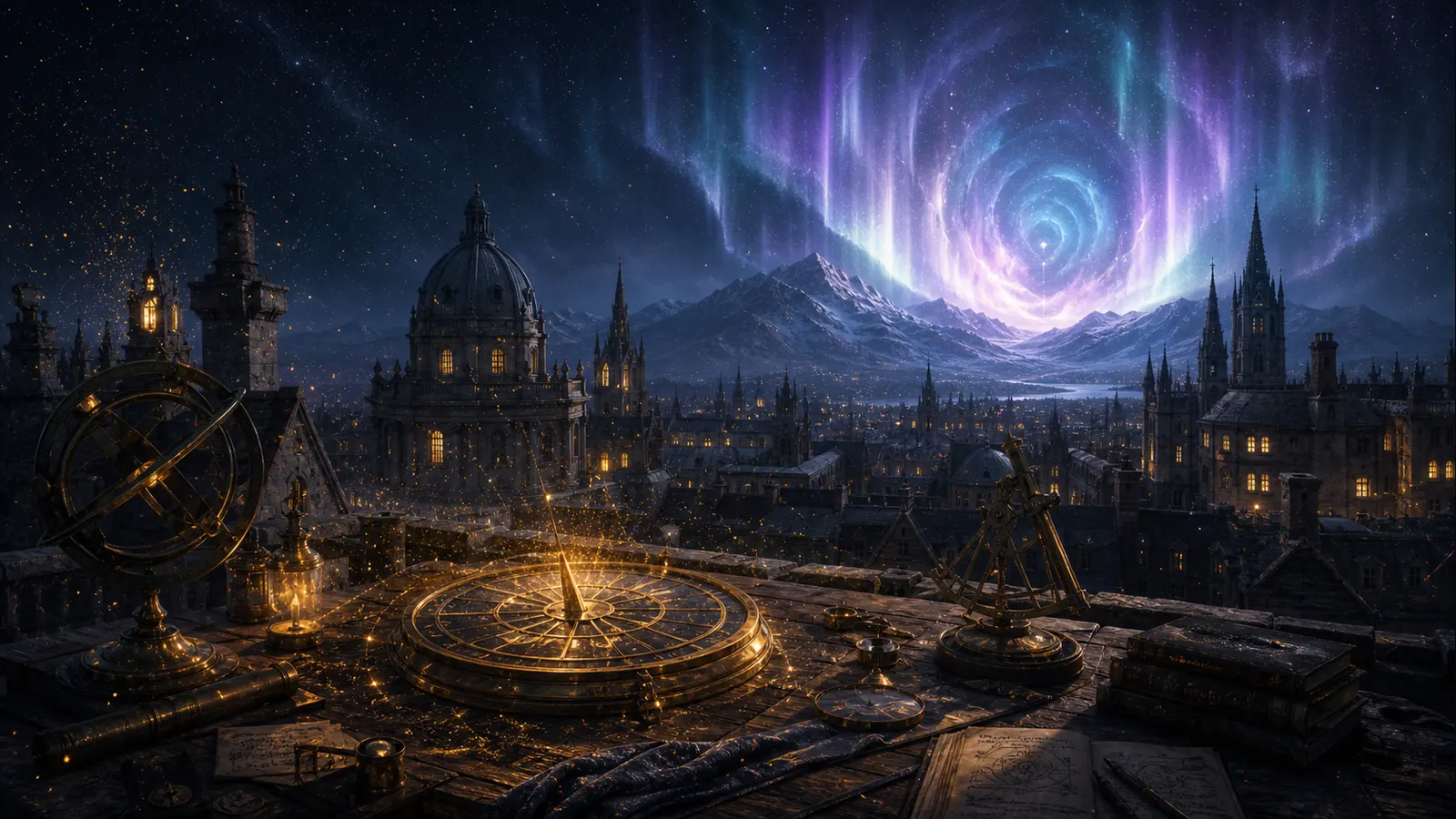
His Dark Materials is full of devices that are not mere props: the alethiometer, the subtle knife, amber spyglasses, experimental apparatus, maps, books, and windows. They make knowledge material. Inquiry is handled, read, cut, focused, misread, protected, and abused.
This gives the world a scholarly texture. Fantasy often uses magical objects as keys to victory. Pullman’s instruments are keys to interpretation. They do not simply grant power. They make the user more responsible for what has been seen.
That connects His Dark Materials to Magic Systems in Fantasy. A strong magic system is not a list of tricks; it is a theory of reality. Pullman’s world asks whether knowledge liberates, corrupts, or simply reveals what was already morally contested.
Authority Afraid of Imagination
Pullman’s world treats institutions with suspicion when they fear free inquiry. The danger is not faith as a human feeling; the danger is authority that wants to control what may be known, loved, questioned, or imagined.
This is why the world feels modern. Its fantasy elements are large, but its anxieties are familiar: censorship, institutional control, fear of bodies, fear of adulthood, fear of knowledge, fear of children becoming independent minds. The Magisterium matters because it gives metaphysical conflict a bureaucracy.
In this sense, His Dark Materials stands in fierce conversation with Narnia. Both are portal fantasies of childhood and moral testing, but they disagree about where sacred authority should stand. Reading them together sharpens the difference between wonder that obeys and wonder that rebels.
Childhood as the Beginning of Freedom
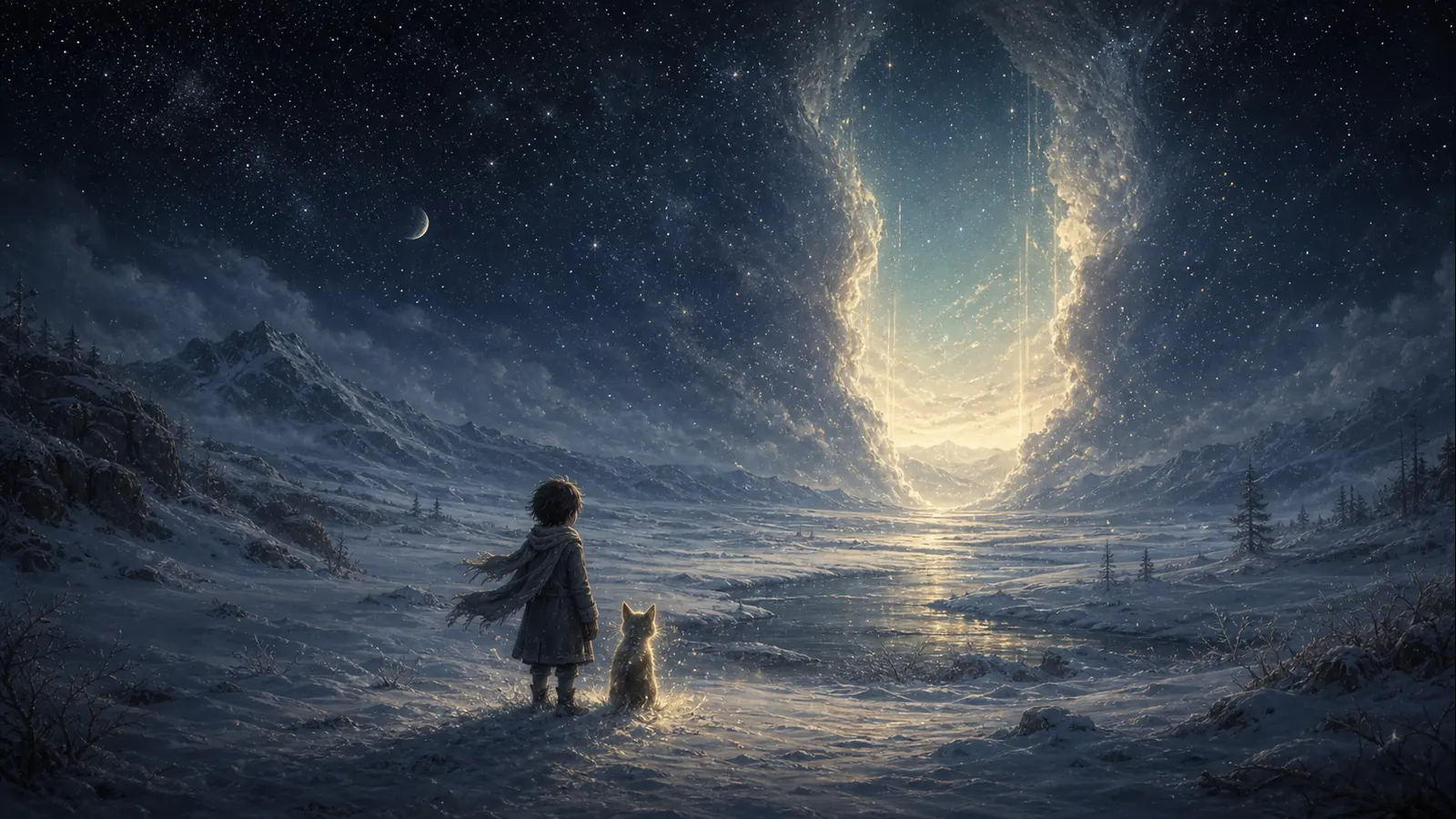
Lyra matters because childhood in this world is not sentimental. It is volatile, inventive, dishonest, loving, perceptive, and dangerous. She survives partly because she can improvise. Her imagination is not decoration. It is a way of moving through hostile systems.
Will brings another kind of childhood: burden, secrecy, care, and the loneliness of responsibility. Together, Lyra and Will make the coming-of-age structure feel cosmic. Growing up is not a private milestone. It changes the fate of worlds.
That is why Dust gathers such emotional force. The transition from childhood into awareness is painful, but the story refuses to call awareness a fall into filth. It treats awareness as the condition of love and moral adulthood.
Matter That Learns Itself
The most radical idea in His Dark Materials is that matter itself can become meaningful. Pullman’s Dust gives a fantasy shape to consciousness, not by escaping matter, but by making matter luminous with thought. The world does not need to despise the body to find spirit. It can find wonder in embodied awareness.
This is a profound inversion of many older fantasies. The body is not merely a prison for the soul. The body is part of how the soul appears, loves, suffers, and knows. Daemons make this visible. Dust makes it cosmic.
Here the world becomes philosophical without becoming abstract. Consciousness is not explained away. It is dramatized as particles, light, danger, affection, and rebellion.
The Knife and the Wound of Passage
The subtle knife is a beautiful and frightening idea because passage between worlds is also injury. To cut a window is to open possibility and make damage. Travel is never innocent when the fabric of reality bears the mark.
That gives the multiverse moral seriousness. Exploration can liberate, but it can also tear. Knowing other worlds exist does not make movement harmless. The more powerful the tool, the more severe the responsibility.
This resembles The Lands Between in an unexpected way. Both worlds understand that metaphysical technology has consequences. In Pullman’s world, even wonder can cut.
Why the World Feels Philosophical
His Dark Materials turns philosophy into weather, architecture, and companionship. What is the soul? Is consciousness a stain or a glory? Can knowledge be innocent? Should children be protected from awareness or guided into it? What happens when authority mistakes curiosity for corruption?
These questions do not sit outside the story. They are the story’s material. A daemon answers one part. Dust answers another. The knife, the Church, the windows, the dead, the bears, the witches, and the children each answer differently.
That is why the world remains powerful. It gives questions bodies.
Why This World Still Matters
His Dark Materials endures because it makes human consciousness a fantasy event. It asks the reader to feel thought as light, love as risk, adolescence as cosmic turning point, and truth as something both dangerous and necessary.
Placed beside Middle-earth, Earthsea, and Narnia, Pullman’s multiverse shows another kind of fantasy power: consciousness and rebellion standing together.
Together, these worlds show that fantasy is not one feeling. It can be elegy, humility, mercy, revolt, inquiry, and awe.
Conclusion
His Dark Materials endures because its world treats awareness as sacred without making it obedient. Dust is dangerous because it awakens. Daemons are moving because they reveal the self. Parallel worlds are thrilling because they fracture certainty. The knife is frightening because every passage has a wound.
Pullman’s multiverse is a fantasy of becoming conscious. It tells us that growing up is not merely losing innocence. It is gaining the burden and beauty of seeing. And in a world that fears that sight, the courage to know becomes one of the highest forms of wonder.
Sources and Further Reading
- Philip Pullman: His Dark Materials for the official overview of the trilogy, awards, and parallel-universe premise.
- Philip Pullman: What is Dust? for Pullman’s explanation of Dust, authority, innocence, and development.
- Philip Pullman: Parallel Worlds for the official note on parallel universes and passage between them.
- Philip Pullman shop: His Dark Materials books for series descriptions, daemons, Dust, worlds, and book context.
- Philip Pullman: About for biographical context and Pullman’s own summary of His Dark Materials.
- Philip Pullman: Writings for essays, interviews, and intellectual background.
- Philip Pullman: Film, Stage & Television for adaptation context.
- Philip Pullman: Q&As for additional author context.
- Britannica: Philip Pullman and Britannica: His Dark Materials for general reference background.