Works
In Game of Thrones, Every Victory Creates a New Debt
Westeros feels real because power never stays in the throne room; it reaches farms, marriages, wounded bodies, empty kitchens, and people who never chose the war.
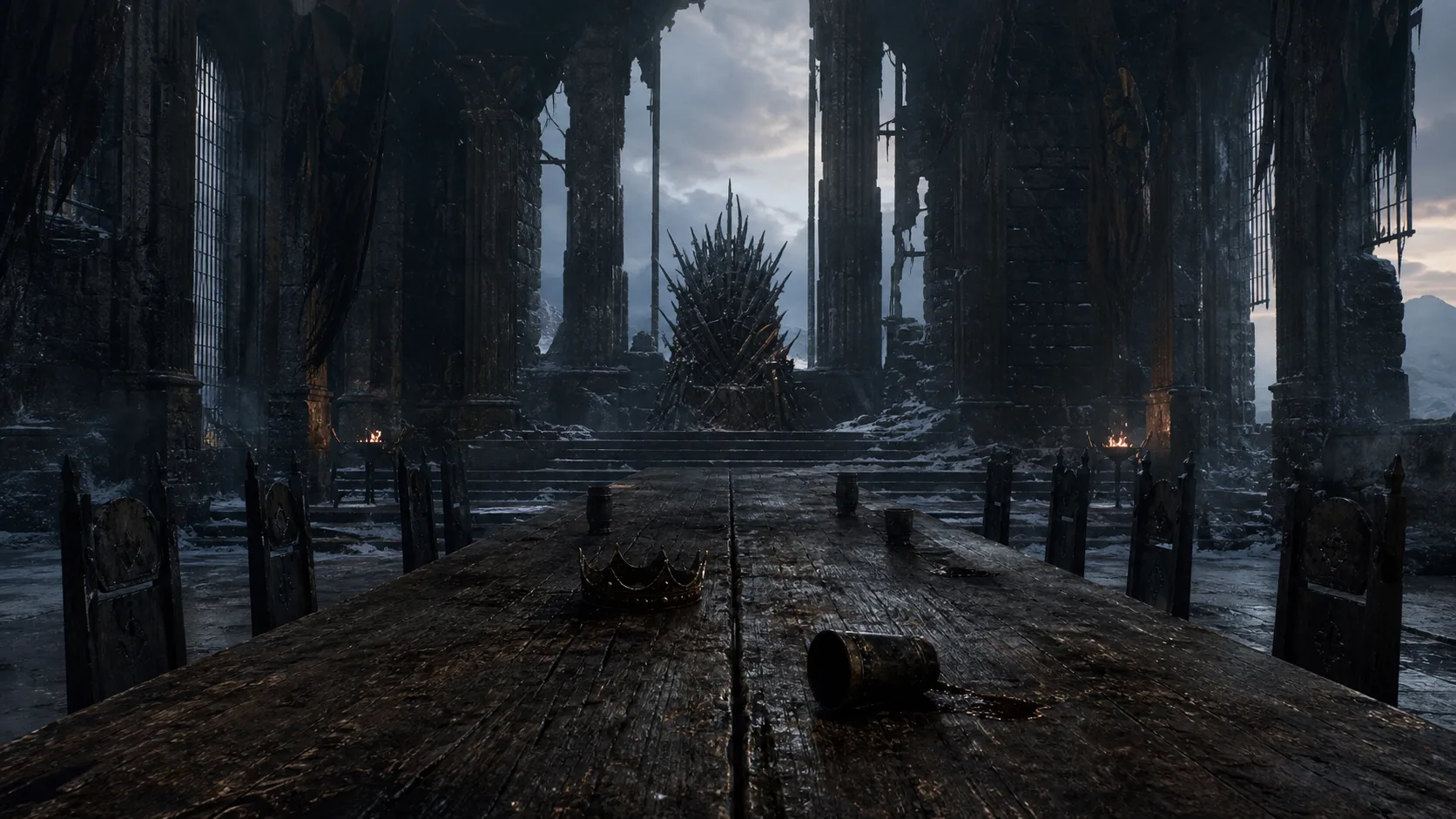
In Westeros, catastrophe rarely arrives wearing a crown. It enters as a sealed letter opened beside a cold breakfast. A lord changes allegiance in a warm chamber; months later, a riverlands family watches soldiers take its grain. A marriage promise is broken, and men who never made it are ordered onto the road. Power begins beneath banners, then becomes hunger, exile, or a roof burned before winter.
That chain is the force of A Song of Ice and Fire: politics becomes physical. Decisions travel through roads, harvests, households, and bodies. A victory removes an enemy while creating widows, grudges, frightened allies, unpaid soldiers, and stories children will inherit. The Iron Throne is less a prize than a machine for producing debts.
Westeros feels human because people are caught between loyalties that cannot all survive: family and justice, love and duty, safety and truth. They choose, and the cost keeps moving.
Spoiler-light note: This essay discusses the premise, the political rules of Westeros, and early character paths from the first novel and season. It avoids later deaths, betrayals, hidden identities, and the television ending. The novels remain the primary text; the HBO adaptation is treated as a separate telling.
The Books Come First; the Television Series Is Another Road
HBO’s early seasons preserve much of the novels’ political architecture, but the versions grow increasingly different. Characters are combined, omitted, or given another person’s material. Martin has described them as separate tellings whose small divergences eventually become much larger.
That distinction matters even before the stories visibly part. A novel can live inside a frightened thought, withhold certainty through an unreliable memory, or let a minor journey occupy pages. Television must turn much of that interior pressure into performance, dialogue, and image. This essay begins with the novels and refers to the show only where adaptation changes how power is felt.
For readers deciding whether to enter this long, unfinished road, our guide to choosing a first fantasy book gives an honest account of the commitment and its rewards.
Power Arrives Through a Point of View
The novels do not give us a neutral camera above Westeros. Each chapter belongs to one consciousness. A royal visit feels ceremonial to one character, claustrophobic to another, and full of practical danger to someone listening for what is not being said. Information arrives late, distorted by affection, class, distance, and fear.
That structure makes power personal. A decree is never merely law; we meet the person who must announce it, obey it, exploit it, or wonder whether it will bring soldiers to the door. Children understand only part of the machinery, while experienced adults can be blinded by old loyalties. No one owns the whole world.
The television series retains multiple perspectives, but prose lets uncertainty sit closer to the skin. Westeros becomes credible through partial knowledge. Everyone acts on a map with pieces missing.
An Iron Chair Cannot Rule
The throne is the story’s most visible object, so it is easy to mistake it for power. Robert Baratheon won it through rebellion, yet victory gave him neither the patience nor desire to govern. His crown depends on soldiers, inherited wealth, councillors, marriage alliances, and a public that must still eat. A royal signature has force only while distant people agree—or are compelled—to carry it.
Power lives between people. It depends on marriages, ravens, roads, grain, hostages, credit, belief, and the expectation that an order will still be obeyed tomorrow. Our essay on what makes a fantasy world believable explores that material structure more broadly. Its political meaning is simple: taking a seat is quick; keeping distant people inside the same story of legitimacy is the work.
A Family Name Is Shelter and Sentence
House names provide protection, identity, memory, and a claim upon other people. A Stark child can call on loyalties formed before birth. A Lannister carries the shield of wealth and fear. Even in exile, a Targaryen name remains a promise to some and a threat to others.
The shelter has walls. Sansa’s hope of marrying a prince is also a contract between houses. Arya’s refusal of the role prepared for her is personal, yet her name ensures that adults will keep trying to return her to it. Theon lives at Winterfell as ward, companion, and quiet hostage at once. Affection cannot erase the political reason he was brought there.
People inherit unfinished wars with their surnames. A child may never have met the dead relative whose vengeance now organizes an entire life. Family keeps characters alive, then asks them to become instruments of its memory.
Honor Needs More Than a Good Man
Ned Stark brings a recognisable idea of rule south with him: hear the truth, accept responsibility, and do not hide the human cost of a sentence. That ethic has meaning in the North, where his authority rests on long relationships and visible duties. King’s Landing runs through a less legible web of informants, debts, private bargains, and armed offices.
The tension is larger than whether Ned is clever enough. Personal virtue cannot substitute for institutions that protect truth, restrain violence, and make an oath costly to break. A good intention without reliable information can hurt the person it meant to protect. A lawful order without anyone willing to enforce it is breath in a room.
Westeros refuses the comfort that a decent ruler automatically creates decent rule. It also refuses the opposite comfort—that cruelty is simply more realistic. Fear produces speed, not trust, and today’s obedience may become tomorrow’s hidden resistance.
History Never Stays Buried in Westeros
Every political conversation has ghosts in it. Robert’s Rebellion decides who sits the throne, but its memories keep shaping the living. To Robert it is love stolen and tyranny defeated. To Daenerys it is the theft of a home she barely remembers. Other survivors carry shame, pride, silence, or an account that cannot safely be spoken at court.
Songs, ruins, scars, and fostered children carry history where records cannot. A song may preserve courage, flatter a patron, or turn a defeat into a warning. Singers, maesters, victors, and frightened witnesses edit the past, but cannot make it inert.
The official companion The World of Ice and Fire presents history through accumulated chronicles, speculation, and inherited tales. That method fits the novels. Westeros is convincing because its people disagree about the past while remaining trapped inside its consequences.
A Promise Can Move an Army
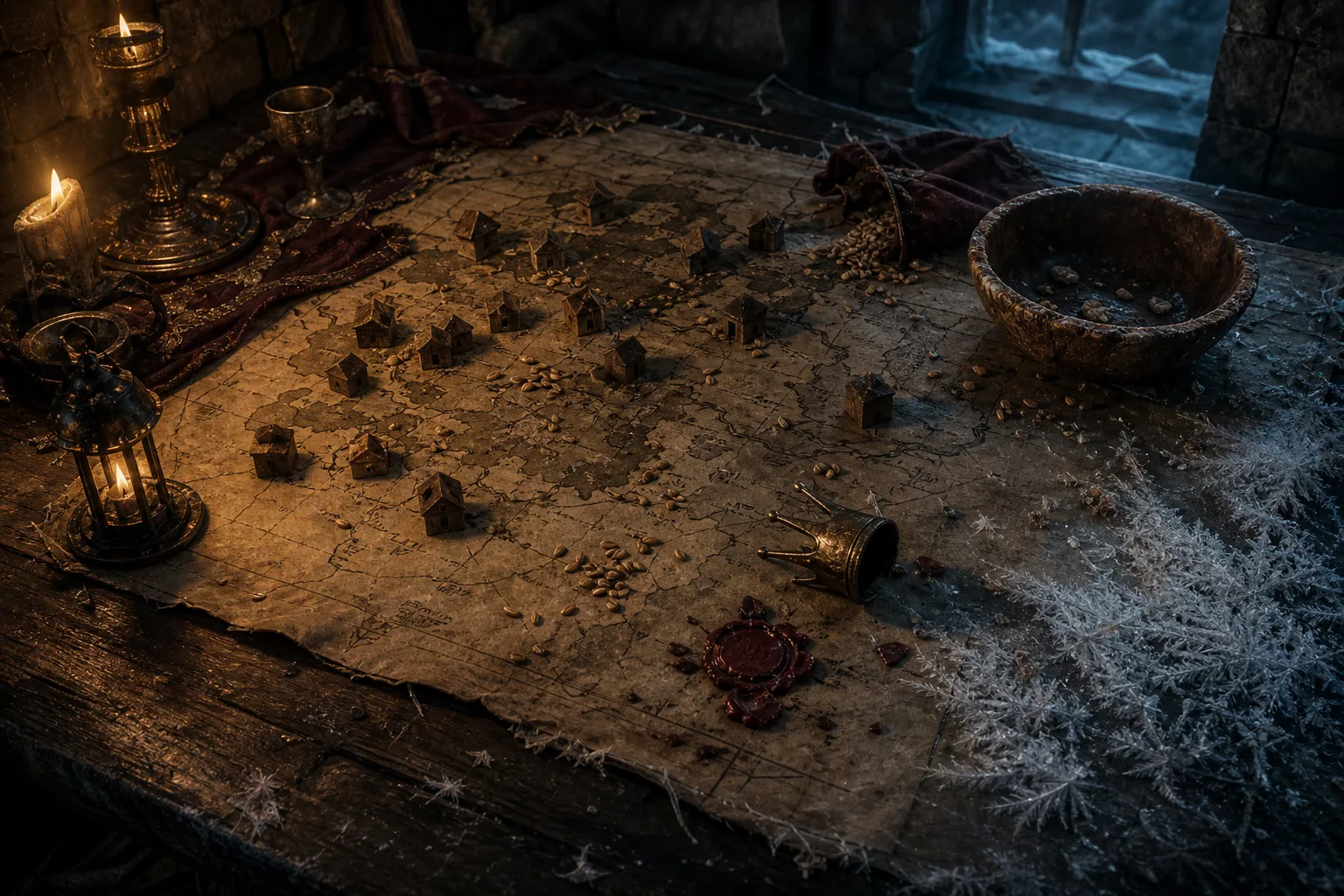
Westeros lacks a strong central administration, so promises perform work that paperwork and public agencies might do elsewhere. Betrothals join military interests. Fosterage can build affection while guaranteeing good behaviour. The Night’s Watch asks men to surrender inheritance and family claims in exchange for a shared duty. Hospitality offers a brief zone in which strangers can lower their hands from their weapons.
These customs are fragile, but fragility does not make them ornamental. An oath allows people to plan beyond the next hour. A marriage pact can determine whether a road is open to an army. A hostage’s safety may keep a defeated region quiet. Trust becomes infrastructure.
Breaking a promise may produce an immediate advantage. It also teaches every witness to demand a higher price next time. The debt appears as suspicion: more guards at the door, fewer honest negotiations, children educated to remember an insult they never saw.
War Reaches People Who Never Chose It
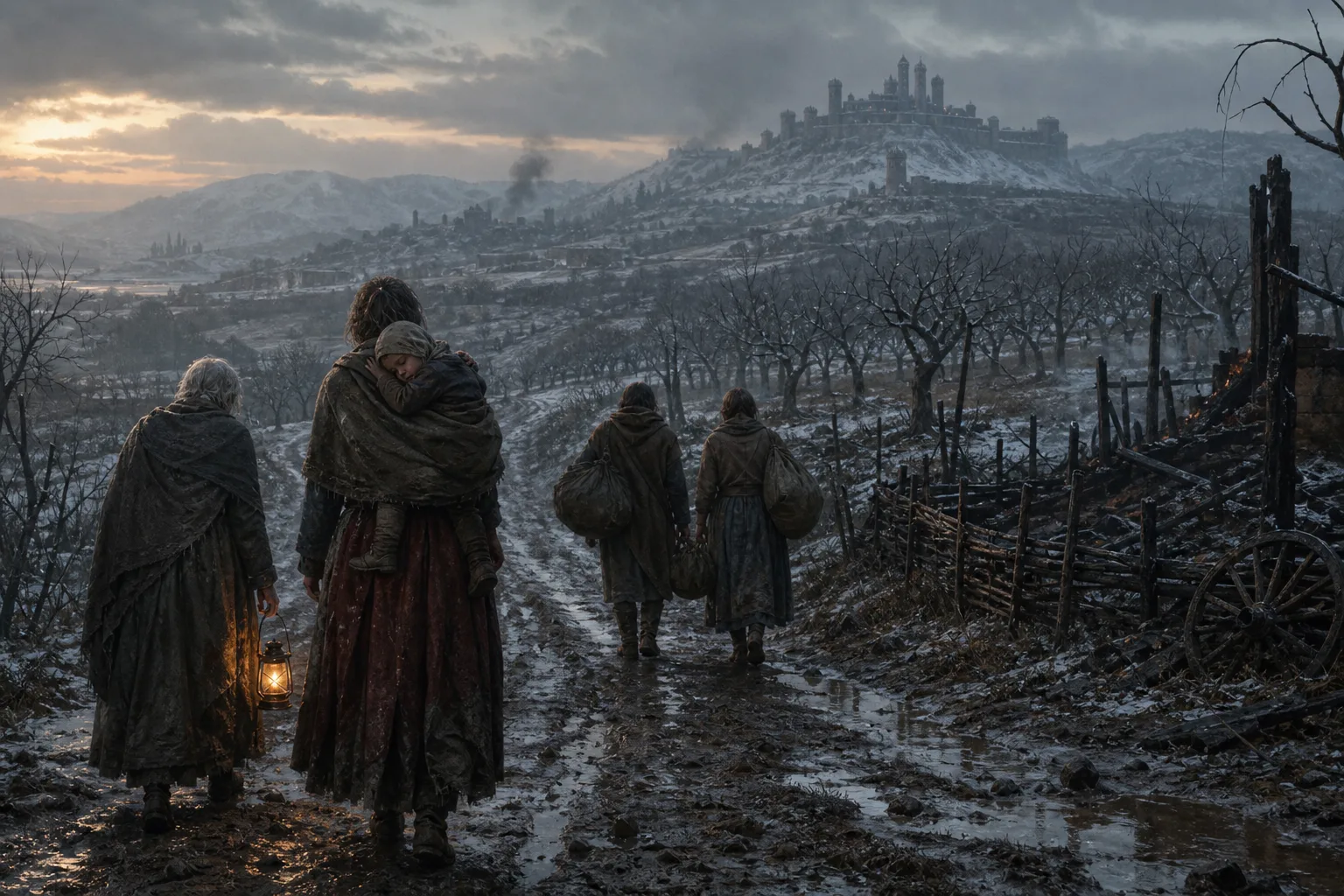
As war gathers, the novels repeatedly leave court and look down ordinary roads. Inns become listening posts. Orchards and mills matter because armies eat. A village must judge the next armed riders before it knows whether to offer food, hide it, or run. The banner above the soldiers may change; the missing grain does not return.
This attention stops war from becoming an elegant board game. A lord can lose a battle and retreat to another castle. A smallholder who loses seed grain may not have a next year. Soldiers who began with a cause still need boots and meat. Violence develops its own appetite long before anyone can declare a clean ending.
The series still spends most of its time near elites. Yet the road interrupts the romance of strategy. Maps show arrows moving cleanly over colored land. Walking it reveals mud, infected wounds, a missing daughter, and soup stretched with water because another hungry person arrived.
Bodies Become Political Territory
Westerosi power is written on bodies. Marriages settle alliances. Fertility becomes public property. Disability changes how a person is valued or permitted to speak. Tyrion’s intelligence cannot free him from a society that treats his body as evidence against him. Bran’s fall changes his daily dependence and the political uses others imagine for him. Sansa learns courtesy as armor because open refusal is often unavailable.
The series deserves scrutiny here. Repeated sexual violence does not become truthful because a setting resembles a harsh version of medieval Europe. The adaptation sometimes uses violation as quick proof that its world is adult and dangerous. Historical texture cannot excuse careless storytelling.
At its strongest, the narrative shows domination becoming intimate. Policy reaches bedrooms, scars, hunger, and the posture someone adopts when footsteps stop outside a door. Power decides what can happen to particular bodies and whose pain counts.
Magic Returns at the Edge of Politics
Magic is scarce at the beginning. The court behaves as if lineage, money, steel, and information are the complete vocabulary of power. Yet the opening beyond the Wall, the direwolves found near Winterfell, old trees, dreams, and Daenerys’s dragon eggs suggest that the world is wider than its political class remembers.
This restraint gives wonder weight. Magic does not arrive as a convenient system explained to everyone. It enters through rumor, private experience, half-believed history, and events that established authorities can dismiss. Characters must decide whether an impossible report is a threat, a superstition, or a truth that will make their expertise obsolete.
The return of magic also deepens the debt at the center of the story. Extraordinary power does not remove ordinary needs. Even a miracle must enter a world of food, fear, loyalty, and vulnerable bodies. Wonder changes what is possible; it does not make consequence disappear.
Winter Is the Crisis Everyone Can Postpone
While courts debate succession, the dead gather beyond the Wall. The contrast is blunt, but not simplistic. Most rulers are trapped by incentives that reward the next alliance, battle, or season. The Night’s Watch asks them to spend soldiers and food on a danger that is distant, difficult to prove, and unlikely to improve anyone’s immediate claim.
That failure feels familiar. A shared catastrophe can be visible for years while institutions continue rewarding short horizons. The Others also return the mythic scale that court politics tries to crowd out. They belong beside Fantasya’s wider questions about why humans create monsters and how dark fantasy turns fear into moral pressure.
Winter reveals the poverty of the game. A ruler may defeat every human rival and inherit a kingdom too divided, hungry, or distrustful to survive what follows.
Why Care About Anyone in a World This Cruel?
If the saga offered only betrayal, its darkness would become monotonous. What keeps it alive are acts that look small beside armies: Tyrion offering Jon unexpected understanding, Jon recognising Sam’s fear without treating him as worthless, Arya forming attachments outside the rank expected of her, or a stranger sharing food without first asking which king the hungry person serves.
These moments show what the system cannot consume. The series’ memorable people are rarely pure heroes, a tension explored in our guide to different kinds of fantasy heroes. They are frightened, compromised, or late to understand. A decent act matters without a promise that decency will win.
This is also where Westeros differs from empty nihilism. Cruelty is common, and danger carries the possibility of death. Our essay on what fantasy does with death explores how loss gains meaning through what remains. Here, it is enough to say cruelty never becomes the only truth about human beings.
Every Victory Leaves Someone Owing
Robert’s victory gave him a throne and a realm still carrying debt, grief, and rival memories. Every house seeking influence must borrow from someone: soldiers from bannermen, money from lenders, legitimacy from custom, safety from marriage, and time from people hoping the next harvest survives.
That is the sorrowful grandeur of Game of Thrones. Power can defend a child, stop violence, or overthrow a tyrant. It can also send its invoice to someone who never entered the hall where the choice was made. Follow it far enough and it becomes a field without seed, a winter store emptied too soon, or a child learning an inherited fear.
In The Lord of the Rings, power is concentrated in an object that must be refused. Westeros scatters it through families, institutions, necessities, and memories. There is nothing single to cast into the fire. The harder task is ruling without making tomorrow pay forever for today’s victory.
Sources and Further Reading
- George R. R. Martin: A Game of Thrones official book page
- George R. R. Martin: A Song of Ice and Fire
- George R. R. Martin: The World of Ice and Fire
- George R. R. Martin: Fire & Blood
- George R. R. Martin: “The Show, the Books”
- George R. R. Martin: Rolling Stone interview reference
- TIME: George R. R. Martin on fantasy and history
- Cambridge Core: George Martin’s A Song of Ice and Fire, HBO’s Game of Thrones and (Neo)Medievalism
- Cambridge Core: Chivalric Romance and Anti-Romance
- Cambridge Core: The Ethical Movement of Daenerys Targaryen
- Cambridge Core: A Song of Ice and Fire’s Ethics of Disability
- Cambridge Core: The Emasculation of Theon Greyjoy