Guides
Which Fantasy Book Should You Start With?
Ten honest doorways into fantasy, chosen by the kind of wonder, danger, comfort, or strangeness you want right now.
The best first fantasy book is not the grandest, the most influential, or the one another reader insists you must admire. It is the book that gives you the right kind of impossible thing at the right moment. Someone looking for a quiet refuge after a brutal week should not be pushed through the same door as someone hungry for dynastic betrayal, difficult magic, and the collapse of a civilization.
So this is not a ranking. It is a map of entrances. If you have no strong preference, begin with The Hobbit: it is welcoming, complete, funny, dangerous without being punishing, and built around an ordinary person discovering that courage does not require becoming someone else. But if you already know what you want—comfort, mystery, moral gravity, political danger, or formal experimentation—there may be a better first book for you.
If you are still unsure what belongs under the name, our guide to what fantasy is gives the broad shape of the genre, while the main kinds of fantasy shows why two books shelved beside each other can feel like different climates. The practical question here is simpler: which climate can you live in for your next few evenings?
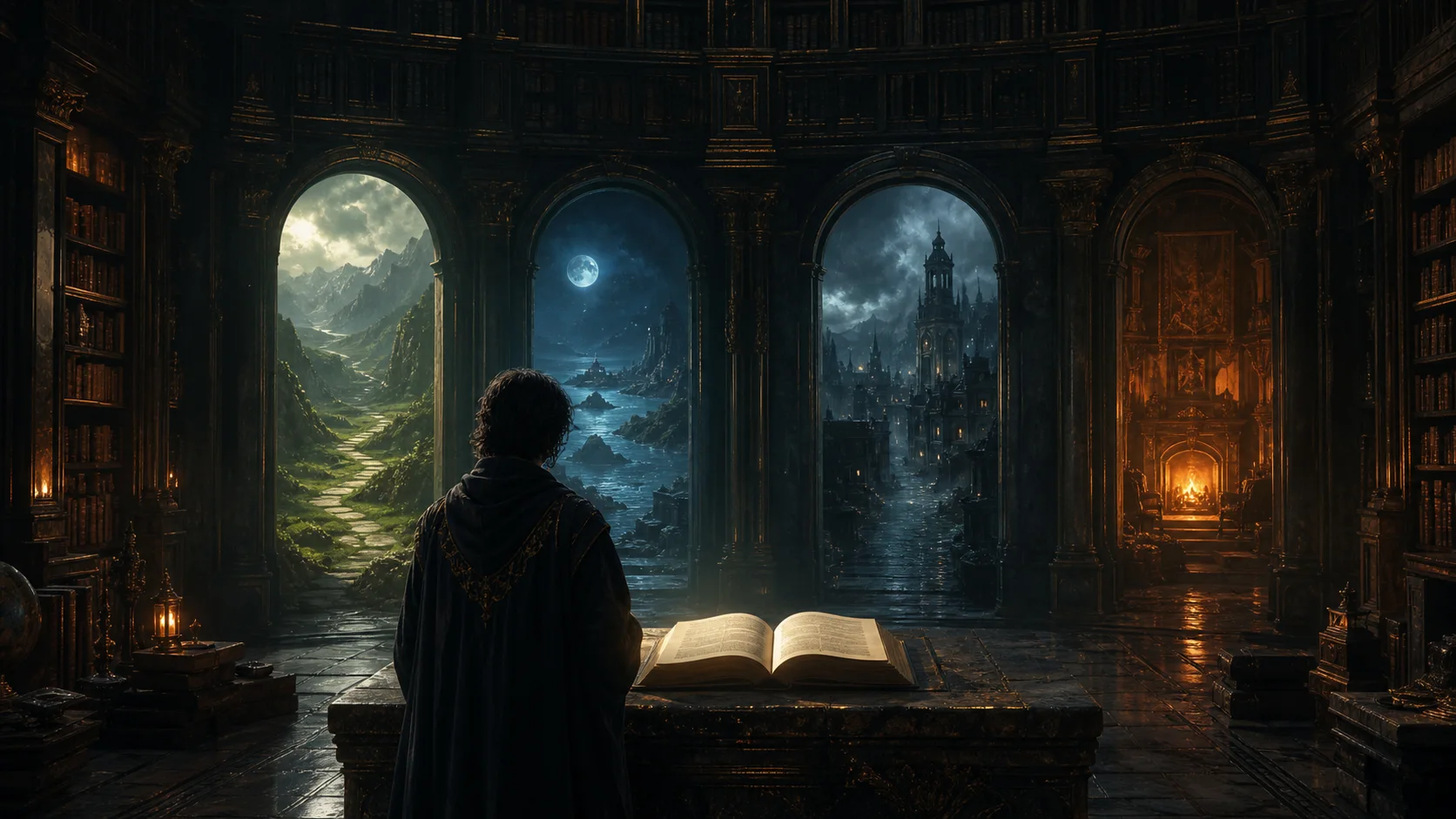
The quick answer: choose the feeling, not the reputation
- If you want the safest all-purpose beginning, choose The Hobbit.
- If you want a brief childhood doorway with moral clarity, choose The Lion, the Witch and the Wardrobe.
- If you want momentum, a heist, and understandable magical rules, choose Mistborn: The Final Empire.
- If you want spare, mythic writing about power and responsibility, choose A Wizard of Earthsea.
- If you want beauty, solitude, and a mystery you must slowly inhabit, choose Piranesi.
- If you want wit, civic chaos, and fantasy that can laugh without becoming shallow, choose Guards! Guards!.
- If you want kindness, routine, and low stakes, choose Legends & Lattes.
- If you want intimate character pain and patient growth, choose Assassin’s Apprentice.
- If you want political danger and a large cast, choose A Game of Thrones.
- If you want an ambitious, demanding novel about survival and a broken world, choose The Fifth Season.

Start with The Hobbit if you have no preference yet
Bilbo Baggins likes meals on time, familiar rooms, and a life that does not make unreasonable demands. That is precisely why he is such a generous companion for a new fantasy reader. Tolkien does not ask you to begin as a scholar of royal bloodlines or invented languages. You begin at home with a reluctant person whose comforts are understandable, then walk outward with him into songs, riddles, forests, treasure, and fear.
It is a good door because it tells a complete story while suggesting a much older and larger world beyond its edges. Its narrator can be playful, yet the journey acquires real loss and moral weight. If you later want to go deeper, our essay on why Middle-earth still feels like a world and the exploration of Middle-earth’s deep time follow that road.
The friction is its age and voice. The narration sometimes addresses the reader, the songs can slow the journey, and a few passages carry the rhythm of an older children’s tale. Readers who only enjoy hard-edged adult realism may find it gentle at first. Still, if you ask for one default answer, this is mine.
Choose The Lion, the Witch and the Wardrobe for a short, clear doorway
This is for the reader who wants to cross from an ordinary world into an impossible one almost at once. C. S. Lewis understands the force of a threshold: a wardrobe, cold air where no cold air should be, snow underfoot, and a lamp burning in a forest. Narnia does not require a long apprenticeship. Wonder arrives quickly and the story moves with the economy of a tale meant to be heard as well as read.
It works as a beginning because its emotional lines are easy to grasp: temptation, betrayal, forgiveness, courage, and the terrible cost of repairing what has been broken. Our piece on Narnia as doorway and moral wonder looks more closely at why that simplicity has such staying power.
Its resistance is equally clear. The book has an older narrative voice, its moral architecture is direct, and its Christian imagery is not hidden. Some adults will find that clarity luminous; others will find it too instructive. Read it if you want a compact fairy-tale experience, not if you need moral ambiguity from the first chapter.
Choose Mistborn: The Final Empire if you want the plot to pull you forward
Perhaps you are not afraid of a large world; you are afraid of being bored while it is explained. Mistborn is a strong answer. Brandon Sanderson gives the reader a heist-shaped plan, an oppressive empire, a crew with distinct abilities, and a magic system whose metals produce specific effects. There is always a next problem to solve, a skill to learn, or a danger moving closer.
That makes it a useful first encounter with modern high fantasy. The setting is unfamiliar, but its machinery is legible. You can understand why a power works, imagine how it might be combined with another, and enjoy the moment when a rule established earlier matters under pressure. The novel also offers a clear bridge from action-heavy films, games, or anime into long-form fantasy prose.
The honest friction is exposition. Characters sometimes explain the world and its magic at length, and the book’s engineering is more visible than its mystery. If you want dreamlike ambiguity, this may feel too neatly constructed. If you enjoy plans, reversals, training, and systems, that visibility is part of the pleasure.
Choose A Wizard of Earthsea if you want magic to carry moral weight
Ged is gifted, proud, impatient, and capable of causing harm before he understands what power asks of him. Ursula K. Le Guin builds from that human truth. Magic in Earthsea is not a collection of convenient effects; names, balance, silence, and consequence belong to the same order. The book is short, but it leaves a long shadow.
This is a good door for readers who want fantasy to feel closer to myth than to an action franchise. It treats a young person’s arrogance seriously without reducing him to his worst act. It also shows that a story about a wizard’s growth can be inward without losing dragons, seas, danger, or wonder. Our exploration of Earthsea, true names, and balance continues that thought without replacing the experience of the novel.
The prose can be a hurdle. Le Guin compresses journeys and years that a contemporary epic might dramatize across hundreds of pages. The narrative sometimes feels as though it has been told for generations before reaching you. Readers who need constant dialogue and close scene-by-scene immersion may feel held at a distance. Readers who hear the deliberate cadence will find an entire archipelago inside a slender volume.
Choose Piranesi if you want to be beautifully lost
Some readers do not need a map before entering. They would rather wake in a place of endless halls, statues, tides, birds, clouds, and a handful of carefully recorded facts. Piranesi meets that desire. Susanna Clarke lets the reader learn the House through the narrator’s journals, and the early uncertainty is not a puzzle placed outside the story. It is the atmosphere you breathe.
This is an excellent beginning for someone coming from literary fiction, surrealism, or quiet mystery. It demonstrates that fantasy does not need armies, medieval kingdoms, or elaborate spellcasting to create another reality. The book’s wonder grows from attention: the names given to things, the pattern of water, a small act of care, an inconsistency that will not remain quiet.
Its friction is the same quality that makes it singular. At first you will not understand the rules or the full situation, and the journal form creates a measured pace. A reader who wants immediate external conflict may become impatient. Do not choose it for a conventional quest. Choose it if strangeness itself can hold your attention until meaning arrives.
Choose Guards! Guards! if you want fantasy with a human laugh
Comedy is sometimes treated as a side corridor of fantasy, as though seriousness requires everyone to speak beneath thunderclouds. Terry Pratchett knew better. Guards! Guards! enters Discworld through an underfunded, disregarded city watch and a city so accustomed to absurdity that even disaster must negotiate with bureaucracy.
It is a welcoming door because the humor is attached to recognizable human behavior: vanity, institutional laziness, class, prejudice, loyalty, and the alarming things people will accept once they become routine. You do not need to start with the first Discworld novel. This book begins one of its major character strands and gives you enough ground beneath your feet.
The friction lies in the density of jokes, turns of phrase, and cultural echoes. Pratchett may interrupt tension for a comic observation, then allow that joke to reveal something painful a page later. If you want solemn immersion with no authorial wink, the rhythm may repel you. If you want a book that can make you laugh at midnight and then quietly ask what a decent public servant owes a damaged city, begin here.
Choose Legends & Lattes if you need a place to rest
Viv has spent her life as an adventurer and now wants to build something that does not require a sword. The dream is a coffee shop in a city that barely knows what coffee is. Around that simple intention, Travis Baldree builds a story of work, friendship, food, habit, and the fragile hope that a person is not imprisoned by the role they performed well.
This is a good first fantasy book for someone who likes found family, slice-of-life stories, or the detailed satisfaction of turning an empty room into a place where people want to stay. Its creatures and city belong to high fantasy, but its attention rests on menus, repairs, customers, and trust. The impossible world gives ordinary labor a warm new light.
The resistance is deliberate: the stakes are mostly local, the mood is reassuring, and the café sensibility is modern. Readers seeking warfare, ancient terror, or difficult moral compromise may find it too soft. Do not demand an epic from it. Read it when your own life has been loud enough and you want fantasy to imagine not victory, but a sustainable morning.
Choose Assassin’s Apprentice if character matters more than speed
Robin Hobb’s novel suits the reader willing to know one wounded person slowly. Fitz grows up near power without securely belonging to it, useful to people who do not always know how to love him and loved by people who cannot simply remove him from danger. His education, loyalties, loneliness, and mistakes matter more than a rapid procession of victories.
It is a strong entrance for readers of intimate historical fiction or coming-of-age novels. The royal court, political duties, and forms of magic create a substantial fantasy world, yet the book’s deepest force comes from emotional memory: the look someone did not give, the kindness misunderstood too late, the animal companionship that reaches a place human speech cannot.
The friction is patience and pain. Fitz does not always make the choice you want, adults fail him, and the plot takes time to gather. The retrospective voice also carries foreknowledge of loss. If you need a triumphant hero who masters every room, look elsewhere. If you can stay beside a flawed narrator through silence and consequence, Hobb may become difficult to leave.
Choose A Game of Thrones if you want power to feel dangerous
Choose George R. R. Martin’s opening novel if your curiosity is political: families, loyalties, contested authority, old grievances, and the private choices that alter public history. Multiple viewpoints let the same world change shape depending on who is afraid, who has information, and who is being underestimated. Fantasy elements begin at the edges and gain weight as human conflicts tighten.
This is a compelling door for readers coming from historical drama, crime sagas, or prestige television. Its world feels inhabited because food, travel, weather, inheritance, rumor, and social rank all affect what characters can do. It is also a clear example of how dark fantasy can arise from moral pressure rather than merely dark scenery.
The friction is substantial. The cast is large, violence can be severe, sexual material is present, beloved characters are not protected by narrative comfort, and the larger series remains unfinished. It also demands more attention than the books above. Begin here because you want that danger—not because cultural fame has made it feel like homework.
Choose The Fifth Season if you want fantasy to challenge your footing
N. K. Jemisin begins with a world already familiar with catastrophe. Survival is shaped by geology, social control, inherited fear, and the knowledge that stability can be temporary. The novel’s structure and shifts in perspective are part of what it is doing, not ornament added to a conventional adventure. Form, world, and trauma press against one another.
It can be a remarkable first fantasy book for an experienced reader who does not need the genre to be easy. Someone who enjoys ambitious speculative fiction, fractured chronology, and stories about systems of oppression may find this more immediate than a traditional quest. Its scale is continental, but its injuries are personal.
The friction should not be minimized. The book contains grief, abuse, dehumanization, and violence involving children; its second-person narration can initially feel strange; explanations arrive on its own schedule. This is not the default recommendation for a tired reader seeking escape. It is the door for someone ready to have the floor move beneath them and willing to keep reading while the pattern takes shape.
How to choose when two doors appeal to you
Use your actual reading life, not an imagined better version of yourself. If you have twenty quiet minutes before sleep, the compact chapters and direct movement of The Hobbit or The Lion, the Witch and the Wardrobe may serve you better than a vast political cast. If you read on a long commute and like tracking clues, Piranesi can turn interrupted time into a private investigation. If you want to spend several weeks with a voice, try Assassin’s Apprentice.
Then ask what you want difficulty to mean. Mistborn gives you the pleasurable difficulty of rules and plans. A Game of Thrones asks you to remember people, motives, and alliances. The Fifth Season asks you to tolerate structural uncertainty. Earthsea asks you to slow down enough to hear what its restraint contains. These are not higher and lower levels of literary worth. They are different kinds of attention.
Finally, decide how much safety you need. Legends & Lattes offers warmth without pretending work is effortless. Guards! Guards! uses laughter to make civic failure bearable long enough to examine it. Piranesi is lonely but luminous. A Game of Thrones and The Fifth Season deliberately remove much of the shelter. A book can be excellent and still be wrong for tonight.
What if the famous book does not work for you?
Stop. Or pause. Or try another door.
Fantasy is too large to be represented by one author’s prose, one map, or one model of heroism. Disliking Tolkien does not mean you dislike fantasy; perhaps you want Pratchett’s city, Jemisin’s broken earth, Clarke’s impossible House, or Baldree’s coffee shop.
Give a book enough pages to reveal its rhythm, but do not turn endurance into virtue. The purpose of a first fantasy novel is not to prove that you belong. It is to discover what kind of impossible world makes ordinary reality look newly visible when you return.
The first book is a door, not a verdict

If you still cannot decide, take The Hobbit. Bilbo begins with no appetite for legend. He is concerned about strangers in the pantry and the disruption of a respectable morning. That smallness is not something the story has to cure. It is the ground from which his courage grows. He returns changed, but he remains recognizably himself.
That is a good promise for a first fantasy book. You do not have to memorize a mythology, admire every classic, or become the sort of person who reads thousand-page series. You only have to open one door and notice what happens to the room around you. Perhaps nothing happens, and you choose another. Perhaps the evening lengthens, the noise outside recedes, and an invented road begins to feel strangely like one you have been missing.
Official sources for the ten books
- The Tolkien Estate: The Hobbit, a cornerstone
- C. S. Lewis official site: The Lion, the Witch and the Wardrobe
- Brandon Sanderson: The Mistborn Saga — The Original Trilogy
- Ursula K. Le Guin: A Wizard of Earthsea
- Bloomsbury: Piranesi
- Terry Pratchett Books: Guards! Guards!
- Macmillan: Legends & Lattes
- Penguin Random House: Assassin’s Apprentice
- George R. R. Martin: A Game of Thrones
- George R. R. Martin: April 2025 update on The Winds of Winter
- N. K. Jemisin: The Fifth Season