Essays
When Metaphor Becomes Real
In fantasy, grief can gain weight, memory can become mist, and power can fit inside a small object: the impossible gives body and consequence to meanings that remain invisible in our world.
We say grief weighs on our shoulders, words wound us, and the past will not leave us alone. No one weighs sorrow on a scale or searches a corridor for the past's footprints. Yet these sentences are not lies. They turn what has no shape into weight, injury, and pursuit so that we can think about it.
Fantasy goes further. It puts grief's weight on an actual shoulder, houses power in a small object, and turns the past into a shadow waiting in the dark. Its gift is more than inventing the impossible; fantasy brings metaphor into the laws of the world and makes characters live with the material consequences. Meaning steps out of the sentence, takes on a body, and no longer obeys its author so easily.
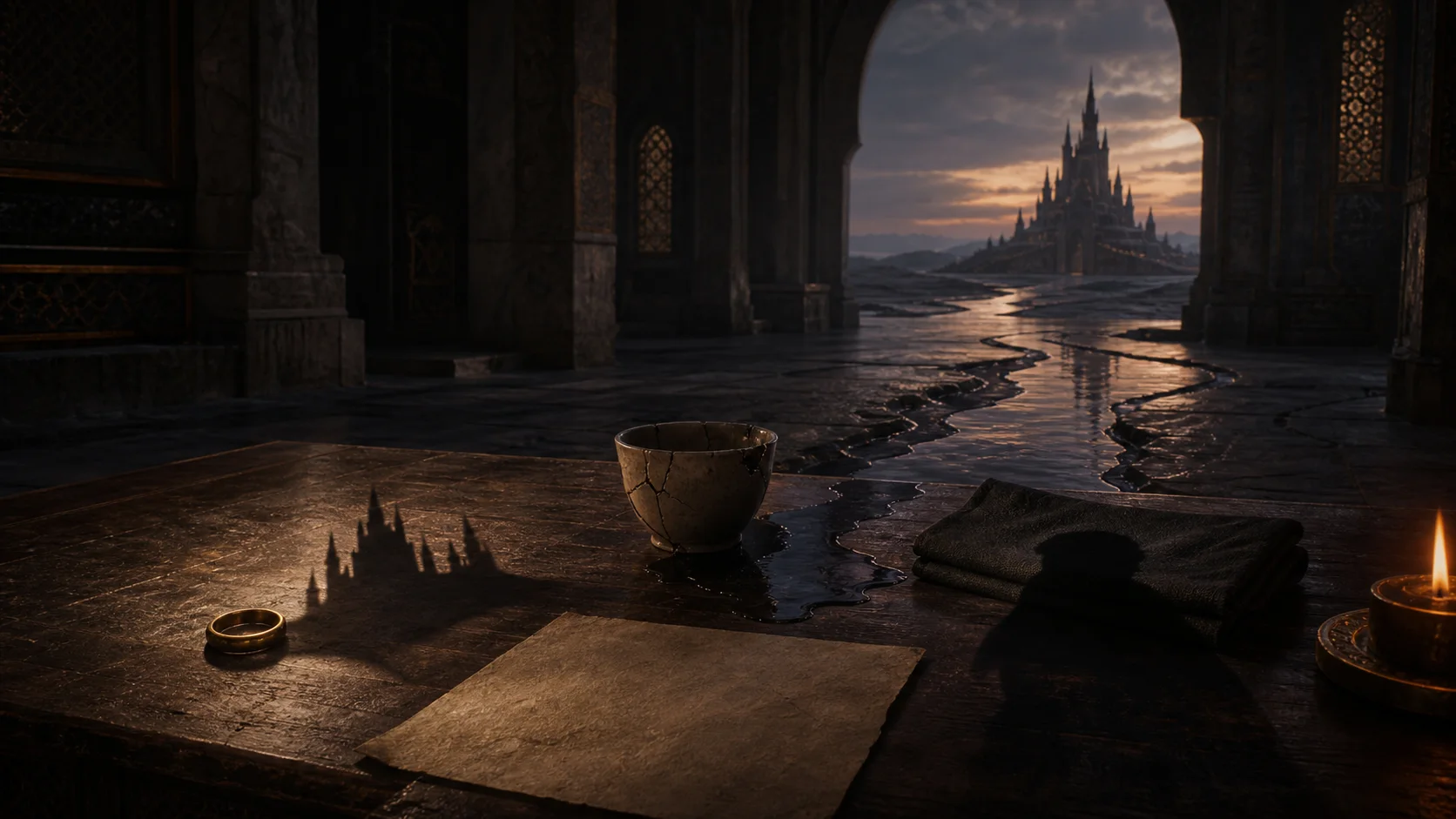
Metaphor was already here before fantasy
Metaphor is not an ornament a poet reaches for whenever a sentence needs beautifying. In Metaphors We Live By, George Lakoff and Mark Johnson argued that much ordinary thought maps a familiar domain onto an abstract one. We “spend” time, “defend” a position, and call a stalled relationship a “dead end.” Their classic paper in Cognitive Science likewise treats metaphor as part of human conceptual structure, not decorative wordplay.
This does not mean every culture thinks through identical metaphors. Bodies, languages, and traditions shape the images we choose. The point is simpler: to understand something formless, we often borrow from what can be seen, touched, or carried. Before any sorcerer turns sorrow into stone, language has prepared the way.
Fantasy moves one step beyond language
When we say “grief is heavy,” the weight is figurative. Fantasy can build a world where mourning truly makes a body heavier, floors crack beneath bereaved feet, and lightness returns only after loss is accepted. The metaphor is no longer commentary from outside the story. It has entered cause and effect.
In Fantasy: How It Works, Brian Attebery identifies this as a major fantasy mechanism: magic can be a metaphor made true within the fictional world. Call it an “embodied” or “literalized” metaphor. Consequence distinguishes it from a poetic image. If forgetting is fog, we must ask where it comes from, who profits, and what returns when it lifts.
Fantasy does not explain a metaphor. It gives the metaphor a body, then asks us to live with what that body does.
We see two truths at once
Fantasy readers develop a curious ability: they see a ring as a real object and as a shape taken by the desire to dominate. A shadow has teeth and a will in the story, yet it also touches nameless experiences within the self. Neither view cancels the other.
This double vision keeps metaphor alive. Treat the ring as only an object and some meaning disappears; call it only “a symbol of power” and we lose its weight, history, temptation, and role in choice. The Stanford Encyclopedia of Philosophy notes that metaphors usually produce more meaning than a simple paraphrase can contain. “And other things” is not a failure of interpretation, but a sign of capacity still unspent.
So the useful question is not, “What exactly does this creature symbolize?” A better question is: what has the embodiment of this image made possible in the story that could not otherwise be seen?
The impossible is not there merely as decoration
Though they disagree over the genre's boundaries, the scholars introducing The Cambridge Companion to Fantasy Literature place the impossible near fantasy's center. Impossibility alone, however, creates no depth. A dragon may be a large enemy; a spell, a quick way to open a door. Fantasy need not turn every stone and bird into a symbol.
Yet sometimes removing the impossible breaks the work's central limb. Take away the soul walking beside a person, the power of names, or a nation's vanishing memory, and the story asks a different question. Here the impossible is not stage dressing. It is a way of thinking.
That distinction helps us avoid defining fantasy as a checklist of creatures and spells. The number of wonders is beside the point. What matters is the change the impossible makes in our understanding of the possible.
The princess who was literally light
One clear example appears in George MacDonald's The Light Princess. A curse deprives the princess of gravity. Her body is light, and she takes nothing gravely. In English, “gravity” carries both physical weight and seriousness; the tale makes that linguistic bond a law of its world.
The complete text at Project Gutenberg shows that the idea is more than a pun. Weightlessness changes the princess's safety, movement, relationships, and ability to face suffering. Love and grief are not a moral pasted onto the ending; they return her to the ground and to life's gravity.
For Attebery, fantasy makes a connection forged by language imaginable again. The princess's “lightness” is true and untrue at once: she floats, while an irresponsible person in our world does not rise to the ceiling. The tale lives in the distance between those truths.
Power that fits in the palm of a hand
The One Ring in The Lord of the Rings is more intricate. Political power and the wish to dominate are shapeless, scattered through law, fear, obedience, wealth, and desire. The Ring gathers them into a small, portable thing. It can be hidden, inherited, stolen, given away, or destroyed. Power now enters an intimate bond with its bearer, who can promise himself he will use it only for good.
Yet the Ring is not a label reading “power.” It has a history, erodes the will, makes promises, and divides good intentions from good outcomes. In his letter to Milton Waldman, Tolkien writes of fall, death, and the urge to impose one's will swiftly upon the world, while resisting closed allegory. Making the Ring the exact equivalent of one weapon or regime drains its life.
In the world of The Lord of the Rings, its meaning belongs to a web of history, peoples, and choices. The metaphor is real because the world pays its price.
A soul that walks beside you
In His Dark Materials, part of every human lives outside the body in animal form. A dæmon speaks, fears, changes shape, and stays near its person. In his official Q&A, Philip Pullman calls Dust a “metaphor” and describes the dæmon as a part of us that helps us grow toward wisdom.
This is far more than a beautiful animal companion. Soul, conscience, desire, and maturity become visible and social. Others see a dæmon's form; touching one is taboo; forced separation brings physical pain and political horror. An inward reality enters public space, and the world builds customs, violence, and law around it.
The world of Dust and consciousness in His Dark Materials grows from this embodiment. The philosophical idea does not wait beside the adventure. It walks with the character and sometimes reacts first.

The mist that covers memory
In Kazuo Ishiguro's The Buried Giant, collective forgetting becomes mist over the land. The official Penguin Random House introduction presents the novel as a meditation on forgetting and memory's power. The characters have lost more than private details: the violent past shared by two peoples has vanished too.
When memory becomes weather, the question leaves the individual mind. Forgetting may preserve peace, but that peace stands on something buried. Clearing the mist can restore truth and identity while waking revenge. Rather than declaring memory good or bad, the novel makes every answer carry a visible cost.
Here the novel touches the question does forgetting make us innocent? without becoming an answer to it. A mist can be dispersed. Responsibility does not vanish when the weather improves.
A sea where stories can be poisoned
In Salman Rushdie's Haroun and the Sea of Stories, narrative becomes a real sea. Its waters can be poisoned and the source of storytelling stopped. The publisher's official page describes Haroun's attempt to save that poisoned source. Censorship and silence are now substances poured into water.
A literary study places the literalization of figurative language in Haroun at the novel's center: darkness is manufactured, lips are sewn shut, and anti-stories destroy the current of stories. Wordplay gives the social critique something readers can almost touch.
Still, the sea is more than an equivalent for free expression. It has an ecosystem, receives differently colored streams, and can be polluted or healed. Say “the sea means free speech” and we lose what fantasy added: an independent life.
A shadow whose name must be spoken
In A Wizard of Earthsea, Ged's hunger for power and need to prove himself unleash a shadow that wounds and pursues him. The Ursula K. Le Guin Foundation likewise describes a terrible shadow freed when Ged meddles with forbidden secrets. It comes from outside, but its relation to Ged grows steadily more troubling.
The darkness does not remain a foreign enemy. Ged must stop fleeing, turn toward it, and discover its name. Fantasy makes the relation to a disowned self into a geographical pursuit: boat, sea, exhaustion, and direction all matter.
This reading should not become a claim about one certain authorial intention. Le Guin made a world and a character, not a psychological diagram. True names and equilibrium in Earthsea invite interpretation without confining it to one answer.
Why does embodied meaning work?
Abstract emotions have no clean borders. Anxiety can return while someone washes a glass, answers a message, or turns off the light. Language approaches it through the body: pressure, knots, falling, heat. Conceptual metaphor theory takes this bond between physical experience and abstract understanding seriously.
Fantasy tests the bond at the scale of a world. If anxiety is a door behind someone, the character may lock it, ignore its rattle, or hear something knocking from the other side. Readers experience the feeling's path, resistance, and demands rather than receiving a report.
This distance lets us approach pain without falling at once into worn language of advice and diagnosis. The mind's need for fantasy is not always escape. Sometimes an impossible distance makes the familiar visible.
The world must pay the metaphor's price
An embodied metaphor convinces only when it lives beyond the major scenes. If true names carry power, people guard them; education, trust, and espionage change. If memories can be sold, inheritance, testimony, punishment, and legal personhood change too. If grief has weight, homes and mourning rites cannot remain identical to ours.
Here metaphor joins worldbuilding. A believable fantasy world needs more than accumulated detail; it needs cause and effect. Meaning with a body must occupy space, create friction, and sometimes produce unwelcome results.
If magic works only when the author needs to prove a point, the world turns into a lecture hall. Once a good metaphor enters a world, it has the right to cause trouble.
Not every magical thing is a code
Decoding is tempting. Readers want to know what a dragon “really” is, which unconscious a forest “exactly” represents, and what fixed idea each color signifies. Yet an imaginary creature may exist for wonder, danger, humor, or the world's own life. Even when it carries meaning, that meaning need not fit one word.
Tolkien writes in the Waldman letter that he dislikes conscious allegory, though living legend inevitably invites many readings. Openness to meaning differs from a one-to-one chart. Closed allegory pairs elements with predetermined equivalents. A living metaphor lets the Ring speak of domination while revealing ownership, addiction, fear, good intentions, and mortality.
Reading fantasy, then, is not a hunt for the author's concealed answer. It is a conversation with a world that has more than one door.
When a metaphor is too neat
A weak metaphor reveals itself early. A character merely represents a concept, every event delivers its predictable conclusion, and the impossible never rubs against ordinary life. The result is a diagram, not a world.
Imagine depression as a monster slain by the hero. The image seems powerful, yet quietly claims that suffering is an external, singular enemy that can be destroyed. Another story might make pain a house whose windows need opening, or a sea crossed with help and rest. Each image judges suffering differently.
Making a metaphor real does not make it the final truth. It renders one model palpable. A mature work can also see the limits of the model it has chosen.
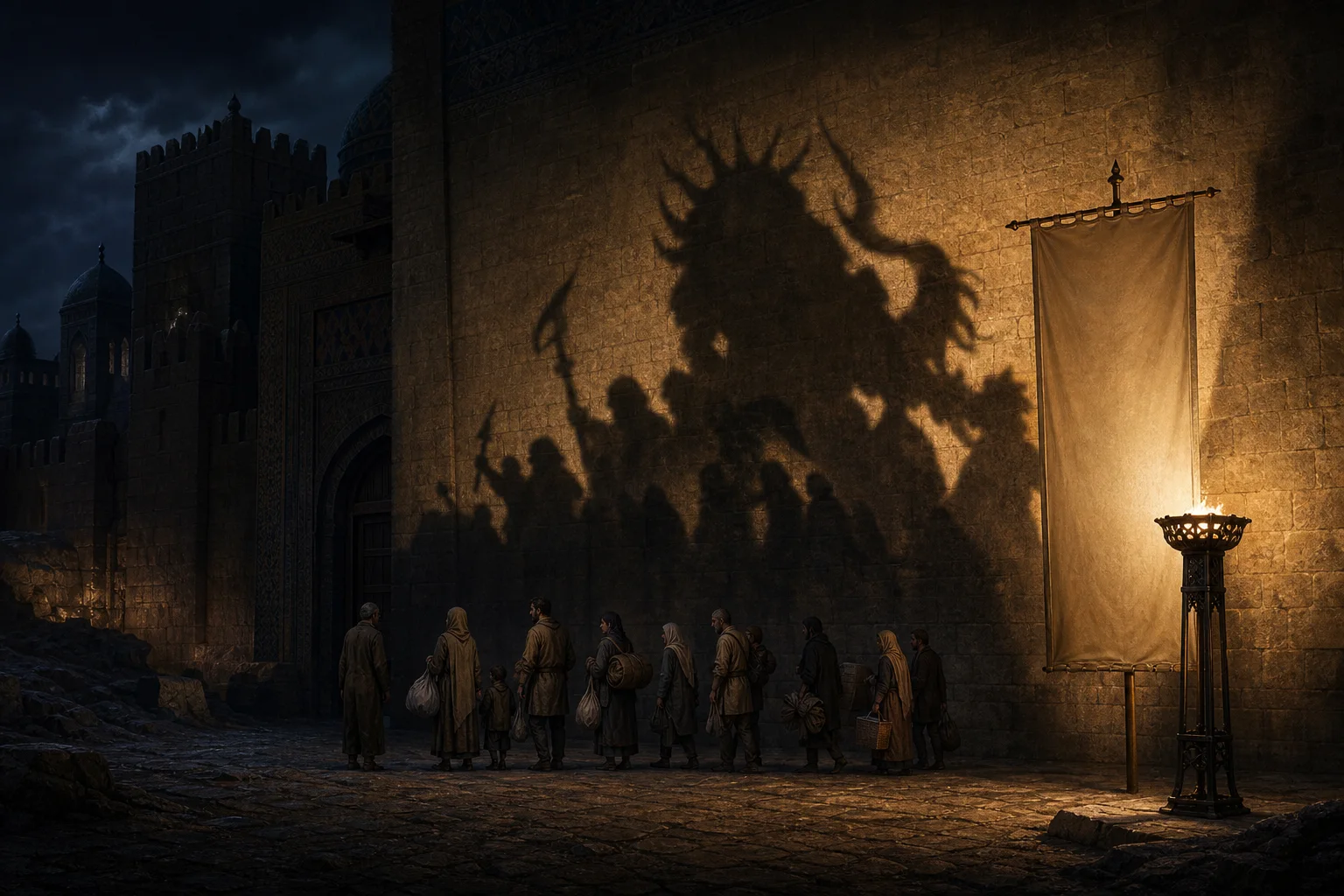
When evil is given a fixed body
A graver danger begins when evil is fastened to blood, species, face, or body. An enemy born wicked simplifies battle: choice, upbringing, obedience, and change no longer matter. Destroying the creature begins to resemble solving a biological problem.
The “monster theory” discussion in the Oxford Handbook of Monsters in Classical Myth shows how monsters expose cultural anxieties and borders; monstrosity changes across societies and periods. Another Oxford study of the “Other” in speculative literature warns that otherness can feed fearful, colonial, and militarized fantasies.
The answer is not to remove monsters from fantasy. Why do we create monsters? is a necessary question; more necessary still is asking who has the authority to name another being monstrous. If the story's light shines from one side alone, perhaps the shadow on the wall does not have the shape of the people who cast it.
Suffering is not decorative material
Fantasy can make illness, grief, or trauma visible, but visibility is not understanding. A luminous wound, blackened eyes, or inherited curse may look beautiful from afar and contain no human experience. When a sufferer exists only to darken the atmosphere, the metaphor gains a body and loses the person.
A stronger work lets the character resist its image. Someone may love the monster of their grief, fear its absence, or be unable to imagine life without it. A curse may have protected as well as harmed them. Contradiction separates a metaphor from a poster.
Small details matter too: medicine that is forgotten, a message written and deleted three times, a bowl left in its familiar place after someone has died. Fantasy's grandeur gains weight when its magical light does not wash out these fragments of ordinary life.
Four signs of a living metaphor
First, a living metaphor works without interpretation. The Ring must be an object with rules and dangers, not a word dressed in gold. Second, it changes choices, relationships, institutions, or bodies. Third, it bears several reasonable readings and survives the first explanation. Fourth, it does not reduce characters to pieces arranged to prove a message.
There is another sign: sometimes the image resists its maker's first intention. An author may imagine grief as a prison, only for a character to discover a way of living within it. A monster intended as absolute evil may reveal a language, a fear, and a desire of its own. At that moment, the world begins to leave the diagram behind.
This resistance is not the author's defeat. It is the price of giving the metaphor life.
When the impossible makes truth visible
In his famous argument about fairy stories, as Verlyn Flieger explains on the Tolkien Estate website, Tolkien speaks of “Recovery”: seeing again what familiarity has hidden. Embodied metaphor offers one path to it. Fantasy leaves reality so it can return reality's hidden forces in a new shape and at a revealing distance.
Close the book and there is no Ring on our table, no dæmon at our heel, no mist hiding a people's memory. Yet power is no longer shapeless, the soul no longer merely abstract, and forgetting resembles the blank space between memories.
Fantasy does not replace reality with the impossible. It gives temporary form to what has no body and lets us sit beside it. Then we return to an empty chair, a cold cup, clothing no one has found the heart to put away. None is magical. None is entirely silent anymore.
Sources and further reading
- Oxford University Press: Brian Attebery, Fantasy: How It Works
- Oxford University Press: Fantasy in the World: How It Means and What It Does
- Cambridge University Press: The Cambridge Companion to Fantasy Literature
- University of Chicago Press: George Lakoff and Mark Johnson, Metaphors We Live By
- Cognitive Science: The Metaphorical Structure of the Human Conceptual System
- Stanford Encyclopedia of Philosophy: Metaphor
- Tolkien Estate: Verlyn Flieger on On Fairy-Stories
- Tolkien Estate: Letter to Milton Waldman
- Project Gutenberg: George MacDonald, The Light Princess
- Ursula K. Le Guin Foundation: A Wizard of Earthsea
- Ursula K. Le Guin Foundation: From Elfland to Poughkeepsie
- Philip Pullman: official Q&A
- Penguin Random House: The Buried Giant
- Penguin Random House: Haroun and the Sea of Stories
- Oxford Handbook of Monsters in Classical Myth: Introduction
- Oxford Academic: Unbarring the Other