Essays
When Magic Leaves the World
The last dragon vanishes, the ship of the elder beings leaves the shore, and the world passes to humankind. Why is fantasy so drawn to wonder’s final days?
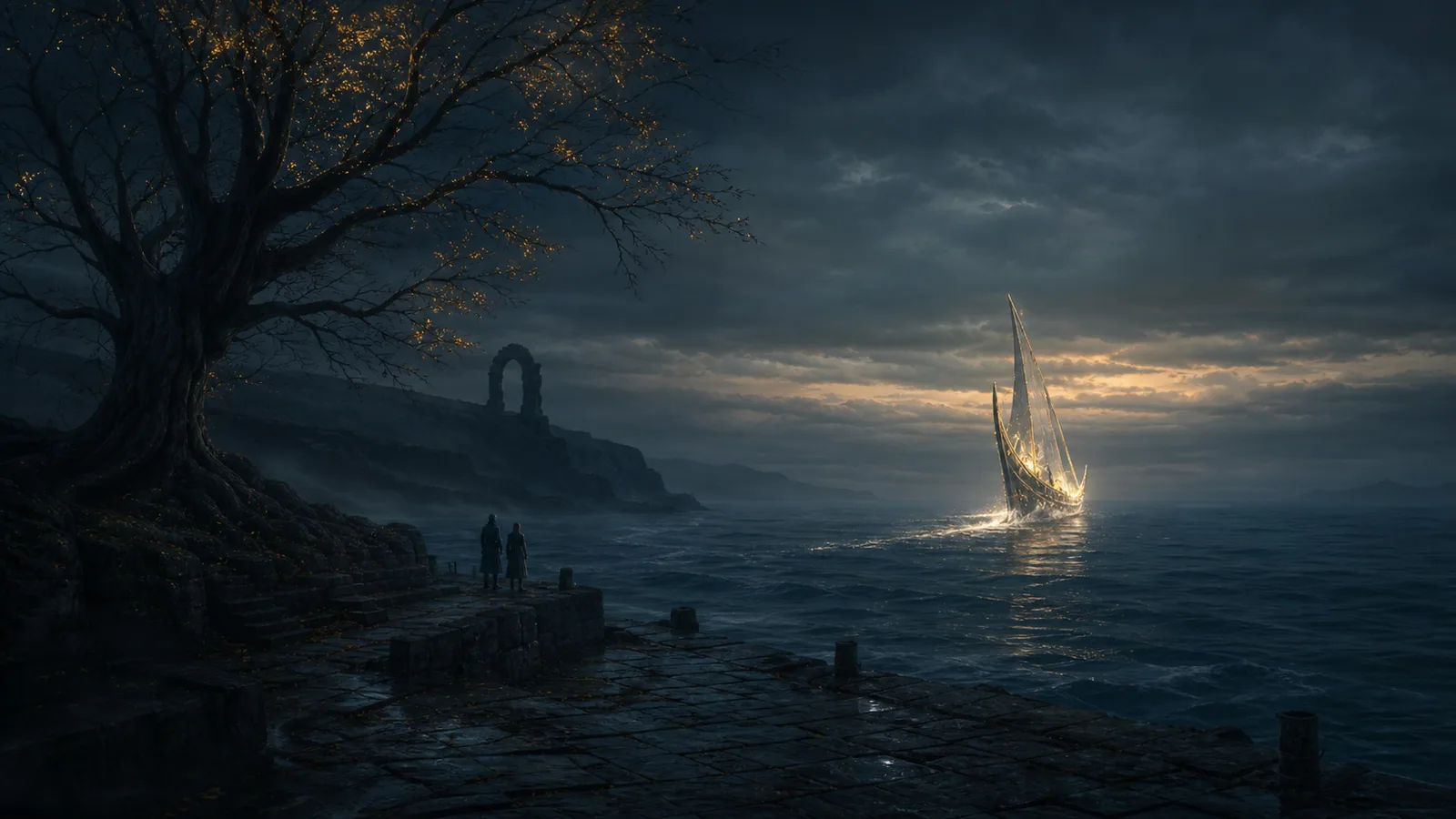
The ship has left the shore. The harbour clerk strikes the final name from his ledger, a fisherman coils a wet rope, and a child waits by the water for bells that will never ring again. Nothing strange has happened. The baker has lit his oven, the bridge toll is still collected, and the wind smells of salt. Only something that belonged to the world for centuries no longer does.
Fantasy often brings us into a world not at magic's dawn but during its last days. That choice does more than beautify ruins. Fading magic reveals what a simple victory conceals: for a world to escape ancient powers and pass into ordinary human hands, it may have to surrender part of its splendour. A hero may save the world. They cannot promise it will remain what it was.
We Always Arrive a Little Too Late
Before the first page, a greater age has passed. Towers have forgotten their builders. An old road leads to a lost capital, and the innkeeper alone remembers the river's old pronunciation. Dragons have grown scarce. Trees still whisper, though few travellers understand them. The world is alive, yet the great feast began long before we came.
This late arrival is one way fantasy gives an invented world history. As we saw in Middle-earth's deep time, the past is not mere appendix material; it presses upon the present. Every ruin says others built before you and failed. Every half-remembered name announces a loss for which even mourning is incomplete.
Why Must Magic Be Mortal?
Magic that remains forever, unchanged and safe, may be useful, but it loses urgency. If a thousand dragons cross the mountains each spring, the next remains magnificent. The last dragon is history. Rarity gives wonder weight. A magical creature is no longer scenery; meeting it may be a generation's last chance to learn the old tales did not lie.
By making magic mortal, fantasy does something close to its work with death and immortality. An ending does not create value, but reveals it. A hand always within reach is easily forgotten. When it must be released tomorrow, its warmth returns to memory. Once magic can leave, it stops being merely an ability and becomes a presence.
A Miracle That Arrives on Schedule Every Morning
Imagine a light spell sold at a fixed nightly rate. Healers need licences; the council bans broomsticks in narrow alleys; the tax office prints a form for inheriting talking swords. Magic has become infrastructure. People depend on it, complain about its price, and notice it only when the service fails.
That fate is not necessarily bad. Magic systems in fantasy can be precise and still inspire wonder. Our relationship changes. A miracle arriving on time each morning joins ordinary life. To restore its awe, a story may extinguish the lamps one by one, until people understand that normality was never the world's eternal contract with them.
Disenchantment: A History That Was Never So Neat
It is tempting to treat fading magic as fantasy's version of a familiar claim: science arrived, so enchantment departed. History offers no such clean, straight line. In The Myth of Disenchantment, Jason Ānanda Josephson-Storm argues that the story of a wholly disenchanted modernity sits uneasily beside the persistence of spiritualism, occult belief, and new forms of enchantment within those same societies. Cambridge's study of representations of magic in modern Ireland likewise describes beliefs enduring and adapting to modernity, rather than vanishing overnight.
This essay will not reduce the history of science to a battle between laboratory and forest. The “disenchanted world” is itself a powerful cultural story, not a complete account of how people lived. Michael Saler's As If, reviewed at Oxford Academic, sees modern imaginary worlds as secular enchantment. Perhaps modernity changed magic's location, language, and claims rather than abolishing it.
A Victory That Left the World Less Enchanted
In The Lord of the Rings, destroying the One Ring is unquestionably necessary. If it survives, the Shadow returns and freedom remains bound to one bearer of power. Yet when evil loses its means to endure, some of the Third Age's loveliest refuges lose their future too. Victory is not a gate into the past. It opens upon a new age.
In his letter to Milton Waldman, Tolkien sets the Ring's destruction beside the Elves' final departure and human dominion. The power that must be broken belongs to an order that preserved much beauty. That is why The Lord of the Rings feels like a world for reasons beyond maps and languages. Even victory can end something.
The Good Rings Fade Too
The Three Elven Rings were not made for domination. Through them, the wounds of time can be slowed, allowing places such as Lothlórien to keep the beauty of a waning age a little longer. Yet their power does not stand wholly outside the history of the One Ring. When that order collapses, what benevolent hands preserved within it cannot endure forever in the same form.
Here lies the bitterness at the heart of fading magic: sometimes the machinery of evil cannot be destroyed while every beauty attached to its age remains untouched. That does not make good and evil equivalent. Quite the opposite. Because the hero knows the difference, they accept the cost. They relinquish power even while knowing that the shadows of beloved trees will shorten with it.
The Last Ship, Humanity's First Morning
At the Grey Havens, the ship carries away more than travellers. A kind of presence withdraws. Beings whose memories outlast kingdoms leave mortals to govern with incomplete ledgers, broken bridges, and short-lived promises. The Tolkien Estate's images and documents concerning The Lord of the Rings show geography and weathered objects bearing history even during the work's creation. Keeping it now falls to people who pass quickly.
Next morning, someone must clean the harbour lantern. No immortal guardian points out the forest path. Bread must be baked, and a child who will never see an Elf must learn from songs what came before. The Age of Men begins not with coronation, but when the lamps no longer light themselves.
The Age of Men: Freedom or Orphanhood?
The departure of ancient beings may be freedom. Humanity's future is no longer written in the margins of wars among gods, deathless peoples, or covenants it had no part in making. Even failure belongs to humanity now. That independence matters. However splendid, a world where people are only pupils, servants, or victims of higher powers is never fully home.
But freedom is not always a celebration. A child leaving home gains agency and learns that nobody else will light the stove first. The human world is lonelier without an authority beyond time to guarantee meaning. Fantasy chooses neither freedom nor orphanhood. Both arrive that morning.
The Farmer Who Does Not Mourn the Last Dragon
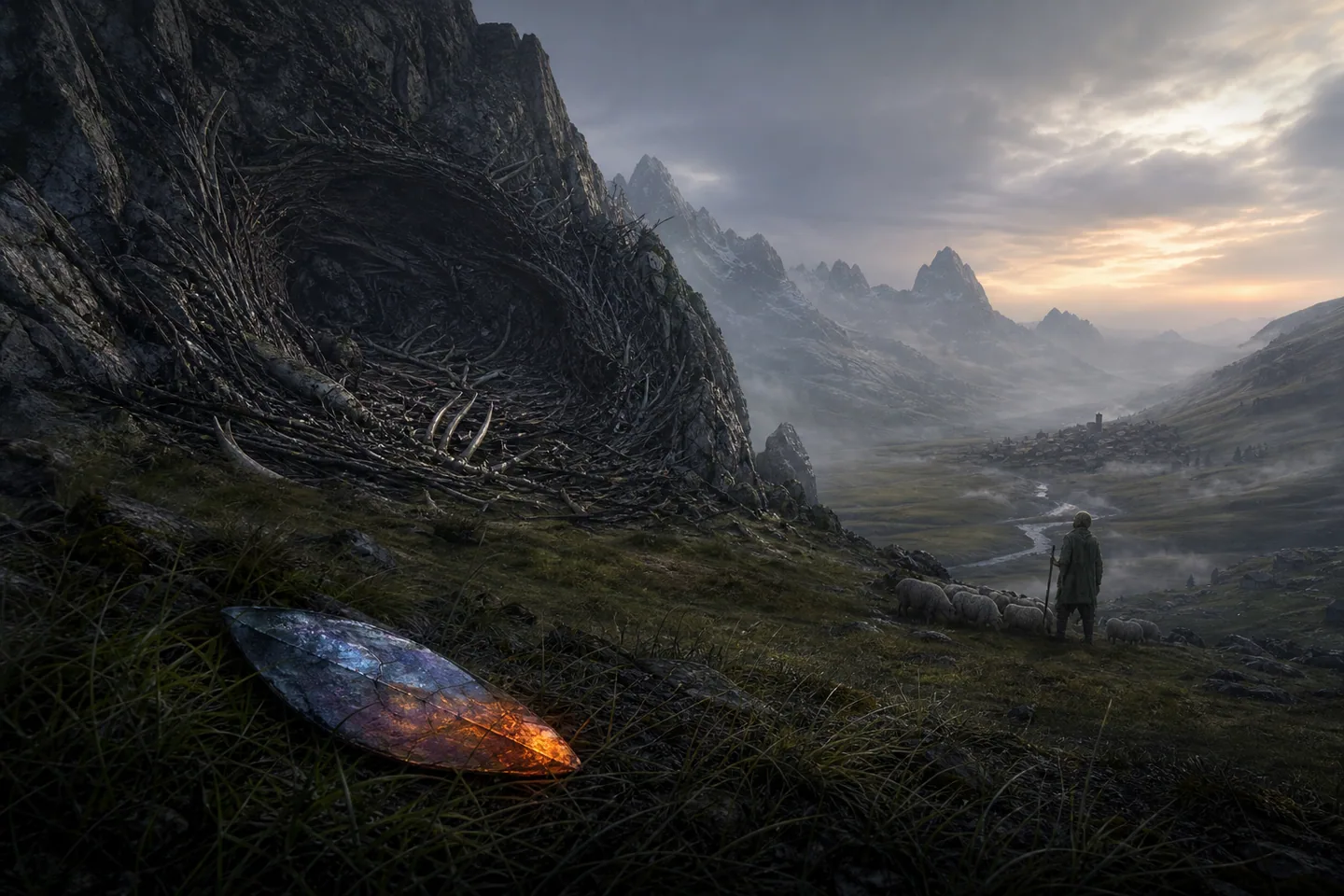
Below the high halls, loss takes another shape. For the shepherd who lost sheep each spring, the dragon's departure may begin an age of safety. The pass opens, the flour cart reaches the village before rain, and children may stay beside the river at dusk. To a poet, the great scale in the grass ends an age. To the cobbler, selling it may mend the leaking roof.
Splendour and suffering are not shared equally. Those in palaces may hear a dragon's wings as the music of history; someone whose house burned may hear only fire. Ignore that difference and sorrow for fading magic becomes nostalgia for the owners of towers. Something immense has left the world. That can be true without demanding equal tears from everyone.
The Old World Was Never Innocent
“Ancient” and “beautiful” are not synonyms for “just.” Old magic may depend on the right blood, a family name, another person's sacrifice, or the command of a being that never has to explain its judgment. In many worlds, magical knowledge belongs to a small class while everyone else pays the price of spells they have no right to question.
Sometimes magic's sunset ends terror too. A god no longer demands tribute from a meagre harvest. A prophecy no longer takes choice from a child; a court magician cannot erase dissent from a city's memory. As we saw in When Metaphor Becomes Real, the impossible embodies more than beauty. It can give a body to discrimination, fear, and unanswerable power.
Who Has Time to Mourn?
For an immortal poet, the silencing of a sacred tree ends a thousand years of memory. For a widow paying the war tax, tonight's concerns are flour and dry wood. Neither grief cancels the other, but they do not speak from the same position. Someone who fights each day to survive may have no time to preserve the name of an age that has ended.
Good fantasy sometimes turns from the last ship towards the quay: a labourer replacing a broken plank, a mother holding her feverish child, a soldier unsure what work follows victory. Grief for magic is real; so is the responsibility after it. Splendour that cannot see these people is only lovely light upon their ruins.
The Last Unicorn and a Return That Cannot Erase the Wound
In The Last Unicorn, a creature sheltered in her lilac wood, unaware the world has changed, sets out to find the others. The official Hachette description also begins with news that the unicorns have vanished. The tale appears to promise their return. Yet time does not run backwards. A creature who has touched fear, love, and mortality cannot remain the untouched being who began the journey.
The distinction matters. To repair a world is not to erase what happened within it. If magic returns, it meets those who lived through its absence, not unaltered copies of their former selves. This separates salvation from a reset button and brings it closer to the repair of reality: a wound may close, but the body keeps the history of its closing.
Salvation Does Not Give the Past Back
A bridge rebuilt after war may be stronger, but lacks the beam where two generations carved their names. A replanted forest lives without the shade of a thousand years. A city that clears its rubble may laugh again, though the householder sees one missing plate on the shelf more clearly than any architect.
Insisting on the difference between repair and return is not pessimism. It is respect for time. A story that restores everything exactly as it was makes the suffering of the journey inconsequential. Fantasy can be kinder because it refuses an impossible promise. It says that life after loss is possible without pretending the loss never happened.
When Magic Returns
Not every fantasy moves towards extinction. In Jonathan Strange & Mr Norrell, England has lacked a practical magician for centuries, until a recluse proves magic is not dead. Bloomsbury's official introduction links his emergence to raising the dead and taking magic into war. This counterexample matters: fading magic is no law of the genre.
Magic does not return quietly or cheaply. A force dismissed as legend enters a world with its own laws, universities, wars, and vanities. Old roads open, but their inhabitants owe nothing to modern justice. The official reading-group guide likewise frames magic's return through power, knowledge, and rivalry, not a simple festival of wonder.
Returning to a Home That Is No Longer Home
If we return to our childhood home after twenty years, the door may still make the same sound. Even so, both we and the house have changed. Return reveals the distance. Ancient magic, when it enters the new city, cannot pretend that nothing happened while it was away.
It may be beautiful, saving, and dangerous. Forgotten knowledge might cure a disease and, on the same day, awaken a covenant in which no living human has a name. Fantasy does not use such returns to warn that the past must remain buried. It asks whether we can welcome something back without restoring its old right to rule.
The Forest and the Furnace, Neither One Pure
Princess Mononoke breaks the simple opposition between innocent forest and wicked town. The official GKIDS page introduces the struggle among Iron Town, the forest gods, and a man caught between them. The forest is sacred but not merely gentle. The town wounds nature, yet gives work, defence, and standing to people society cast aside.
The British Film Institute's discussion of the green wave in 1990s animation stresses the same moral complexity: neither side is wholly good. Erasing one cannot save the future. When magic fades, we should ask what is dying, who destroys it, and who gains a first chance to live within the new order.
Science Did Not Kill Magic
Knowing how rain works does not make it less precious. A star remains a lost traveller's guide after we measure its mass, distance, and composition. Science gives precision to how. It does not thereby answer every question about experience, value, and meaning. The mistake begins when we confuse a mechanism with the whole truth of a thing.
Nor can meaning replace evidence. Calling suffering beautiful does not cure disease; stories do not regrow a felled forest. Cambridge research on music as the “only real magic” of modern life shows magical language persisting in daily life and art without claims of supernatural force. Science and enchantment need not be opposing armies, but neither should counterfeit the other's work.
Perhaps Magic Only Changes Its Dwelling
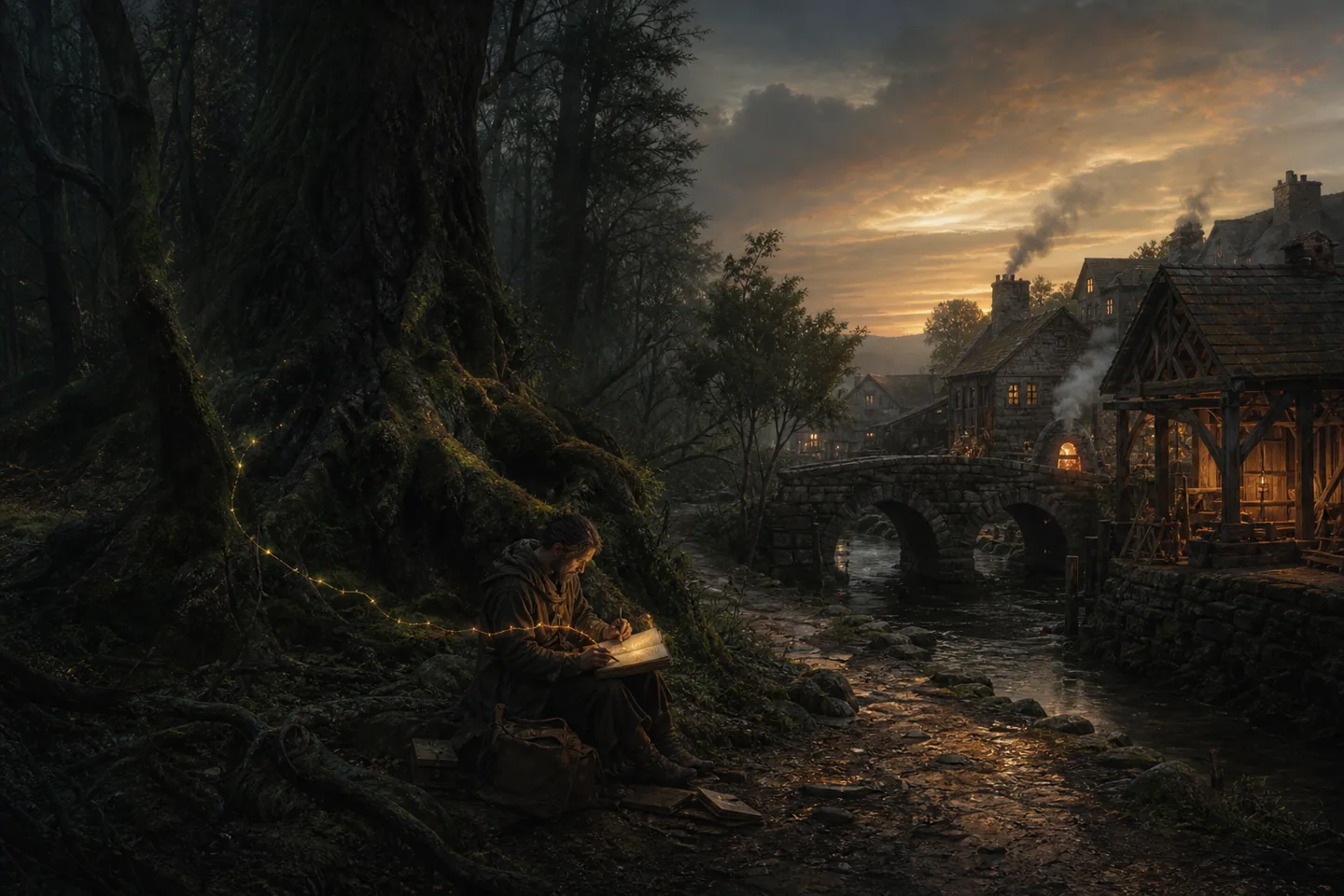
When ancient beings withdraw from geography, magic may enter memory, ritual, and story. The tree's name survives in a song. A dragon is painted on the family's winter soup bowl. The harbour child never saw the luminous ship, but knows why his grandfather fell silent at a certain bell. Wonder no longer governs the land; it reveals what habit hides.
This is the “recovery” of sight Verlyn Flieger describes in Tolkien's “On Fairy-stories”: fantasy makes familiar things visible again. Our essay on why humans still dream of magic asked why we desire that relationship. The next question is whether, once magic no longer rules, a story can preserve its presence without lying about its loss.
A Story Cannot Replace a Forest
The easy answer is that “real magic lives inside us.” It comes too cheaply. A tale cannot replace a destroyed forest; remembering a dragon will not restore it, nor naming injustice return its victim home. Earthsea and the idea of true names remind us that naming can be a responsibility. Even the right name does not spare us the work of preservation.
The work of story is smaller and more honest: it refuses to let loss remain nameless. There is an ethical distance between “it never existed” and “it existed, and was lost.” In the first, nobody owes anything. In the second, memory may ask why it went, who profited, and what we will do with the emptiness left behind.
The Responsibility of a World After Wonder
When magic goes, humanity does not inherit absolute power. It inherits unfinished work. People must protect the forest without an immortal guardian, write laws without a speaking sword, and use their brief lives to decide for generations they will never meet. Building imaginary worlds often begins by changing a single rule. Such a world's maturity begins when its inhabitants become responsible for that rule's consequences.
Perhaps that transfer is the value of magic's fading. Ancient powers withdraw, and no one remains upon whom humanity can blame its failures: fate, a curse, or the will of the gods. If the river is poisoned, if names are forgotten, or if the weak are crushed beneath the new order again, the Age of Men cannot say it still needed time to prepare. Morning has arrived.
The Lamps That No Longer Light Themselves
Years have passed. The child from the harbour now tends the lamps along the shore. Each evening he wipes the glass with a coarse cloth, measures the oil, and raises the wicks one by one. Sometimes, before lighting the last lamp, he looks towards the horizon. There is no sail. The ancient bells remain silent, and this spring the great tree has grown only ordinary leaves.
Perhaps the world has grown poorer. Perhaps it has grown freer. Perhaps both words are too small for what took place. What remains are people who, without any certainty that a miracle will return, must care for fragile things: a bridge, a name, a piece of forest, the memory of a creature that is gone, and a child whose future deserves to be more than a museum of the mistakes of the past.
The man raised the next wick. Behind him, the town shone. The sea remained dark.
Sources and Further Reading
- Jason Ā. Josephson-Storm: The Myth of Disenchantment
- Cambridge: Representing Magic in Modern Ireland
- Oxford Academic: Michael Saler, As If
- Cambridge: Enchantment in Music’s Modernist Ordinary
- Tolkien’s Letter to Milton Waldman
- Verlyn Flieger: On Fairy-stories
- The Tolkien Estate: Tom Shippey, The Lord of the Rings: Book of the Century
- The Tolkien Estate: The Lord of the Rings Paintings
- Oxford Academic: Faërie in Tolkien
- University of Glasgow: Fantasy, Recovery and Re-enchantment
- Bloomsbury: Jonathan Strange & Mr Norrell
- Bloomsbury Reading Guide: Jonathan Strange & Mr Norrell
- Hachette: The Last Unicorn
- The Folio Society: The Last Unicorn
- GKIDS: Princess Mononoke
- BFI: The 1990s Green Wave of Eco Animations
- Oxford Academic: Princess Mononoke, Understanding Studio Ghibli’s Monster Princess
- University of Oxford: Fantasy, Medievalism and Oxford English