Stories
The First Gate: A Beginning for Fantasya
A short opening story for a world built from fantasy, memory, wonder, and the strange pressure of being alive.
There was a room before there was a world.
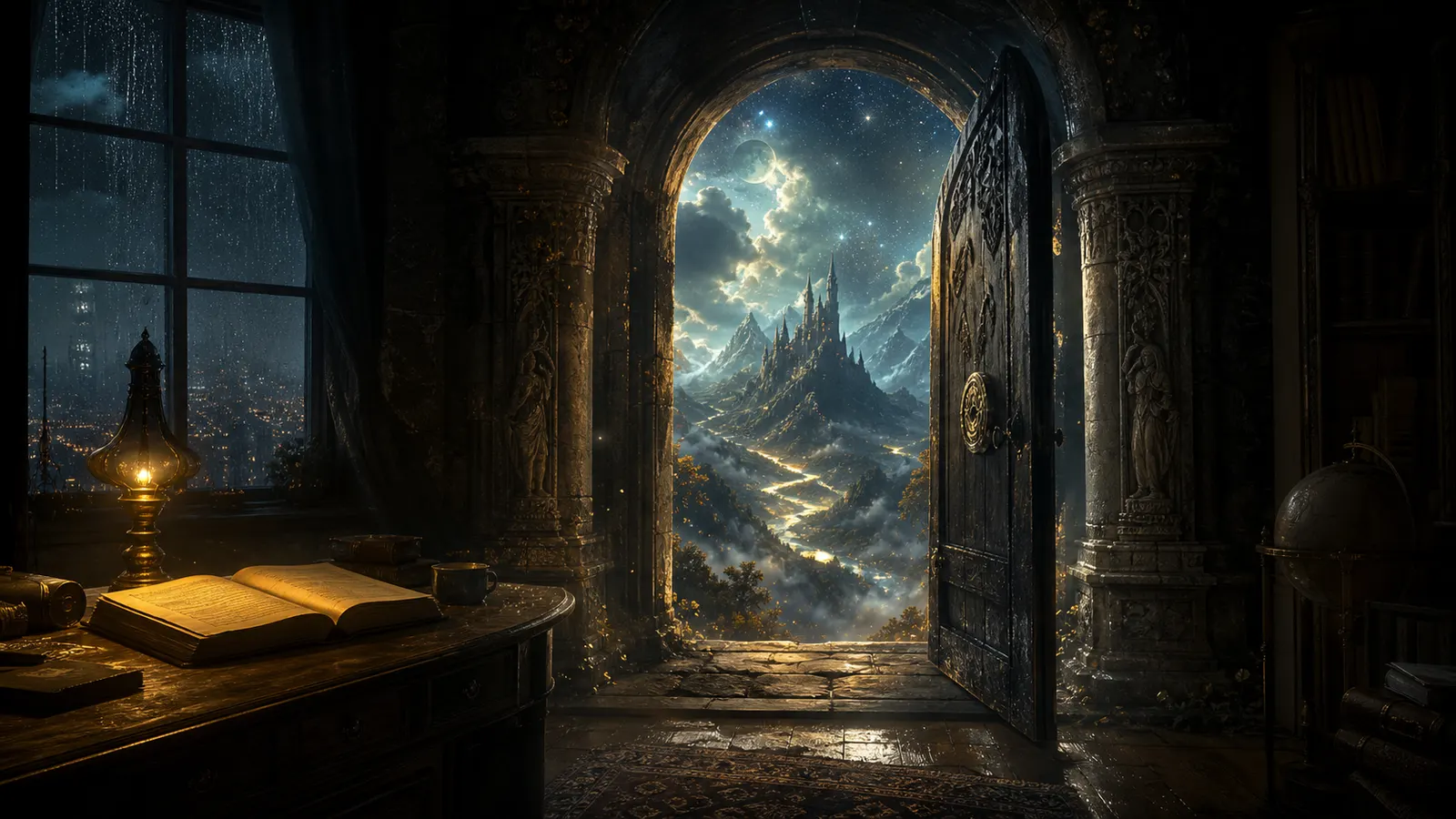
It was not a grand room. No throne waited there, no sword slept on a velvet cloth, no prophecy burned in silver letters. There was a desk marked by old scratches, a lamp with a small tired flame, a window darkened by rain, and a book left open as if someone had stood up in the middle of a sentence and forgotten how to return.
Outside, the city kept its ordinary face. Cars passed like dull comets behind wet glass. A phone lit, went dark, lit again. Somewhere a neighbor moved a chair. Somewhere water traveled through pipes. Life continued with the brutal modesty of real things.
The room belonged to reality. That was the problem.
Reality was present, undeniable, full of clocks and bills and bodies and messages that arrived too late or too often. Yet something in the room had begun to loosen. The air near the wall did not bend dramatically. It simply grew attentive. Dust stopped falling. The rain on the window seemed to wait between one drop and the next.
Then the wall remembered a door.
The Stone That Was Not There Yesterday
At first the door looked like a mistake in the room. Its arch was made of dark stone, too old for the plaster around it, too heavy for the floor that carried it. Fine lines ran through the frame, carved by a hand that loved patience more than decoration. In those lines, tiny points of amber light woke and faded, like embers under ash.
The door did not promise safety. That mattered. Safe doors belong to hotels, offices, houses, classrooms. This one carried a different kind of invitation. It did not say, come and be spared. It said, come and see what your life has been trying to say without words.
Every true threshold does this. In old stories, a gate is rarely a piece of architecture. Dante begins in a dark wood because the soul has lost its straight road. Orpheus descends because love has become stronger than the border of death. Gilgamesh goes looking for Utnapishtim because grief has torn the shape of kingship apart. Even the wardrobe in Narnia matters because it turns a child into someone who can cross from the ordinary room into consequence.
Fantasya begins at such a threshold. Not with a map first. Not with a catalogue of monsters. Not with a lecture about genre. First, a pause. First, a question.
A Door Is a Question
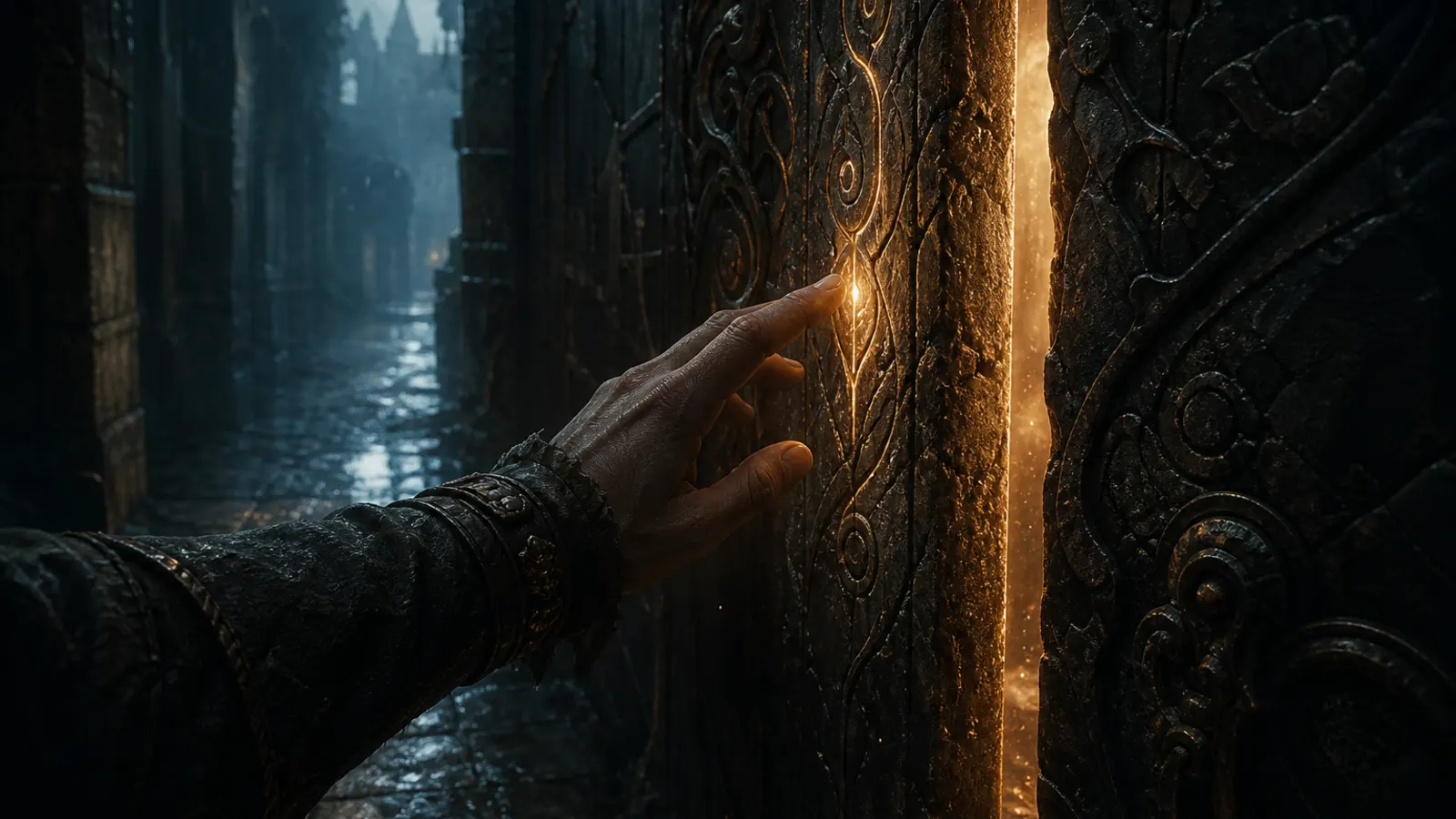
The hand that reached toward the gate trembled only a little.
It was an ordinary hand. That detail must remain. Fantasy becomes weak when it forgets the ordinary body that enters it. Fingers still remember cold. Skin still carries small scars. The pulse still rushes when the unknown comes near. The person before the gate was no chosen king, no immortal wanderer, no child of a secret bloodline. Just someone who had lived long enough to feel that the visible world was real and unfinished at the same time.
That is where Fantasya stands.
In What Is Fantasy?, fantasy is described as more than strange creatures and impossible laws. Here the idea becomes intimate. Fantasy begins where reality still exists, but can no longer explain the pressure inside us. A door appears because the mind refuses to accept that habit is the whole truth.
Some doors open onto escape. This one opened onto attention.
What Waited Beyond the Crack
Through the thin bright line between the stones came no trumpet, no battle cry, no dragon's roar. The first sound was water.
A river moved somewhere in the dark beyond the door. Not a symbolic river drawn for grandeur, but water with stones beneath it, reeds along its banks, cold mist above it, and a small wooden bridge that had probably been repaired many times by people whose names no epic had preserved. Farther away, towers rose on a ridge. Their windows held a yellow light. Between the towers and the river lay fields, grave markers, half-seen roads, and the smoke of morning fires.
This was important. A world should not begin by showing only its kings. It should show where bread is baked, where children are warned away from wells, where widows keep keys, where guards grow bored, where a song has survived after everyone forgot the war that made it necessary.
That is why the worlds that stay with us are rarely empty spectacles. Middle-earth carries languages and old griefs. Earthsea gives power to names and therefore changes silence itself. Skyrim remains in memory through roads, snow, inns, mines, and the feeling of walking without permission. The Witcher makes monsters inseparable from villages, hunger, prejudice, and dirty choices. These examples matter because they prove a simple law: wonder needs a ground under its feet.
The Road Beyond Entertainment
Someone could have closed the door at that moment and called the whole thing imagination.
The word would not have been wrong. It would have been too small.
Imagination is often treated as a softer faculty, something decorative, private, childish, or optional. Yet the mind uses imagination to survive the real. It gives shape to fear before fear devours us without a face. It lets grief speak in a language less naked than confession. It tests choices before the body must pay for them. It builds dragons when power becomes too large to look at directly.
In Why Our Own World Is Fantasy, Fantasya asks why existence itself feels stranger than any spell once we stop being numb to it. The gate belongs to that same question. It does not deny the real world. It exposes how mysterious the real world already is.
There is a kind of fantasy that works like a curtain. It covers the wound. Fantasya is more interested in the kind that works like a lantern. It does not remove the dark. It teaches the eye to notice paths inside it.
The Old Stories Were Already Waiting
The person before the gate thought of older doors.
The gates of Moria open to a word of friendship and then lead into memory, loss, greed, and the deep places under civilization. The rabbit hole in Alice's Adventures in Wonderland breaks scale and logic until language itself becomes unstable. Fairy-tale forests swallow children, princes, woodcutters, saints, thieves, and fools, not because forests hate them, but because the familiar road has ended.
Todorov wrote about the fantastic as a hesitation between explanations. Mendlesohn mapped different rhetorics of fantasy, different ways a world lets the impossible enter. Le Guin warned that fantasy loses power when its language becomes careless. Tolkien spoke of secondary worlds and the inner consistency that makes belief possible. These are not museum labels. They are tools for understanding why a door can feel more honest than a mirror.
The gate in this story carries all of that behind it. Not as citation, not as ornament, but as ancestry.
What Fantasya Is For
Beyond the arch, the road divided.
One path led toward essays, where fantasy becomes a way to think about reality, death, freedom, consciousness, and the ache of being human. Another led toward guides, where a reader can ask clear questions: what is high fantasy, why does dark fantasy call to us, how does a magic system work? A third path turned toward worlds and works, toward Skyrim, Elden Ring, The Witcher, Tolkien, and the many places where invented lands become emotional geography. A quieter path entered lore: creatures, symbols, magic, ruins, names, old fears.
None of these paths needed to compete. A living fantasy site should have many doors. Some readers arrive through search. Some arrive through a game they love. Some arrive because a creature, a spell, a ruined kingdom, or a sentence has been haunting them for years.
Fantasya does not ask every visitor to begin with philosophy. It asks for a little patience with depth. Come for the dragon if that is where the road begins. Stay long enough to ask why humans keep making dragons.
The Wound That Becomes a Lantern
There was one more thing behind the door.
On the left side of the road stood a lantern fixed to a black post. Its flame was small, but it did not shake in the wind. Around its glass someone had tied strips of cloth, each one marked by rain, ash, salt, or old ink. They looked like prayers from people who had crossed before and returned carrying something they could not explain easily.
One strip might have belonged to a reader who finished a book and felt homesick for a place that never existed. Another to a player who left a game world and found the real room suddenly too small. Another to a child who understood monsters before adults gave pain a name. Another to someone who realized that fantasy can repair reality by showing its broken edges in a shape the heart can bear.
The lantern was not cheerful. It was better than cheerful. It was faithful.
How to Enter
The gate did not open all at once.
No worthy gate does. It made the person wait. The stone listened. The room behind remained visible: desk, lamp, rain, open book, city lights. Fantasy becomes dangerous when it asks us to hate that room. The real world contains faces, bread, illness, touch, responsibility, graves, mornings, debts, and love. A door that erases all of that is too cheap.
This gate asked for another movement. Bring the real world with you. Bring its wounds, its jokes, its hunger, its fatigue, its unanswered messages, its small tenderness. Bring the part of you that still believes the world should mean more than repetition. The door has no use for an empty traveler.
When the hand finally touched the stone, the light did not explode. It warmed.
If You Return
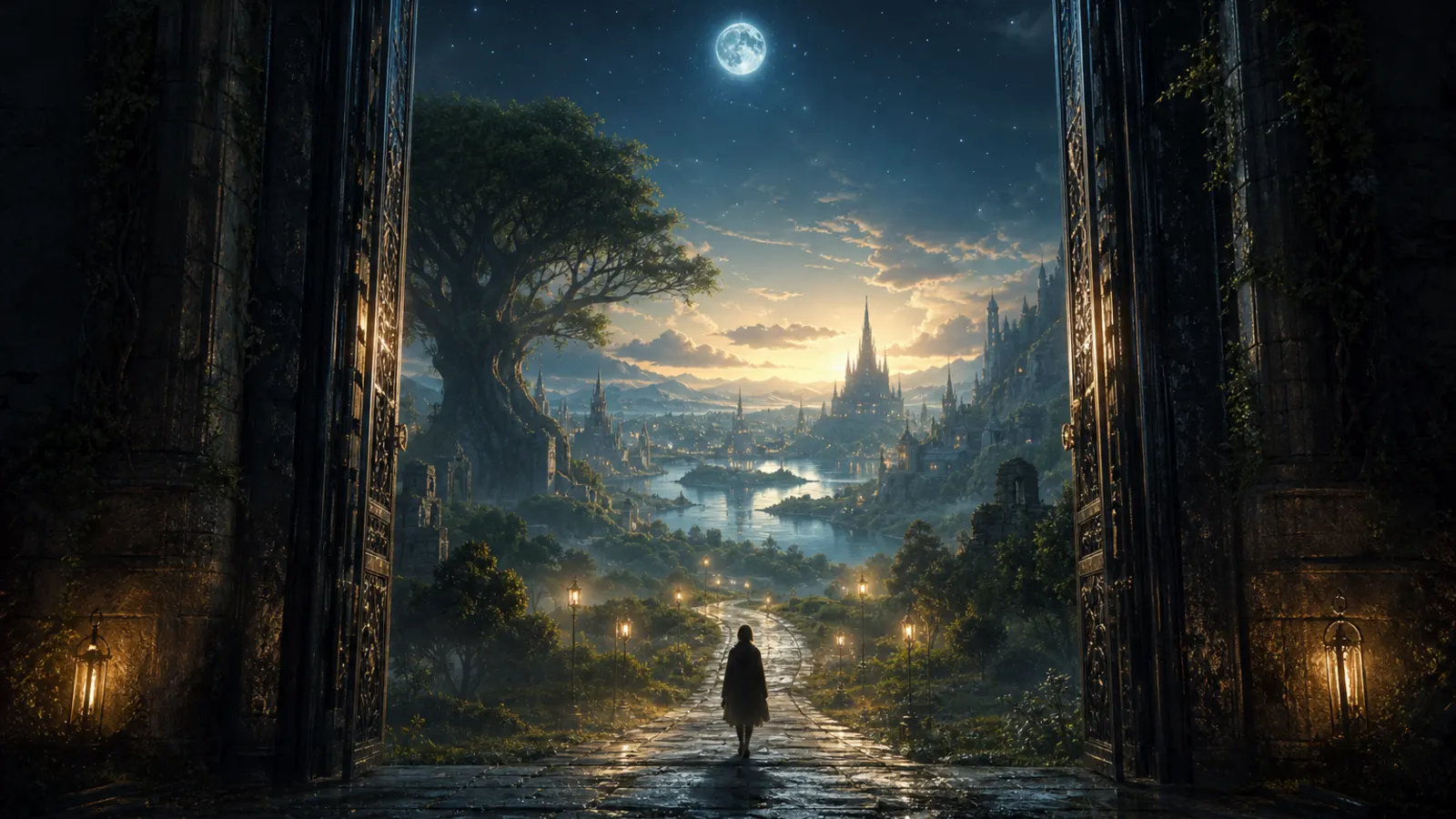
The first step through the gate was almost disappointing.
No crown appeared. No music announced destiny. The traveler simply felt the floor change underfoot. Wood became wet stone. Indoor air became mist. The smell of dust gave way to rain, moss, smoke, and a river that seemed to remember stars.
The world beyond did not kneel. It continued being itself. That was its dignity.
Perhaps every good fantasy world should behave this way. It should not flatter the visitor too quickly. It should have weather, distance, cost, silence, and people who are not waiting for the hero to give them meaning. A world that breathes without us can change us more deeply than a world built to praise us.
From the other side of the threshold, the old room was still visible. That mattered too. The gate was not a betrayal of reality. It was a way of seeing reality from farther away, with new shadows and new lights.
The First Gate Remains Open
Fantasya begins here: at the door, before certainty, before classification, before the map becomes neat.
It begins with the feeling that fantasy is not an extra room added to life after the serious work is done. It is one of the ways human beings approach what is too large, too painful, too beautiful, or too strange to face directly. We invent other worlds because this one overwhelms us. We return from them because this one still needs us.
So the first gate remains open.
Enter through wonder. Leave with a question.
Sources and Further Reading
- Tolkien Estate: Verlyn Flieger on On Fairy-Stories for secondary worlds, belief, recovery, and enchantment.
- Ursula K. Le Guin: From Elfland to Poughkeepsie for language, style, and the spell of fantasy prose.
- Ursula K. Le Guin: The Child and the Shadow for shadow, imagination, and inner darkness.
- Tzvetan Todorov: The Fantastic for hesitation and the structure of fantastic literature.
- Farah Mendlesohn: Rhetorics of Fantasy for portal, immersive, intrusion, and liminal fantasy.
- Brian Attebery: Stories about Stories for fantasy, myth, and the remaking of narrative traditions.
- Joseph Campbell Foundation: The Hero with a Thousand Faces for the journey pattern and mythic crossing.
- Project Gutenberg: The Blue Fairy Book for a public-domain archive of fairy-tale thresholds, forests, quests, and transformations.