Essays
When Escaping the Future Creates It
In myth and fantasy, prophecy does not always discover the future; fear of it can build the road that leads straight there.
Spoiler warning: This essay reveals major events from Oedipus Rex, Harry Potter, Macbeth, Kung Fu Panda 2, and A Song of Ice and Fire.
The king hears the news: an unborn child will one day take his crown. Guards multiply, doors are locked, and infants begin to look like enemies. Years later, one of those children returns—not by the road prophecy promised, but by the road the king's fear has built.
Myth and fantasy return to this pattern again and again. Someone is shown a terrible future and acts to prevent it. That action moves people, creates enemies, opens a door, or turns a victim into a weapon. The prediction is no longer a sentence about tomorrow. It has entered the present and become one of tomorrow's causes.
If the warning had never been spoken, would the future still have found the same way? The story may offer no certain answer. It leaves a trail—the footprints of someone who fled the future and, with every step, helped make it.
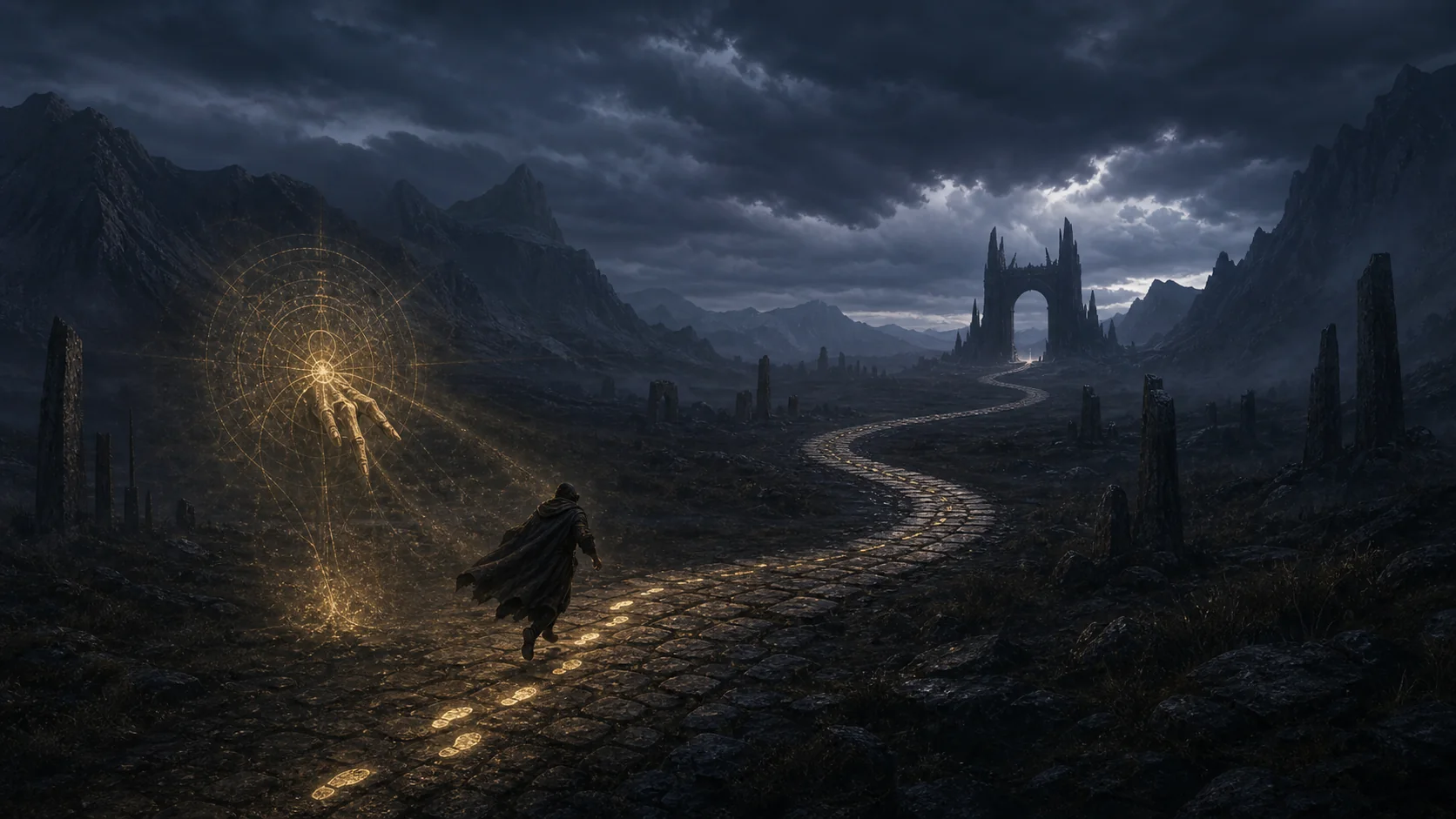
News from the future becomes part of the future
Prophecy often speaks as though it stands outside time. It has seen what is coming, returned to the past, and delivered a brief report. Yet the person who hears that report is still inside time. They become afraid, make plans, and alter the behavior of others. From the moment it is heard, prophecy is no longer a neutral observer.
That is why prophecy should be distinguished from a self-fulfilling prediction. In fantasy, the first may come from magic, divine will, or a glimpse beyond the veil. The second needs nothing supernatural. A claim about the future only has to be taken seriously enough that the behavior it produces helps bring that future about.
The American sociologist Robert Merton described a situation that begins as false but inspires actions that make it true. A healthy bank may be ruined when rumors send depositors rushing to withdraw their money.
Fantasy gives this invisible chain a body. The rumor becomes the voice of an oracle, fear wears a crown, and the line outside the bank becomes an army marching to kill a child.
Oedipus left home so he would not commit the crime
Oedipus lives through one of the cruelest versions of this pattern. Laius learns that he will be killed by his son. He and Jocasta hand the wounded infant to a shepherd to be abandoned on a mountain. The child survives, reaches Corinth, and is raised by another king and queen without knowing who his true parents are.
Years later, Oedipus hears a more terrible oracle: he will kill his father and marry his mother. Believing the Corinthian couple to be his parents, he makes what appears to be a moral choice: he leaves home so he cannot harm them. His escape brings him to a crossroads where, after an angry confrontation, he kills a stranger. The stranger is Laius.
The tragedy is not simply that Oedipus did not know the future. He set out to avoid a crime. Laius, trying to save himself, had already severed his son from his home and identity. Two attempts at prevention created the ignorance the catastrophe required.
We cannot leave the play certain that the prophecy would have failed without those actions. Sophocles' world is saturated with divine power and fate. The uncertainty keeps the tragedy alive: had the gods closed every road, or had frightened people built the only road left open?
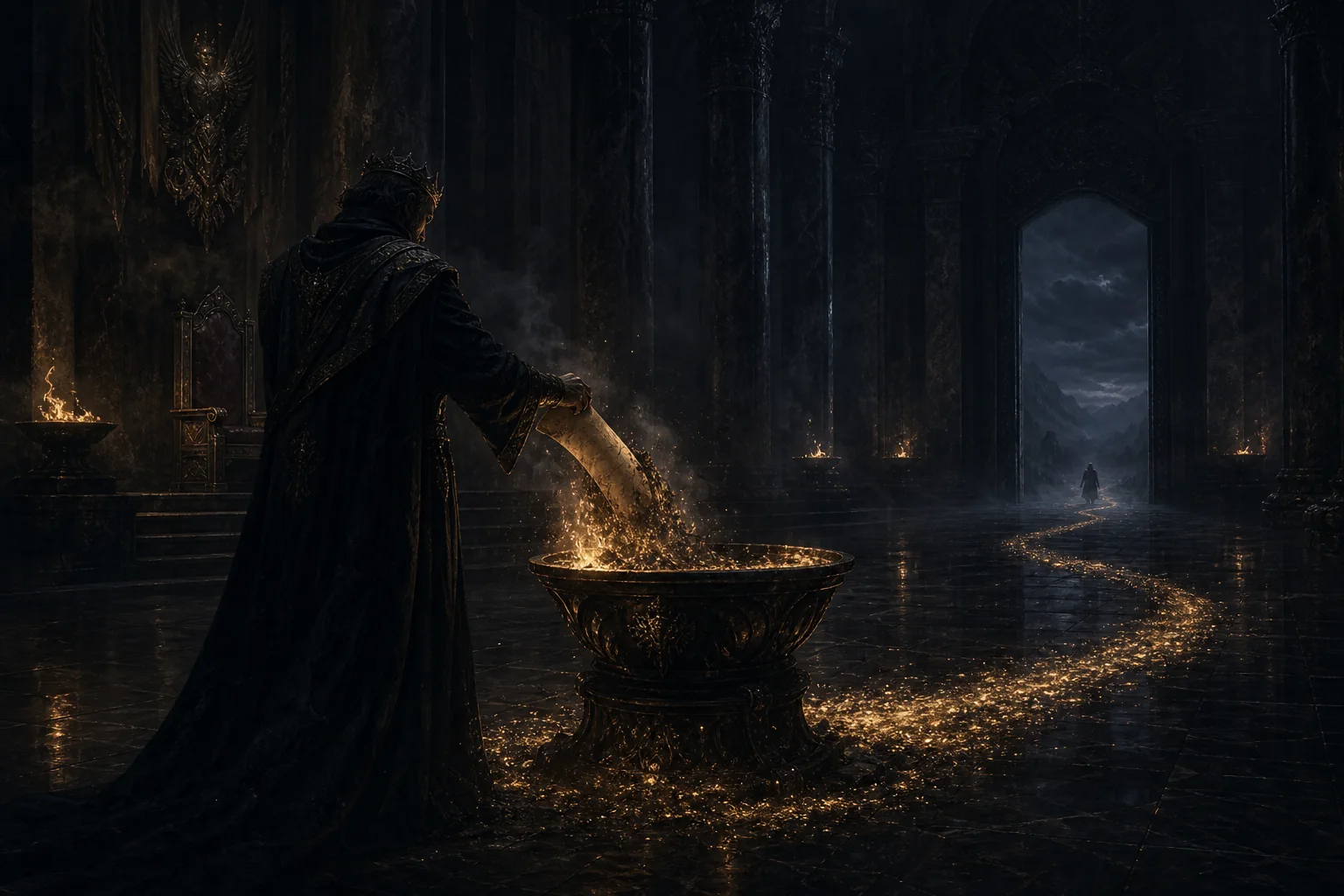
Cronus swallowed the future and raised his enemy
Before Oedipus, Hesiod told of a ruler who learned that he would be overthrown. Cronus knew one of his children would depose him. Whenever Rhea gave birth, he swallowed the infant before any heir could grow strong enough to challenge him.
His violence did more than hide his victims. It turned Rhea into an enemy. She secretly bore Zeus and gave Cronus a stone wrapped like a newborn. Zeus grew up far away, freed his swallowed siblings, and stood against their father with the very family Cronus had wounded.
Hesiod presents the overthrow as fated, so this is not simply a false forecast made true by the king's response. Even so, Cronus shaped the enemy who defeated him. Instead of raising an heir, he created prisoners and a rebellion. To preserve his crown, he turned his family into an alliance against it.
Fantasy often returns to this image. Power fears a successor and treats every relationship as a security threat. A child is judged guilty before making a choice. That judgment can turn a future that does not yet exist into the only identity the child is allowed to have.
Voldemort chose the “Chosen One” himself
The prophecy in Harry Potter could have referred to either of two children: Harry Potter or Neville Longbottom. Its words had not yet selected a victim. Voldemort did. From two possibilities, he chose the boy who resembled him more closely and went to Godric's Hollow to kill him.
The attack failed. By trying to erase the danger, Voldemort marked Harry, transferred some of his own abilities to him, and forged a connection that would later be used against him. Harry's status as the Chosen One was not bestowed by prophecy alone. It was also the result of his enemy's interpretation and decision.
This goes beyond the general discussion of types of heroes in fantasy. “Chosen” does not always descend from heaven. Sometimes a ruling power chooses a victim and creates its future enemy. Violence, loss, and an imposed name drive a child who might have lived another life onto a new path.
In Harry Potter: the child who found a home at Hogwarts, the difference between Harry and Tom Riddle emerged through their choices. Here lies a darker layer: some of the most important choices in Harry's life became possible only after someone else had made a decision about him, before he could even understand the world.
Fear sees only one enemy among many possibilities
Predictions are often ambiguous. Fear dislikes ambiguity. It wants a face, a name, and a door it can lock. Voldemort chooses one child from two. In A Song of Ice and Fire, Cersei Lannister sees Margaery as the younger queen destined to replace her. After hearing that Banquo's descendants will be kings, Macbeth begins to see his friend as the beginning of a dangerous dynasty.
The future has not arrived, yet present relationships have changed. A friend becomes a rival, a child a threat, and advice a conspiracy. Fear assigns one meaning to every sign, while each defensive move makes reconciliation less possible.
Cersei's final fate remains unresolved in the published books, so her prophecy is not a closed case. What matters is its hold over her life before the ending arrives. Suspicion of Margaery and hatred of Tyrion shape her politics. As we saw in the price of power in Game of Thrones, a ruler securing the throne may hollow out the ground beneath it.
A prediction need not be perfectly accurate to become dangerous. It only has to settle so deeply in a ruler's mind that every event is thereafter seen through it.
Not every attempt at prevention makes the future happen
Not every frightening warning fulfills itself. A forecast may prompt seat belts, an evacuation, or early treatment and prevent the bad outcome. News from the future can cancel itself.
Myth does not give every act of resistance the same ending. Hesiod relates that Zeus, like his father, feared a powerful child and swallowed Metis. The two acts differ in detail and meaning, but one leads to rebellion while the other apparently stops the predicted successor.
There is no fixed magical formula. We have to follow the causes. Did the warning create an enemy or conceal crucial information? Did escape lead toward danger? Did a defense place the means of catastrophe in someone else's hands?
In Kung Fu Panda 2, Shen attacks the pandas to destroy the black-and-white warrior he fears. That attack separates Po from his home and begins the journey that makes him the warrior who eventually faces Shen. The prediction's power does not come from perfect wording. It comes from the response Shen chooses with his own hands.
A prediction is no longer neutral once it enters a decision
Imagine a machine able to calculate the future with astonishing precision. While its result remains locked away, it may be only an observer. Tell someone what it found, however, and the state of the world has changed. Another mind now possesses new information and may submit, resist, or deliberately act against it.
Here Laplace's demon differs from a story's prophet. Causal determinism says that a given state of the world and the laws of nature fix what follows. It does not mean a limited being inside that world can calculate the path. Chaos, sensitivity to initial conditions, and limits of measurement and computation remain.
Announcing a forecast is itself a new event. If the machine says, “Tomorrow you will leave by the northern gate,” and the hero chooses the south to prove it wrong, the forecast has changed their behavior. The machine must predict that reaction too; announce its revised answer, and the game begins again.
This does not prove free will or disprove determinism. It shows that knowing the future, if such knowledge is possible, would not be a simple relation between spectator and scene. Knowledge can reach into the scene and move what it observes.
Fantasy gives the fear of tomorrow a voice
In ordinary life, causes are scattered and faceless. Temperament, upbringing, money, accident, the body, birthplace, and a sentence heard years ago all surround today's decision. No breakfast-table oracle declares each one's share.
Fantasy gathers that invisible pressure into a sentence. The oracle says the crown will fall. A mirror shows the murderer's face. A dream places someone's death before the hero. Fear suddenly has a destination, and we can watch what a person does with it.
In why we create monsters, fantasy gave fear a body. Prophecy gives a voice to the formless future. The difference is that a monster may remain outside the door, while news of the future begins living inside the mind as soon as it is heard.
That is why a good prophecy does more than spoil the ending. It puts the character under pressure. Instead of asking only “What will happen?”, the reader begins to ask, “Who will this person become now that they know?”
Real life is quieter, but it is not harmless
The real world rarely gives us oracles and scrolls. A small label can start a quieter version of the same process. A child called untalented receives fewer opportunities and less trust, grows cautious, then sees poorer performance offered as proof of the label. A manager expects failure, removes responsibility, then condemns the employee's lack of initiative.
Psychological research shows that expectancy effects can occur, though they are rarely absolute or impossible to overcome. Many predictions are accurate because they were based on good evidence in the first place. Self-fulfillment should not become a superstition in which every thought creates the world.
One experiment found that positive and negative economic forecasts could alter perceived risk and choices before any real change occurred. Its sample and laboratory setting were limited; it is no universal verdict on markets or life. The careful insight is that telling the future can become one of the forces through which it must pass.
We can recognize this force in intimate relationships too. Someone fears betrayal, searches their partner's phone, interrogates them, and reads every silence as a confession. There may have been no betrayal. Distrust can still create a relationship in which neither person wishes to remain.
Responsibility does not vanish into the chain, but it grows complicated
Had Laius not feared the future before Oedipus was born, the child would not have been taken from home. Had Oedipus not feared harming his parents, he would not have left Corinth. Had Voldemort never heard the prophecy, he might not have chosen Harry. There is a choice in each case, yet none is made in a vacuum.
Does the chain diminish responsibility? Laius orders a child left to die; Voldemort attacks a home. Fear and a belief in future danger explain these acts without making them innocent.
Oedipus does not know the stranger at the crossroads is his father. Harry never chose the prophecy. A child branded dangerous from birth did not create every condition of their life. Responsibility spreads across people, information, and power without disappearing.
Philosophical debates about moral responsibility preserve the same difficulty. If every decision is the product of prior causes, some philosophers question whether anyone truly deserves blame. Others define freedom as the capacity to act from one's own reasons and desires, even when those desires have causes. A story need not settle the dispute. It can show us what each answer costs.
Prophecy can become an instrument of power
Whoever defines the future may command the present. A king calls a child a threat and presents preventive violence as necessity. An oracle gives an ambiguous name, and the court tears itself apart. A commander promises victory to draw soldiers into battle; their presence makes victory likelier.
The prophecy's truth is not the only question. Who spoke it, who may interpret it, and who pays for the response? A child named “chosen” may receive honor, but their future has been claimed before they can speak.
Why do we still dream of magic? explored the human longing for a world that can hear us. Prophecy is the darker face of that wish: if the world answers, those in power may turn its answer into a sentence.
A believable fantasy world follows that sentence down from the oracle's hall into ordinary lives. Just as we build imaginary worlds to test possibilities, prophecy must reveal who loses a home, who is accused, and which mother carries her child through the gate at night.
The road we built to escape
The final image is often magnificent: hero and king face one another as ancient words come true. Beneath it lies a trail of smaller acts—a letter sent, a child exiled, a friend turned enemy, a door barred so firmly that the wall beside it collapsed.
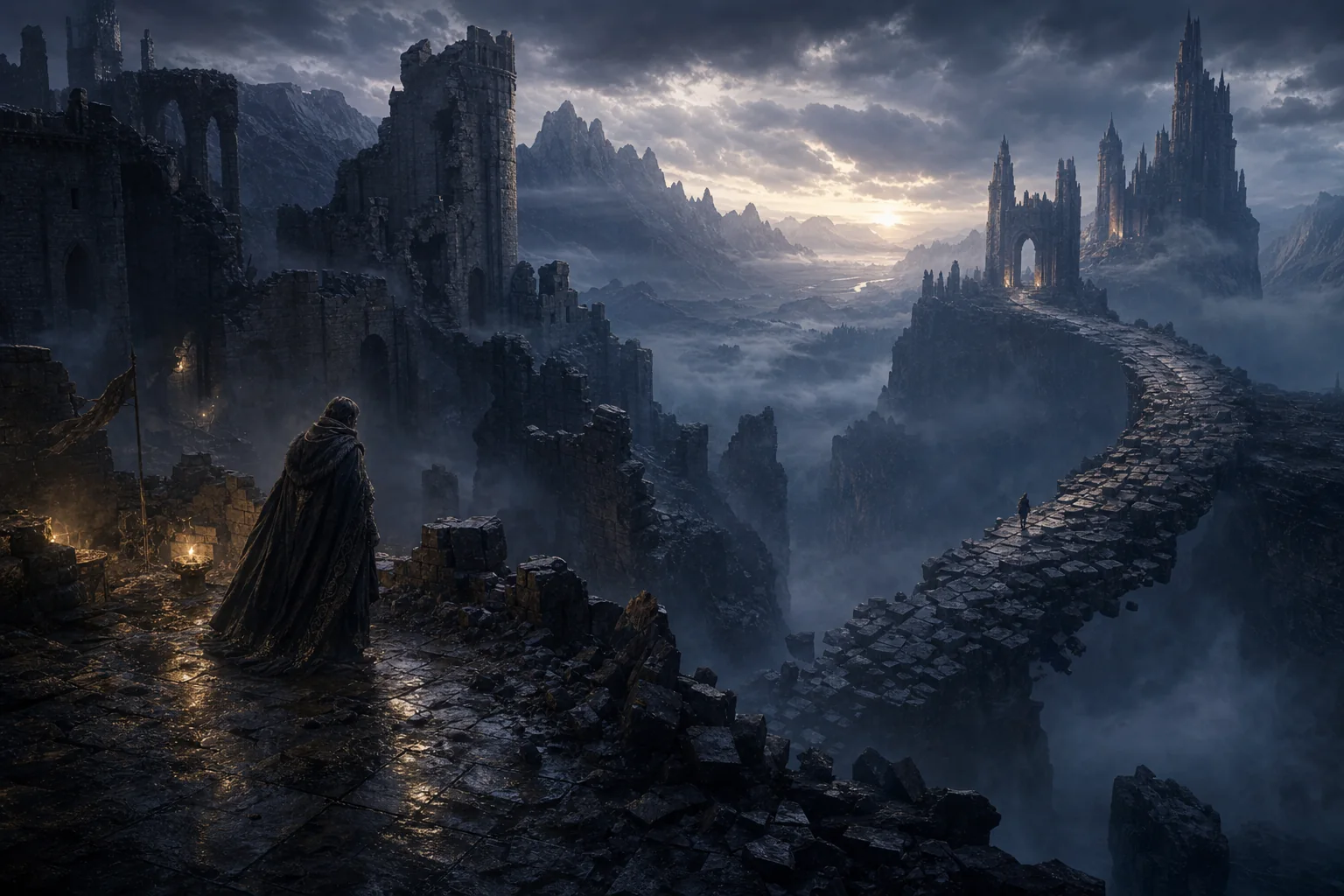
Perhaps the future was fixed from the beginning, and every attempt to escape it belonged to the design. Perhaps many roads once existed, and fear closed them one by one until only the road to catastrophe remained. From inside the story, we cannot always judge between them.
What remains is the responsibility to examine the path. Before destroying an enemy because they may become dangerous one day, we should ask what our treatment will create in them today. Before seeing every face as a traitor in order to preserve the crown, we should ask whether we are building the rebellion we fear.
Fantasy offers no final answer. It brings the future into a dark hall and gives it a voice, then places a human being before it who must decide. Tragedy begins when that person runs to escape and discovers too late that the road formed beneath their own feet.
If the prophecy had never been spoken, would the same ending still have come? Perhaps. Or perhaps the future was never waiting for us at all, and fear laid the road to it stone by stone.
Sources and further reading
- Sophocles, Oedipus the King, in the MIT Classics Archive, for the abandonment of Oedipus, his departure from Corinth, and the encounter at the crossroads.
- Hesiod, Theogony, at Harvard's Center for Hellenic Studies, for Cronus swallowing his children and the concealment of Zeus.
- Macbeth at the Folger Shakespeare Library, for the witches' predictions and Macbeth's response to Banquo's descendants.
- HarryPotter.com on prophecies and predictions in the wizarding world, for Voldemort's role in interpreting the prophecy and choosing Harry.
- HarryPotter.com on Tom Riddle's choices, for the attack on Harry and its unintended consequences.
- DreamWorks' official page for Kung Fu Panda 2, for the film and its Po, Shen, and Soothsayer storyline.
- Robert Merton, “The Self-Fulfilling Prophecy,” at JSTOR, for the classic formulation of the concept.
- Lee Jussim's theoretical and integrative review of self-fulfilling prophecies, for the stages and limits of expectancy effects.
- A PLOS ONE study on economic forecasts and decision-making, for an experimental example of behavior changing after a forecast.
- The Stanford Encyclopedia of Philosophy on causal determinism, for the distinction between determinism and predictability.
- The Stanford Encyclopedia of Philosophy on moral responsibility, for competing accounts of freedom, control, and deserving blame.
- The University of New Orleans on interpreting prophecy in A Song of Ice and Fire, for ambiguity and multiple possible fulfillments.
- Lund University on the narrative role of prophecy in A Song of Ice and Fire, for prophecy's effect on narrative structure and character behavior.