Essays
The Night Before War
No sword has left its sheath, yet in the granary, infirmary, and at the gate, the war has already begun.
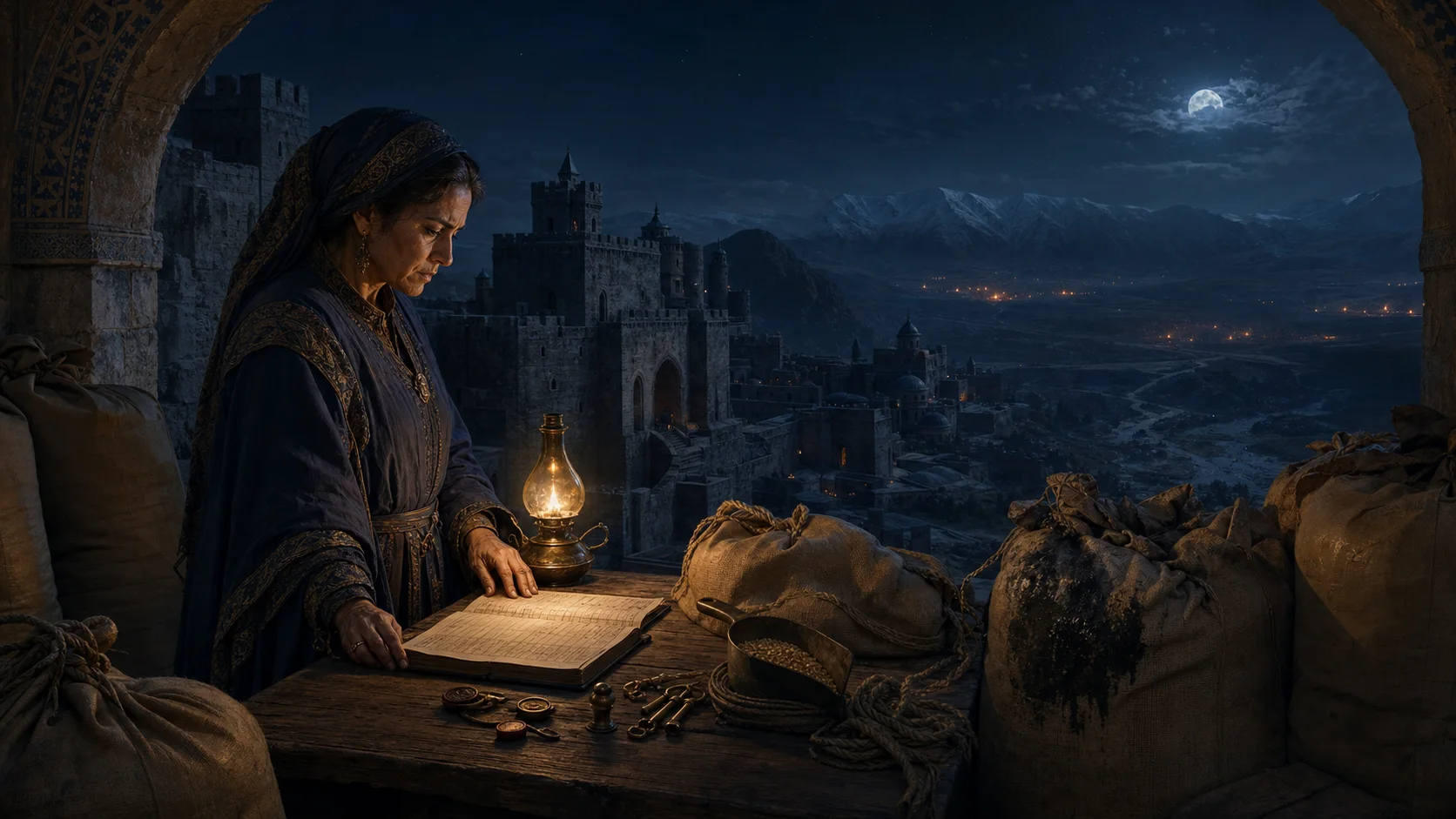
The sack yielded too easily beneath Mehra's fingers. She slipped the tip of her knife into the seam, and the smell of damp barley spread through the storehouse: sour and heavy, like earth after a rain in which nothing would grow. She lifted a handful. Some of the grains had gone black.
Above her, on the northern wall, her son was standing his first night watch. No horn had sounded. No arrow had risen from the valley. In the commander's official ledger, the war would begin at dawn. Yet beside that ruined sack, Mehra already knew that war begins before the first sword is drawn. It begins when tomorrow's bread is weighed tonight, and someone must decide who will eat less.
One Sack Less
Mehra crossed out the previous figure. The city had food for twenty-seven days, provided no one else came through the gates, the rats did not reach the second storehouse, the millstone held, and the soldiers did not ask for more than their allotted share after hours of standing in the wind. Four conditions were enough to destroy a number.
Her apprentice asked whether he should count the spoiled sack. Mehra said no. In war, hope could be kept, but it had no place in the inventory column.
The history of war remembers commanders. Armies and besieged cities, however, depend on grain, fodder, water, roads, and the people who carry them. Research into the provisioning of medieval armies shows that this unglamorous work began long before anyone reached a battlefield.
Fantasy remembers the sword and forgets the flour on the baker's hands. But a city without bread is no longer a fortress, even if its walls were raised by magic. It is a grave whose roof has not yet fallen in.
Certainty Is the First Thing to Die
In the command room, four stones held the map flat against the table. The messengers said the enemy would reach the river in three days. The watchman in the western tower swore he had seen the haze of their camp that afternoon. A merchant who had arrived before the road closed spoke of two separate columns. None of them sounded like a liar. That was the worst of it.
The commander asked Mehra how much time they had.
“Until what happens?” she replied.
Perhaps three days until the first assault. Perhaps a few hours until the southern road was cut. As for fear, it had already arrived.
Preparedness is not the art of knowing the future. It is the willingness to admit that the map is incomplete, then arrange things so that one false report cannot break everything. In When Fleeing the Future Creates It, fear sometimes builds the very road it dreads. Panic sees one future and mistakes it for certainty. Preparation leaves room to be wrong.
There Are No Heroes in the Ration Ledger
By midnight, Mehra had rewritten the bread allowance. The watch needed more food. Children ate less, but suffered sooner. Prisoners and old men who could no longer carry stones still had to remain alive. On paper, the figure divided cleanly. Returned to human faces, it would not divide at all.
The young commander suggested halving the prisoners' ration. Mehra did not ask whether the enemy would show mercy to their people. She said that if the kitchen began cooking a separate pot for certain bodies, everyone would know by week's end that justice in the city depended on the colour of a coat. Every bowl of soup would become a new rumour.
Morale is made when the commander eats the soldiers' bread, the queue for water has an order, and a wounded person knows he will not be abandoned in a corner of the courtyard. Trust cannot be weighed, but a siege consumes it at a terrifying rate.
Water Matters More Than the Wall
The great key to the cistern hung from Mehra's belt. She descended the wet steps with two guards. The surface of the water lay still in the darkness, so still that the approaching war made no shape upon it.
One guard said the northern wall was two courses thick and no ram could breach it.
Mehra asked whether those two courses of stone would boil water for them if the supply became foul.
Old cities survived by more than towers. Wells, cisterns, and distribution routes belonged to the defences too. Humanitarian experience in war shows that safe water and sanitation are conditions of survival before they are comforts.
From that night onward, Mehra ordered that no one enter the cistern alone. She did not believe betrayal was inevitable. A tainted bucket, a dropped torch, or a guard falling asleep could accomplish what a thousand enemy soldiers could not.
Horses Eat Glory
In the stable, the horses' breath gathered beneath the rafters. Knowing nothing of banners, they chewed their fodder and struck the floor from time to time with a hoof. The stableboy said the commander had ordered every sound horse reserved for the cavalry.
Mehra asked who would pull the water cart.
The boy had no answer.
Songs place the horse beneath a rider. A besieged city finds it beside the mill, the water wagon, and the stretcher. Research on horses in fifteenth-century siege warfare shows them moving supplies while their immense need for feed made them a vulnerable part of the system they sustained.
Mehra struck six animals from the cavalry list. Beside their names, she wrote: water, mill, infirmary. The commander would probably be furious by morning. Some sound decisions look like cowardice in the moment because their glory cannot be seen.
A School That Must Learn Pain
Until evening, the school below the temple had been full of benches. Now carpenters had stacked them against the wall and were laying narrow pallets across the floor. The old healer cut white cloth into even strips. No blood had touched them yet. Their cleanliness made the room more frightening.
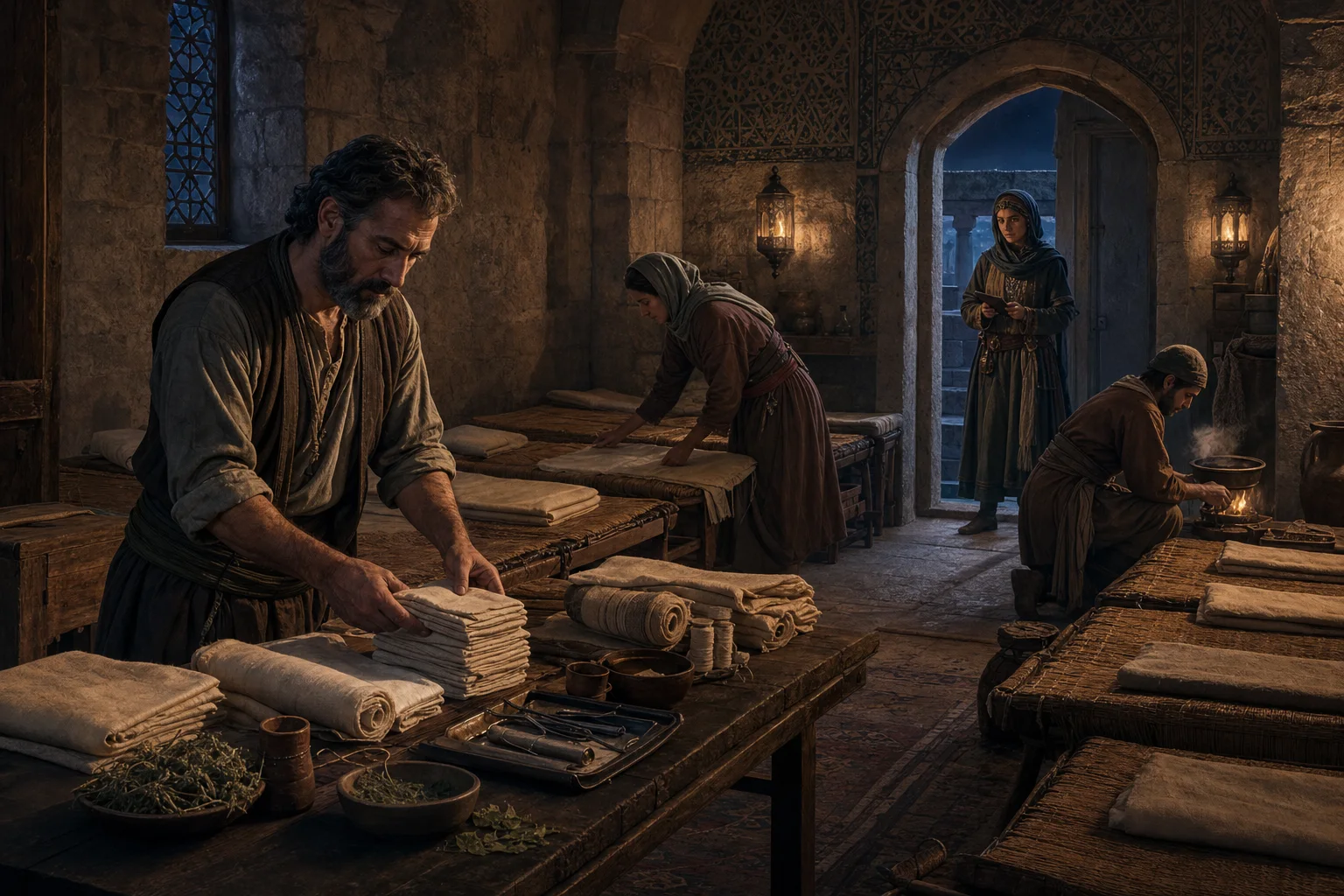
The city's mage could stop the bleeding of a few people, but after each healing his hands shook and his sight blurred for hours. Magic was not infinite. The infirmary still needed boiled water, thread, beds, stretchers, and people who would not turn away from pain.
When fantasy takes the laws of its world seriously, it does not separate a miracle from its cost. If a spell closes every wound without consequence, preparation loses its meaning. Limited power returns choice to the world: saving one person may diminish the chance of saving another.
The healer asked Mehra to clear two more rooms. In her ledger, she wrote, children's classroom, room for the wounded. Then she looked at the words for a moment. The war had yet to begin, and already the city was changing what its objects and its people were for.
Bad News Is a Kind of Provision
The eastern messenger had not returned by midnight. The commander said his horse had probably gone lame. The watchman said he might have lost his way in the fog. No one offered the third possibility.
Later, a charcoal burner came through the postern gate, muddy and bleeding from a split lip. He had seen enemy troops on a narrow track behind the abandoned mine. The path was absent from the command map because its maker had never gone into those hills to cut wood.
News must also be weighed and distributed at the proper time. If it arrives late, it resembles flour delivered after the hunger. If it is scattered before anyone tests it, defenders leave the ground where they are needed. A scout, a shepherd, or a charcoal burner may see what no one can see from a tower.
Mehra took the man into the map room. He knew nothing of war. He knew the names of three bends in the path, a hidden spring, and a shelf of rock that gave way after rain. That small knowledge moved two hundred guards before dawn.
Rumour Burns a City Before Fire Does
By the time the report reached the commander, the market had made a story of its own. One person said the messenger had returned carrying a white banner. Another swore the enemy had brought a sorcerer who could soften stone. A woman in the bread queue had heard that the southern gate would be left open that very night so the wealthy could escape.
The commander wanted the crier to announce that everything was under control. Mehra objected. Before sunrise, the people would see the northern guards being moved. A comforting lie survives only until the first visible contradiction. Afterwards, it poisons the truth as well.
The crier announced the changed route, the redeployed guard, and the unchanged water ration. He promised neither victory nor help. The truth did not calm the city, but its people no longer had to fear the enemy and their commanders' tongues at once.
In the world of A Song of Ice and Fire, power forms in the distance between what rulers know, what they say, and what ordinary people endure. War is a collision of armies, but it is also a trial of the order that gives commands.
A Wall Does Not Defend People by Itself
Mehra passed the inner wall. The stones were large enough for a child to hide behind each one. An inscription preserved the name of the king who had built it. The workers who raised the stones had left no names.
A wall buys time. It cannot decide how that time will be spent.
Sixteen Ways to Defend a Walled City looks at defence through shortage, engineering, and organisation. In Legend, Dros Delnoch derives its meaning from people who know the walls may fall and choose to remain.
Remaining is not always a virtue. A commander may keep civilians behind stone simply to delay the sight of his own defeat. The height of a wall matters less than the question of whose time it purchases, and what is done with that time.
Someone Was Still Standing Beyond the Gate
Shortly before dawn, three blows landed on the gate. They were not the blows of a ram, but tired fists against wood.
Forty-three villagers stood outside. Two carts, several goats, five children, a pregnant woman, and an old man who refused to abandon his toolbox. The gate guard said that admitting them would exhaust the city's stores two days earlier. If they held the gate open, an enemy scout might see how people entered. The commander asked for a number.
Mehra gave him the number. Then she asked for their names.
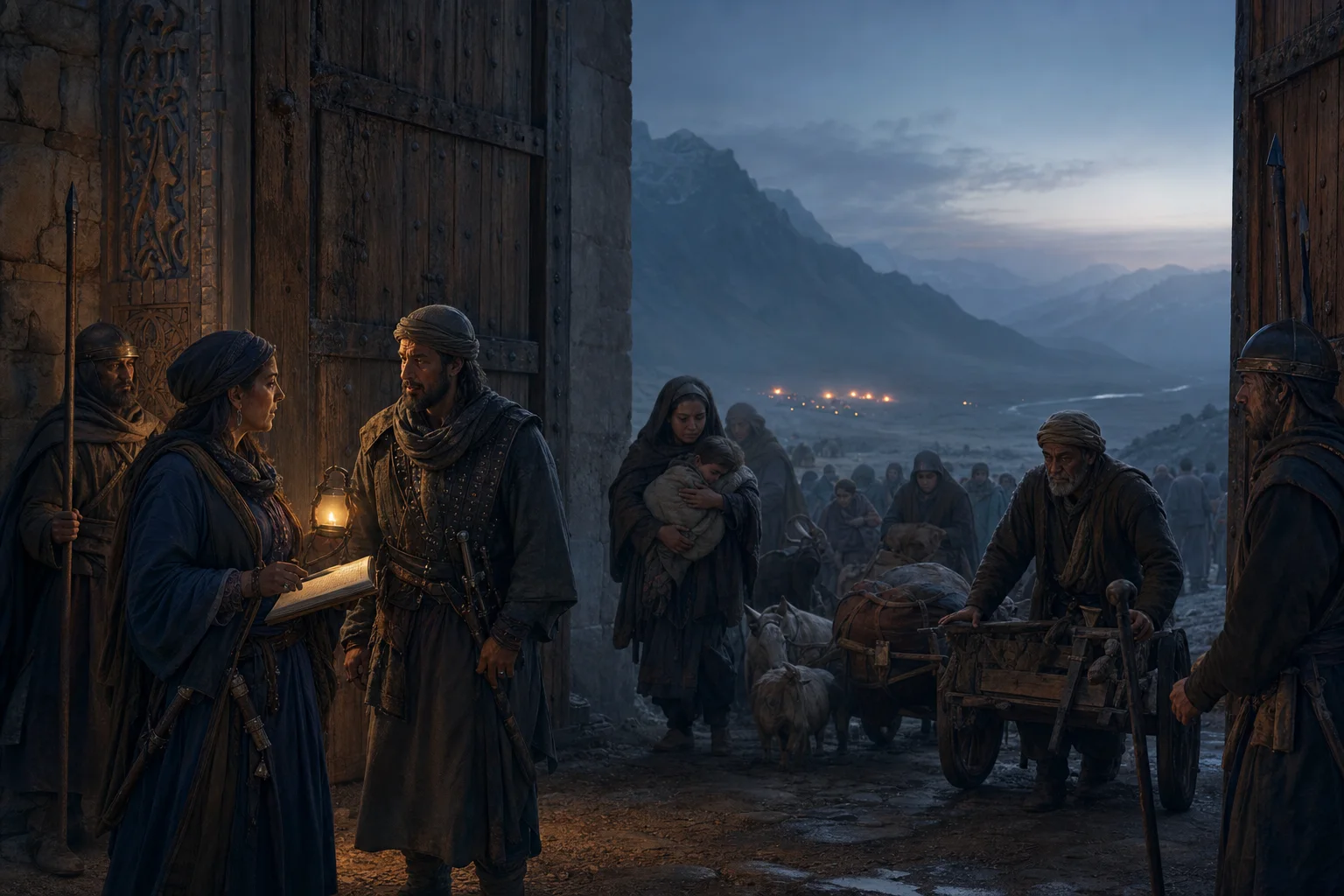
War turns people into units with terrible speed: one mouth, one pair of hands, one soldier, one casualty. Sometimes the conversion is unavoidable. No keeper of stores can keep a city alive without numbers. The danger begins when the number is mistaken for the whole truth.
The gate opened for the people. The second cart and most of the animals remained outside. The first cart could be broken down for infirmary beds, and the milk goats were brought in. The old man carried his tools through and left everything else beside the road. There was no clean solution, only a choice whose price was not concealed.
Additional Protocol II prohibits starving civilians as a method of warfare and protects food, livestock, drinking-water installations, and irrigation works. Fantasy need not reproduce the laws of our world, but it should not make a siege glorious by erasing the suffering of those who did not begin it.
Courage Needs Something to Eat
Mehra's son sat beside the tower stairs with his food untouched in his hand. He said he was not hungry. His face was the same face that had feared thunder years ago, except that a helmet now rested on his head and he was trying to keep his mouth from trembling.
Mehra did not tell him to be unafraid. Fear was already there, like the cold wind entering through a seam in the stone.
“Eat,” she said. “If your hand shakes, you'll drop the lantern.”
The sentence was too small to survive in an epic. Her son ate.
Mental readiness does not remove fear. People hold their ground better when they understand their task, trust the person beside them, and know what to do if the first position falls. Training, rest, and honest command turn courage into something a human being can actually perform.
In Game of Thrones and the Price of Power, the plan at the Blackwater changes the battle, but the fragile fire that breaks the enemy also tests the defenders' minds. The human figure on a map seldom behaves as neatly as it was drawn.
A Way Back Is Not Betrayal
The old commander of the western tower refused to discuss evacuation. The fortress had built its name upon holding, he said, and no one should speak the word retreat before the battle.
Mehra laid a map of the old tunnel on the table. It was too narrow for an army, but children and wounded people could use it to reach the second valley. If the enemy discovered the outer mouth, the tunnel would become a trap. It needed a guard, a signal, a small supply of food, and a clear moment at which it would be used.
Preparing for the worst does not summon it. An oath and the loyalty it demands must know what it is loyal to. A guard sworn to the stones may bury everyone beneath them. Loyalty to the people can require accepting retreat.
At Minas Tirith, the call for aid and the arrival of Rohan depend on roads, messages, and knowledge of the land. The world of The Lord of the Rings feels vast because victory does not belong to one hero. Roads, promises, and distant peoples all bear some of fate's weight.
What Must Not Be Spent in a Siege
Seven jars of seed stood against the rear wall of the third storehouse. The war council wanted them entered among the grain. Seven jars would feed the city for only a few hours. Mehra resisted.
The commander asked what use seed would be if the city did not live until spring.
Mehra had no ready answer. A day might come when the last grain had to be boiled. A right decision could change with circumstance. She wanted that moment to arrive later. A city that eats all its seed has borrowed something from the future that it may never be able to repay.
War eventually asks something heavier than “How do we survive?” It asks, “For what kind of life?” If a defence burns the weakest people and every thing that can carry a future, its walls may remain while all that made them worth defending has vanished.
Preparation Is Not Another Name for Control
Near dawn, word came that lights had been seen in the south. Some said the allied army was approaching. Others said the villages were burning. The commander could wager on the first hope and send his forces out to meet their friends. He could wager on the second fear and draw everyone behind the gate.
He did neither. He sent two scouts, made the gate ready to close, and arranged the defence around what he knew rather than what he wished.
Preparation does not tame the world. It merely keeps the first calamity from becoming the last possible choice.
How Fantasy Makes War Real
Fantasy can darken the sky with armies and split towers with magic. Yet war gains weight in kitchens, cisterns, infirmaries, and at gates. A last stand matters because another path existed, and people understood the price of staying.
The First Horn
As the sky faded from black to grey, Mehra returned to the storehouse. The damp sack still lay open. Her apprentice had picked out the sound grains and spread them across a cloth. Less than half of a full sack remained. It would not save the city. It was simply something that did not have to be thrown away yet.
The first horn sounded from the northern wall.
Mehra looked up without meaning to. Her son was there. For one brief moment, every calculation left her mind: days of food, buckets of water, empty beds, the mouth of the tunnel, the lights in the south. Then she placed her hand flat upon the table so no one would see it tremble.
She opened the ledger. Until that night, she had thought its purpose was to count the things the city possessed. With the horn in the air, she understood that now it must also record the things the city would lose, one by one.
On the new page, before the numbers, she wrote her son's name.
Sources and Further Reading
- Cambridge University Press: Feeding Mars: Military Purveyance in the Long Fourteenth Century
- Cambridge University Press: Besieging Bedford: Military Logistics in 1224
- Cambridge University Press: The Islamic countryside and food supplies to Crusader cities in the twelfth century
- Cambridge University Press: Horses and horsemen in fifteenth-century siege warfare
- University College London: Trauma and Surgery in the Crusades
- University of Malta: Feeding the Besieged
- Project Gutenberg: The Art of War, the chapter on spies and intelligence
- ICRC: Protection of the civilian population during sieges
- ICRC: Additional Protocol II, Article 14
- ICRC: Water and war
- Tolkien Estate: The Riders of Rohan and the siege of Gondor
- Tolkien Estate: The reach and pauses of the world of The Lord of the Rings
- Hachette: K. J. Parker's Sixteen Ways to Defend a Walled City
- Orbit: David Gemmell's Legend
- U.S. Army Quartermaster Museum: The history of feeding an army